
Reading time: 18 min
Table of Contents
- Key Takeaways
- Quick Answer: How Much Collagen Should You Take Per Day?
- The Short Answer
- Why the Range Is So Wide
- What Counts as a Dose?
- Dosage by Goal: Skin, Joints, Bones, and Muscle
- Skin and Healthy Aging
- Joint Pain and Osteoarthritis
- Bone Density
- Muscle Mass and Training
- Hydrolyzed Collagen vs. Undenatured Collagen vs. Gelatin Dosages
- Hydrolyzed Collagen Peptides
- Undenatured Collagen
- Gelatin
- How to Read a Collagen Label and Convert Scoops, Tablespoons, and Capsules
- Find the Collagen Content, Not Just the Scoop Size
- Powder, Capsules, and Gummies
- Check for Added Vitamin C
- Timing, Vitamin C, and Consistency: How to Take Collagen for Better Results
- Morning, Before Bed, or Post-Workout?
- Vitamin C Pairing
- How Long Should You Stay Consistent?
- Can You Take Too Much Collagen? Safety, Side Effects, and Upper Limits
- Digestive Discomfort
- Kidney and Protein Intake Cautions
- When to Talk to a Clinician
- Who May Need a Different Collagen Dose? Body Weight, Age, Pregnancy, and Medical Conditions
- Age, Menopause, and Activity Level
- Pregnancy, Breastfeeding, and Medical Conditions
- Collagen Is Not a Complete Protein
- A Practical 7-Day Collagen Dosing Plan and Common Mistakes
- 7-Day Starter Plan
- Common Dosage Mistakes to Avoid
- Frequently Asked Questions
- The Bottom Line on Daily Collagen Dosage
Key Takeaways
- Most research supports 2.5 to 15 grams of hydrolyzed collagen peptides daily, but no official guideline exists.
- Dose follows the goal: 2.5-10 g for skin, 5-10 g for joints (or 40 mg undenatured collagen), 5 g for bone, 15-20 g for muscle with training.
- Form changes everything: hydrolyzed peptides are dosed in grams, undenatured collagen in milligrams. Never compare a 40 mg capsule to a 10 g scoop.
- Consistency beats timing, and high doses are not automatically better. Pair with vitamin C, read the label, and stop if digestion objects.
You have seen the 2.5-15 gram collagen range everywhere — on labels, in wellness newsletters, in the caption of a wellness influencer holding a frosted glass. But is that the right dose for your skin, your joints, or your training goal? The honest answer is that collagen dosage is not one number. It is a decision matrix, and the people who get results are the ones who read past the headline range.
This guide exists because the internet has flattened an elegant piece of nutrition science into a single scoop. In the following pages we will untangle how much collagen you should take, how hydrolyzed collagen peptides differ from undenatured collagen, how to convert a scoop into grams, and how to build a daily dose that matches your actual goal — skin, joints, bones, or muscle. The discerning reader knows that specificity is the difference between a supplement habit and a therapeutic one.
Quick Answer: How Much Collagen Should You Take Per Day?
Most research supports 2.5 to 15 grams of hydrolyzed collagen peptides per day for general use. For specific goals, studies suggest 2.5-10 grams for skin, 5-10 grams for joints (or 40 mg undenatured collagen), and 15-20 grams for muscle support with training. There is no official daily guideline.
The Short Answer
If you only have ten seconds, here it is: collagen dosage per day ranges from 2.5 to 15 g of hydrolyzed collagen peptides for most adults, with goal-specific windows inside that range. Skin protocols cluster at the lower end (2.5-10 g), joint protocols sit around 5-10 g of peptides or 40 mg of undenatured collagen, bone studies tend to land at 5 g, and muscle studies stretch to 15-20 g alongside resistance training. Anything labeled an “official” daily recommendation is a marketing invention — no health authority has set one.
Why the Range Is So Wide
The range is wide because the evidence is not one body of work. Skin elasticity trials use 2.5-10 g. Osteoarthritis trials use 8-10 g of peptides or a 40 mg undenatured dose. Bone mineral density studies after menopause gravitate around 5 g. Each outcome recruits different tissues, different biomarkers, and different timelines — so the dose that shows up in the literature follows the question the researchers were asking. A skin dose will not treat a knee. A knee dose will not build muscle.
What Counts as a Dose?
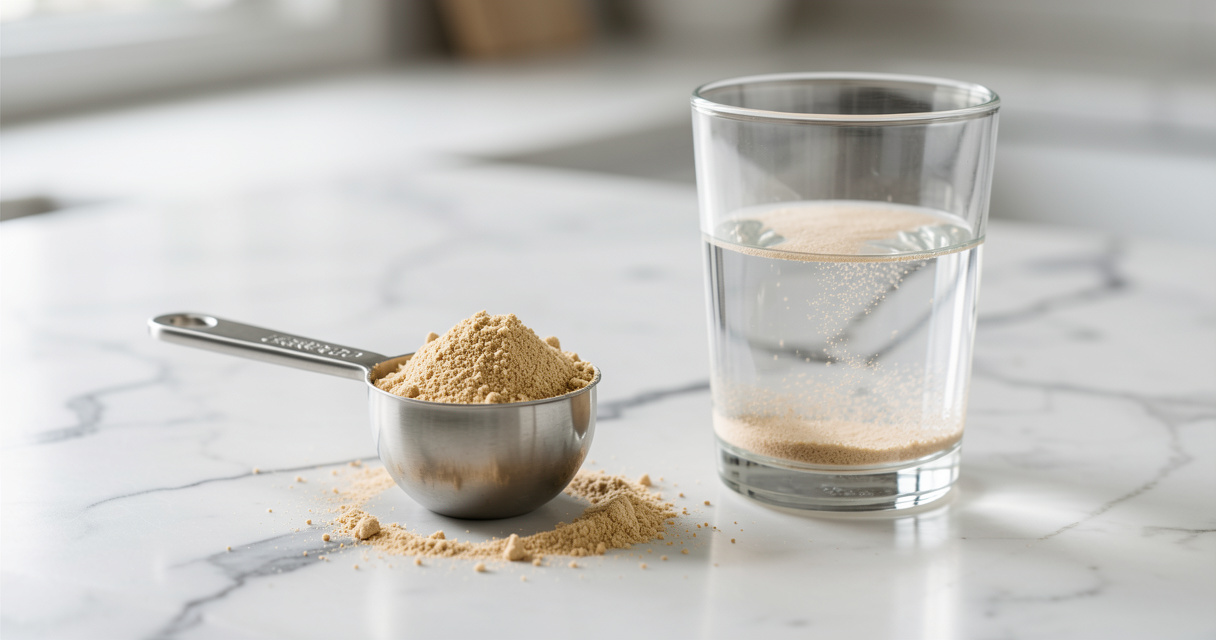
A dose is the grams (or milligrams) of actual collagen in the product — not the size of the scoop. A 10 g scoop of a flavored blend may contain only 5 g of collagen peptides; a 12 g scoop with vitamin C may contain 10 g of peptides and 1 g of ascorbic acid. This single distinction resolves more label confusion than any other. “The number that matters is on the back of the pack, in the supplement facts,” a sports dietitian once told me. She was right.
| Goal | Form | Research dose | Notes |
|---|---|---|---|
| Skin and healthy aging | Hydrolyzed peptides | 372 mg – 10 g/day | Lower end for maintenance, upper end for elasticity trials |
| Joint pain and function | Hydrolyzed peptides or undenatured | 2 mg – 10 g; or 40 mg undenatured | Undenatured dose is far smaller but a different molecule |
| Bone density | Hydrolyzed peptides | 5 g/day | Often studied post-menopause, combined with calcium and vitamin D |
| Muscle mass and body composition | Hydrolyzed peptides | 15 g/day | Paired with resistance training in the trials |
Callout: No official daily guideline exists. Treat research ranges and the product label as your compass — not a government RDA that does not exist.
Now that the range is on the table, we can look at how each goal reshapes the dose — and why the outcome you want should set the number you choose.
Dosage by Goal: Skin, Joints, Bones, and Muscle
The collagen dosage by goal question is the one readers actually search for — and the one most articles gloss over with a single wide range. According to Healthline, medically reviewed by Philip Ngo, PharmD, research ranges include: joint pain and function 2 milligrams to 10 grams; bone density 5 grams; healthy skin aging 372 milligrams to 10 grams; and muscle mass and body composition 15 grams (2026). Read that carefully: the ranges overlap, but the goals do not.
Skin and Healthy Aging
Collagen for skin dosage sits at the low end of the gram spectrum. Trials on skin elasticity, hydration, and wrinkle depth have used anywhere from 372 mg to 10 g of hydrolyzed peptides daily, with the sweet spot for most randomized trials landing between 2.5 g and 5 g. Higher doses are not necessarily better here — the trials that compared 2.5 g to 10 g did not show a clean linear benefit, which suggests the ceiling is reached relatively early. If your goal is skin, start at 2.5-5 g and hold it for at least eight to twelve weeks before judging.
Joint Pain and Osteoarthritis
For collagen for joint support dosage, the literature splits into two camps. The hydrolyzed peptide camp uses 8-10 g daily and measures outcomes on the WOMAC scale for osteoarthritis of the knee. The undenatured collagen camp uses 40 mg daily, a dose that would look absurdly small if you only knew the peptide literature. Both have evidence. The 40 mg figure is not a typo — it reflects a different molecule working through a different mechanism, likely via Peyer’s patches in the gut rather than through direct peptide absorption. Pick one form, follow its dose, and do not grade it against the other.
Bone Density
Bone mineral density evidence sits around a remarkably consistent 5 g of hydrolyzed peptides daily, most often studied in post-menopausal women and usually paired with calcium and vitamin D. Interesting secondary data suggests collagen may support the bone-building side of the equation rather than just the density reading itself, but the trials are modest. If bone health is your goal, 5 g is the anchor dose — and collagen should sit alongside, not instead of, a well-designed resistance program and adequate total protein.
Muscle Mass and Training
Muscle trials push the dose up to 15 g daily of hydrolyzed peptides, and often to 15-20 g in the protocol, alongside resistance training. The mechanism is different again — collagen is not a great muscle-building substrate on its own (more on the amino acid profile below), but the glycine and proline content appears to support connective tissue recovery, which lets you train more consistently. Think of this dose as recovery support for the joints that let you lift, not as a replacement for whey or a plant protein blend.
| Goal | Daily dose | Best-supported form | Evidence note |
|---|---|---|---|
| Skin elasticity and hydration | 2.5-5 g | Hydrolyzed peptides | Trials up to 10 g, but returns plateau |
| Joint pain / osteoarthritis | 8-10 g OR 40 mg | Hydrolyzed peptides or undenatured | Different molecule, different dose, same goal |
| Bone mineral density | 5 g | Hydrolyzed peptides | Post-menopausal women, plus calcium and vitamin D |
| Muscle support with training | 15-20 g | Hydrolyzed peptides | Paired with resistance training |
Callout: Do not assume a skin dose will treat joint pain. The tissue target is different, the biomarker is different, and the evidence base is different.
Understanding the goal is half the equation; the other half is the form the collagen arrives in — which is where most label confusion begins.
Hydrolyzed Collagen vs. Undenatured Collagen vs. Gelatin Dosages
The hydrolyzed collagen peptides dosage and the undenatured collagen dosage are not interchangeable — and treating them as if they were is the single most common error in this category. According to Healthline, a 2023 review found that 40 milligrams of undenatured collagen is the recommended daily dose to help improve joint health and manage osteoarthritis of the knee (2023). Read that again: milligrams, not grams. The molecule is different, the delivery route is different, and the dose is a thousand-fold smaller.
Hydrolyzed Collagen Peptides
Hydrolyzed collagen is gelatin that has been enzymatically broken down into short peptide chains — usually two to twenty amino acids long. This is why it dissolves in cold water and why it absorbs quickly. The research dose for hydrolyzed peptides sits at 2.5-15 g/day, and it is the form used in nearly every skin, joint, bone, and muscle trial you will read about. When a label says “collagen peptides,” this is the form. When it says “collagen hydrolysate,” same thing.
Undenatured Collagen
Undenatured collagen — sometimes labeled UC-II or native collagen — is intact collagen, not broken down. It is dosed at 40 mg per day for joint health, based on trials that measured osteoarthritis symptoms rather than skin. The mechanism is thought to work through immune tolerance rather than through amino acid delivery, which is why such a small dose can plausibly matter. If you buy an undenatured product expecting the skin effects of a 10 g peptide powder, you will be disappointed — and vice versa.
Gelatin
Gelatin is cooked collagen — the same molecule, but not hydrolyzed, so it gels when cooled and absorbs more slowly. According to Healthline, a 2024 research review found that gelatin may have antioxidant and anti-inflammatory properties, but limited research supports specific dosage recommendations (2024). In practice, gelatin shows up in homemade gummies and bone broth, and the dose typically mirrors hydrolyzed peptides at 5-15 g — but the evidence base is thinner. If you enjoy the ritual, use it. If you want the most-studied form, choose hydrolyzed peptides.
| Form | Typical research dose | Best use | Label tip |
|---|---|---|---|
| Hydrolyzed peptides | 2.5-15 g/day | Skin, joint, bone, muscle | Check grams of collagen per serving, not scoop size |
| Undenatured collagen | 40 mg/day | Joint pain, osteoarthritis | Look for UC-II or “native collagen” on the label |
| Gelatin | 5-15 g/day (limited evidence) | General collagen intake, gummies | Gels when cold; not a clear substitute for peptides |
Definition: Hydrolyzed collagen is collagen broken into short peptide chains so it dissolves in liquid and absorbs quickly. “Peptides” and “hydrolysate” describe the same thing on a label.
Picture a reader scrolling a supplement aisle. In her left hand, a joint formula reading 40 mg undenatured collagen. In her right, a skin powder reading 10 g hydrolyzed collagen peptides. Same word on the front of the box, a 250-fold difference in the back panel. She puts both back on the shelf and buys neither — because the label did not tell her which dose matched her goal. That is the whole problem in one scene, and the fix is learning to read a label in ninety seconds.
How to Read a Collagen Label and Convert Scoops, Tablespoons, and Capsules
The collagen serving size on a label is the single most useful piece of information and the one most readers skip. Serving size tells you the weight of one scoop — it does not tell you the grams of collagen inside it. Those are two different numbers, frequently on two different lines of the supplement facts panel, and confusing them is the fastest way to underdose or overpay.
Find the Collagen Content, Not Just the Scoop Size
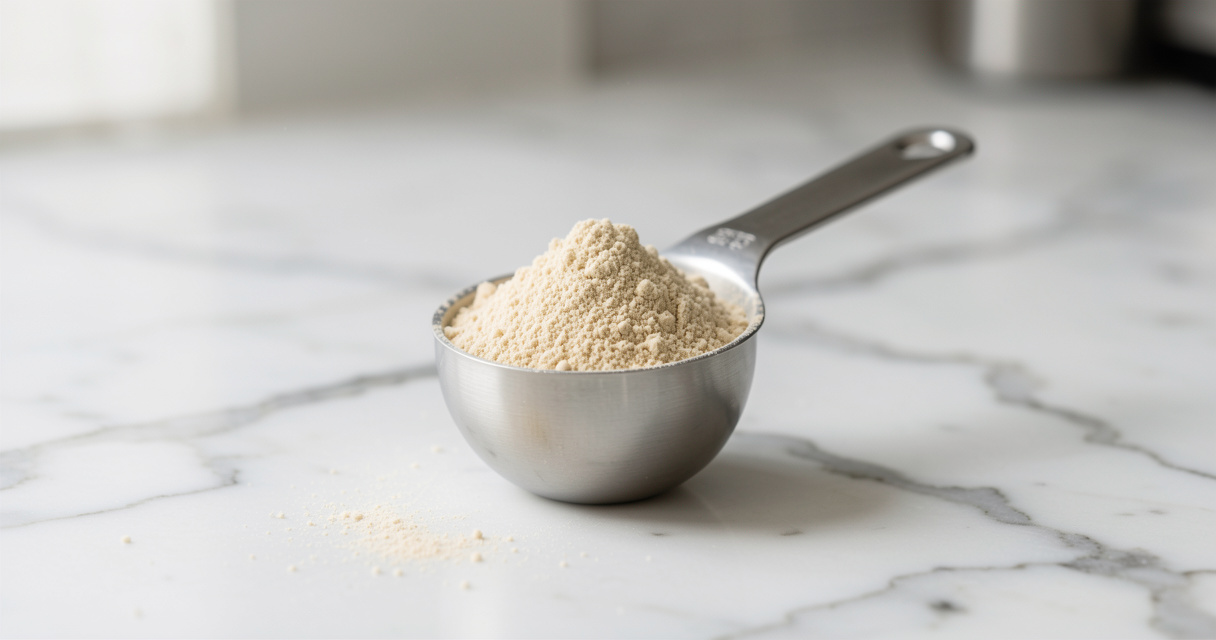
Look at the supplement facts panel. The serving size might read “1 scoop (12 g)” while the active line reads “Hydrolyzed Collagen Peptides 10 g.” That means 2 g of the product is flavoring, vitamin C, or anti-caking agent — and your actual collagen dose is 10 g. A different product may use a 10 g scoop that contains only 5 g of collagen because it is bulked with maltodextrin. Both are legal. Only one gives you the dose you thought you paid for.
Powder, Capsules, and Gummies
How many tablespoons is 10 grams of collagen? Roughly one level tablespoon — but that estimate depends on the density of the powder, whether it is flavored, and how generously you heap it. This is why the label wins every time. Capsules are usually 500 mg to 1 g of collagen each, which means hitting a 10 g dose takes 10-20 capsules — rarely practical and rarely what clinical trials used. Gummies are the least efficient format: most deliver 1-3 g of collagen per serving, sweetened with sugar or sugar alcohols, and priced per gram far above powders. Powders remain the format that gives you the gram dose the research actually tested.
Check for Added Vitamin C
Many collagen powders already include vitamin C because it supports normal collagen synthesis. If yours does, do not stack a second 1,000 mg supplement on top without checking total intake. If yours does not, a small glass of orange juice or a 500 mg supplement delivers the cofactor the trials often paired with collagen. The label is not just a dose tool — it is a stacking tool.
- Confirm the serving size in grams and the actual grams of collagen per serving.
- Verify the form (hydrolyzed peptides, undenatured, or gelatin).
- Note any added vitamin C, sugar, or flavoring.
- Look for third-party testing (NSF, Informed Sport, or USP) if you are an athlete.
- Multiply grams per serving by servings per container to see real cost per gram.
| Product type | What to check | Common mistake |
|---|---|---|
| Powder | Grams of collagen per scoop | Confusing scoop weight with collagen content |
| Capsules | Milligrams of collagen per capsule | Taking 10-20 capsules to reach a 10 g dose |
| Gummies | Grams of collagen per serving and added sugar | Assuming 1 gummy equals a clinical dose |
| Ready-to-drink | Grams of collagen per bottle | Paying a premium for 5 g of collagen |
Once you know the real dose, the next question is not how much but when — and whether vitamin C belongs in the same glass.
Timing, Vitamin C, and Consistency: How to Take Collagen for Better Results
Here is the quiet truth about collagen with vitamin C and timing: consistency outperforms clockwork. The evidence for a precise window — morning versus evening, fasted versus fed, pre- or post-workout — is thin. The evidence for taking a meaningful dose every day for eight to twelve weeks is thick. So build the habit around your life, not around a TikTok theory.
Morning, Before Bed, or Post-Workout?
Each window has a plausible rationale and none has strong clinical proof. Morning works because it is easy to remember. Before bed appeals for glycine’s role in sleep and for the theory that overnight repair is when collagen synthesis peaks. Post-workout uses the training window to support connective tissue recovery. What matters is that you pick one and stick to it long enough for your skin, joints, or training to register the difference. In my years of covering sports nutrition, the athletes who actually saw results were the ones who kept a scoop by the coffee machine and took it every day without thinking.
Vitamin C Pairing
Vitamin C is a cofactor for the enzymes that stabilize collagen’s triple helix, so the pairing is not folklore. The Huberman Lab protocols sometimes cite 500-1,000 mg of vitamin C alongside 5-30 g of collagen, but this is not an official rule and the optimal ratio has not been settled. Check your product first — many powders already include vitamin C, and stacking a second high dose adds cost without clear benefit. If you take collagen in a glass of orange juice, you have covered it.
How Long Should You Stay Consistent?
Skin trials typically run eight to twelve weeks. Joint trials run three to six months. Bone mineral density trials run twelve months or longer, because bone remodels slowly. If you expect a change in a week, you will quit before the data has a chance to arrive. Judge nothing before eight weeks; judge longer for joints and bone. Consistency is not a slogan — it is the variable every trial shares.
Checklist: Pair with vitamin C if needed. Choose the time you will actually remember. Take with food if you have GI upset. Reassess with a clinician at three months.
Callout: Consistency beats perfect timing. A daily 5 g scoop beats a 15 g dose taken three times a week.
Timing optimizes a good habit — it cannot rescue a bad dose. Next we cover what happens when the dose is too high, and who should treat collagen with more caution.
Can You Take Too Much Collagen? Safety, Side Effects, and Upper Limits
The too much collagen side effects question deserves a straight answer, and here it is: no official upper limit exists for collagen peptides. That does not mean more is better. Most clinical trials do not test above 20 g of hydrolyzed peptides or 40 mg of undenatured collagen per day, so the data above those thresholds is limited. If you are taking 30-40 g thinking you are flooding the zone with benefits, you are outside the evidence base, not ahead of it.
Digestive Discomfort
At higher doses, the most common complaints are bloating, heartburn, a feeling of fullness, and occasional diarrhea. The reasons vary — large single servings of any protein can slow gastric emptying, and some people are sensitive to specific additives or flavorings. The practical fix is simple: split the dose across two servings, take it with food, or reduce the total. If that does not resolve the issue, stop and speak to a clinician.
Kidney and Protein Intake Cautions
WebMD notes that excess protein can put strain on the kidneys, especially in people with existing kidney disease. For most healthy adults, 10-20 g of collagen peptides on top of a normal diet is a modest addition, not a protein overload. For someone with reduced kidney function, every gram counts — collagen is protein and should be tallied appropriately. This is not a reason to fear collagen; it is a reason to check with the clinician who already knows your kidney numbers.
When to Talk to a Clinician
Stop and seek medical advice if you have persistent digestive symptoms, if you have diagnosed kidney disease, if you are on a protein-restricted diet for any reason, or if you are taking medications that interact with amino acids. A supplement does not need a prescription to matter — it just needs the right context.
| Concern | What the evidence suggests | Practical step |
|---|---|---|
| Bloating or fullness | More common at single servings above 15 g | Split into two doses or take with food |
| Heartburn | Reported with powders taken on an empty stomach | Mix with a meal or dilute in more water |
| Diarrhea | Occasional, often with flavorings or additives | Try an unflavored product; reduce dose |
| Kidney stress | Relevant mainly in kidney disease (WebMD) | Discuss with a clinician before starting |
Callout: Seek medical advice if you have persistent digestive symptoms or kidney disease. High doses are not automatically better.
Safety is about personalization too, which is why the next question — who needs a different dose — matters more than any single number.
Who May Need a Different Collagen Dose? Body Weight, Age, Pregnancy, and Medical Conditions
The search term collagen dosage body weight gets a lot of traffic, and it deserves an honest answer: there is no validated body-weight formula for collagen. Unlike protein intake for athletes, which is often dosed per kilogram, collagen trials use fixed daily doses regardless of weight. A 60 kg reader and a 90 kg reader are usually both told 5-10 g. That is not lazy science — it is simply the evidence that exists. Personalization here is about context, not arithmetic.
Age, Menopause, and Activity Level
Age and menopause matter, because endogenous collagen production slows and estrogen’s supporting role in skin and bone declines. Post-menopausal women are over-represented in the bone density trials for exactly this reason, and the 5 g dose reflects that population. Activity level matters too: a serious lifter doing resistance training four days a week has a stronger case for 15 g than a sedentary reader focused on skin. Match the dose to the demand.
Pregnancy, Breastfeeding, and Medical Conditions
Pregnancy and breastfeeding lack sufficient trial data to recommend a routine dose, so the default is to consult a clinician. The same applies to people with kidney disease, liver disease, or any condition requiring protein restriction. Medication interactions are rarely an issue with collagen peptides themselves, but additives and flavorings can vary, and label reading becomes more important in these populations, not less.
Collagen Is Not a Complete Protein
Collagen is rich in glycine, proline, and hydroxyproline, but it lacks tryptophan and is low in several other essential amino acids. That means it cannot replace your total protein intake — it sits on top of it. If you take 20 g of collagen and skip lunch, you have not improved your protein status; you have replaced a complete protein with a partial one. Food protein first, collagen on top.
Callout: Collagen is not a complete protein. It supports protein intake, not replaces it.
With the theory covered, the practical plan becomes simple — and it fits into a single week.
A Practical 7-Day Collagen Dosing Plan and Common Mistakes
The daily collagen intake plan does not need to be complicated. Choose a goal, pick a form, start at the low end of the research range, read the label, pair with vitamin C if needed, and increase only if you tolerate it. Seven days is long enough to build the habit and short enough to catch early digestive trouble.
7-Day Starter Plan
- Day 1: Choose your goal (skin, joints, bone, muscle) and note the target dose from the table above.
- Day 2: Read the label. Confirm grams of collagen per serving and form.
- Day 3: Start at the low end of the range (2.5-5 g for skin, 5 g for joint, 5 g for bone, 10 g for muscle).
- Day 4: Pair with vitamin C if the label does not already include it.
- Day 5: Choose your time of day and put the container where you will see it.
- Day 6: Check for digestion, sleep, and skin feel — note anything unusual.
- Day 7: If well tolerated, consider increasing toward the target dose for your goal.
Common Dosage Mistakes to Avoid
- Confusing milligrams and grams — a 40 mg undenatured product is not 40 g of peptides.
- Assuming the scoop equals the dose — check the supplement facts panel.
- Taking a 20 g dose when 5 g is the research number for your goal.
- Expecting overnight results — expect to judge at eight weeks.
- Replacing meals with collagen shakes — it is not a complete protein.
Callout: Key mistake: comparing 40 mg undenatured collagen with 10 g hydrolyzed collagen as if they were the same number. They describe different molecules at different doses.
Frequently Asked Questions
What is the recommended daily dose of collagen?
Most research uses 2.5-15 g of hydrolyzed collagen peptides daily, while goal-specific doses range from 2.5-10 g for skin to 15-20 g for muscle support with training. No official daily guideline exists, so use research ranges and product labels as your guide.
Is 10 grams of collagen per day enough?
Yes, for many people. Ten grams falls comfortably within the research range for skin and joint support. Muscle-focused protocols often use 15-20 g alongside resistance training, so consider increasing if that is your goal.
Can I take collagen on an empty stomach?
Yes. There is no strong evidence that empty-stomach timing is required, and absorption is not meaningfully impaired by food. If you feel digestive discomfort, take it with a meal and check the label for additives that may be triggering symptoms.
Do I need vitamin C with collagen?
Vitamin C supports normal collagen synthesis, and some protocols pair 5-30 g of collagen with 500-1,000 mg of vitamin C. Check your product first, because many supplements already include vitamin C and stacking more may not add benefit.
What happens if I take too much collagen?
There is no official upper limit, but excessive intake may cause bloating, heartburn, or diarrhea. High protein loads matter mainly for people with kidney disease, who should speak to a clinician before increasing any protein source.
How long does it take for collagen to work?
Research timelines vary by outcome: skin trials run eight to twelve weeks, joint trials run three to six months, and bone density trials run twelve months or longer. Judge results over consistent use, not a single dose, and stop if you notice side effects.
Is collagen safe for everyone?
Collagen is generally safe for most adults, but pregnancy, breastfeeding, kidney disease, medication use, and allergies to collagen sources warrant professional advice. A clinician who knows your history is the right person to set your dose.
The Bottom Line on Daily Collagen Dosage
The daily collagen dosage question is not answered by a single number — it is answered by a matrix. No official guideline exists, and the research ranges are goal-specific: 2.5-10 g for skin, 5-10 g for joints (or 40 mg undenatured), 5 g for bone, and 15-20 g for muscle with training.
Form matters as much as grams. Hydrolyzed peptides use gram doses, undenatured collagen uses milligram doses, and gelatin sits in a thinner evidence lane. Consistency, label reading, and safety checks matter more than the perfect time of day. High doses are not automatically better and may trigger digestive discomfort — a smaller, steady dose you actually take beats a large one you abandon.
So the question is not “how much collagen should I take?” in the abstract. It is this: what is your goal, and does your label actually match the dose you need? Read the back panel. Match the form to the outcome. Then start — and let the next eight weeks answer the rest.