


Reading time: 18 min
Table of Contents
- Key takeaways
- What Makes a Rectangular Watch for Men Different
- Rectangular vs Square vs Round Cases
- Key Design Signatures: Tank Case, Roman Numerals, Thin Profile
- Top Men’s Rectangular Watches in 2026
- Under $300: Entry-Level and Microbrand Picks
- $300 to $1,000: The Sweet Spot
- $1,000 and Up: Heritage and Haute Horlogerie
- Iconic Rectangular Watches That Defined the Shape
- Cartier Santos and Tank: The Origin of the Shape
- Jaeger-LeCoultre Reverso: Built for Polo, Worn in Offices
- Modern Icons: Monaco, DolceVita, Tetra and Toccata
- How to Choose the Right Rectangular Watch for Men
- Measuring Your Wrist Correctly
- Case Dimensions Explained: Width vs Length vs Thickness
- Dial Legibility on a Narrow Case
- Movements and Materials: What Your Money Actually Buys
- Quartz, Swiss Quartz and Automatic: The Real Differences
- Case Materials and Finishes Compared
- Crystal and Strap: Where Brands Cut Corners
- Budget Guide: Rectangular Watches Under $300, $1,000 and Beyond
- Under $300
- $300 to $1,000
- Above $1,000 and Total Cost of Ownership
- How to Style a Rectangular Watch: Dress Code, Straps and Occasions
- Formal and Business Settings
- Casual and Weekend Wear
- Strap and Bracelet Options
- Frequently asked questions
Key takeaways
- Fit is measured lug-to-lug, not by width. A rectangular case reads 15–20% larger than a round case at identical dimensions, so the number that decides whether a watch suits your wrist is total case length.
- The category spans every budget. Peugeot, Casio and Hamilton sit at entry and mid level; the Raymond Weil Toccata anchors the practical luxury tier at around $810; Cartier, Jaeger-LeCoultre, Longines, NOMOS and Patek Philippe live above.
- Quartz is not a compromise at entry level. Rectangular movements are harder and costlier to manufacture than round ones, so automatics concentrate at the top of the market.
- Heritage drives value. The Cartier Santos (1904) and the polo-proof Jaeger-LeCoultre Reverso (early 1930s) still set the design language of every rectangular watch made today.
In 1904, in a workshop above the Rue de la Paix in Paris, Louis Cartier solved a problem that had irritated aviators for years. Alberto Santos-Dumont — the Brazilian pioneer then the most famous pilot in the world — could not check the time mid-flight without reaching for a pocket watch. Cartier’s answer was a flat rectangular case on a leather strap, and the modern wristwatch was born. That shape, utilitarian first and elegant second, has outlived a century of round-case fashion.
More than 120 years later, rectangular watches for men still occupy a strange corner of the market. Every ranking page lists them. Almost none explain them.
That is the gap this guide fills. Most coverage of the category is a brand catalogue dressed up as advice: product photos, spec sheets, no context. Nobody tells you whether a 40 mm rectangular case will swallow a 16 cm wrist. Nobody explains why quartz dominates the affordable end while automatics cluster above $5,000. And nobody answers the question every serious buyer eventually asks: is a tank watch the same thing as any other rectangle?
Answer that, add a handful of sizing rules, a price-tier map and a movement breakdown, and the category stops being complicated.
What Makes a Rectangular Watch for Men Different
A rectangular watch is defined by non-round case geometry — what the industry calls a tank-shaped case or, more broadly, a shaped-case watch. It is not simply a square watch. Square cases exist, and the TAG Heuer Monaco is the most recognisable of them, but the rectangular format imposes a different set of proportions entirely.
Look at the documented dimensions across Peugeot’s 2026 rectangular collection: 33 mm square, 38×24 mm, 40×24 mm and 43×30 mm. That spread reveals how flexible the category is. A 24 mm wide rectangular case sounds tiny next to a 40 mm round sport watch. On the wrist, it does not read that way.
Why? Because the eye measures the long axis. A 38×24 mm rectangular case occupies roughly the same visual territory as a 38 mm round case, not a 24 mm one. This is the single most important mechanic in the entire category, and no brand page explains it. A rectangular case reads about 15 to 20 percent larger than a round case at identical nominal dimensions.
Rectangular vs Square vs Round Cases
The distinction between the three shapes matters for buying decisions, and it matters more than most buyers realise.
- Round — uniform in every direction. Diameter is the only relevant measurement, and it is predictable on the wrist.
- Square — equal width and length, four sharp corners. Reads large for its size and demands a confident wrist.
- Rectangular — unequal width and length, elongated. Reads larger than round at the same width, smaller than square at the same length.
Where the round case spreads its mass evenly, the rectangular case concentrates it along a single axis. That is why a man who comfortably wears a 40 mm round watch should look carefully at a 30 mm rectangular case before assuming it will feel small.
| Case Type | Typical Dimensions | Perceived Size | Best Use Case |
|---|---|---|---|
| Round | 38–42 mm diameter | Baseline | Daily wear, sport, diver styling |
| Square | 30–36 mm × 30–36 mm | +10–15% vs round | Statement, chronograph, casual |
| Rectangular | 24–30 mm × 36–47 mm | +15–20% vs round at same width | Dress, business, heritage evening |
Key Design Signatures: Tank Case, Roman Numerals, Thin Profile
Three design signatures recur across nearly every serious rectangular reference.
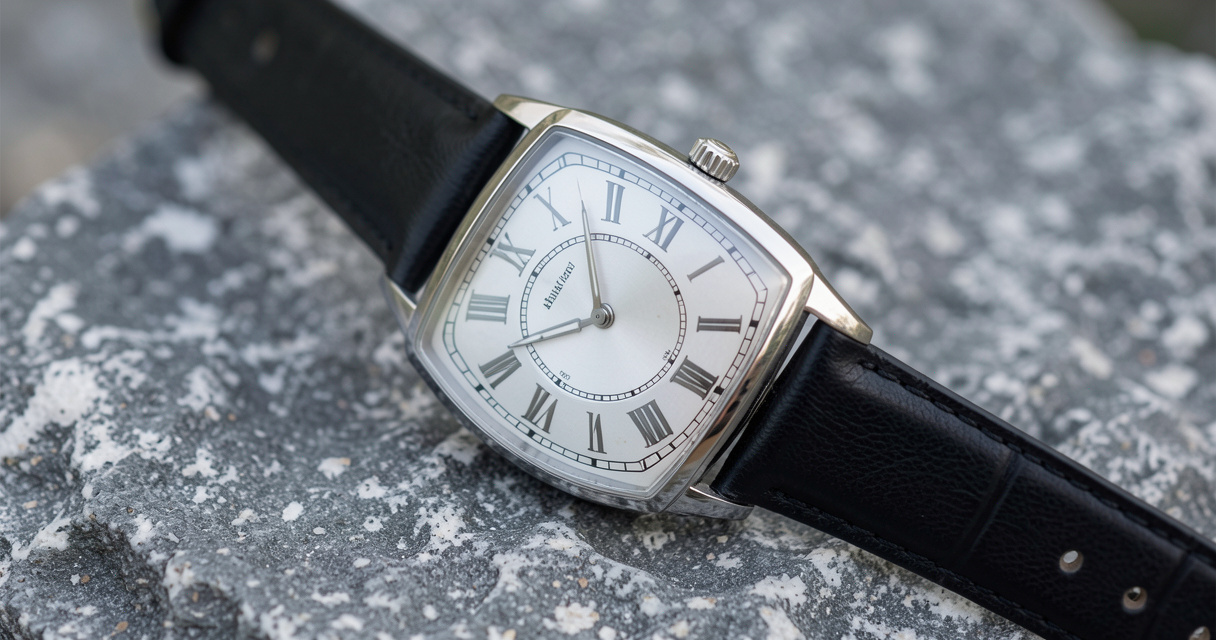
The first is the tank-shaped silhouette itself — straight or gently curved lugs flowing into the case like the treads of a tracked vehicle, which is exactly where the Cartier Tank got its name.
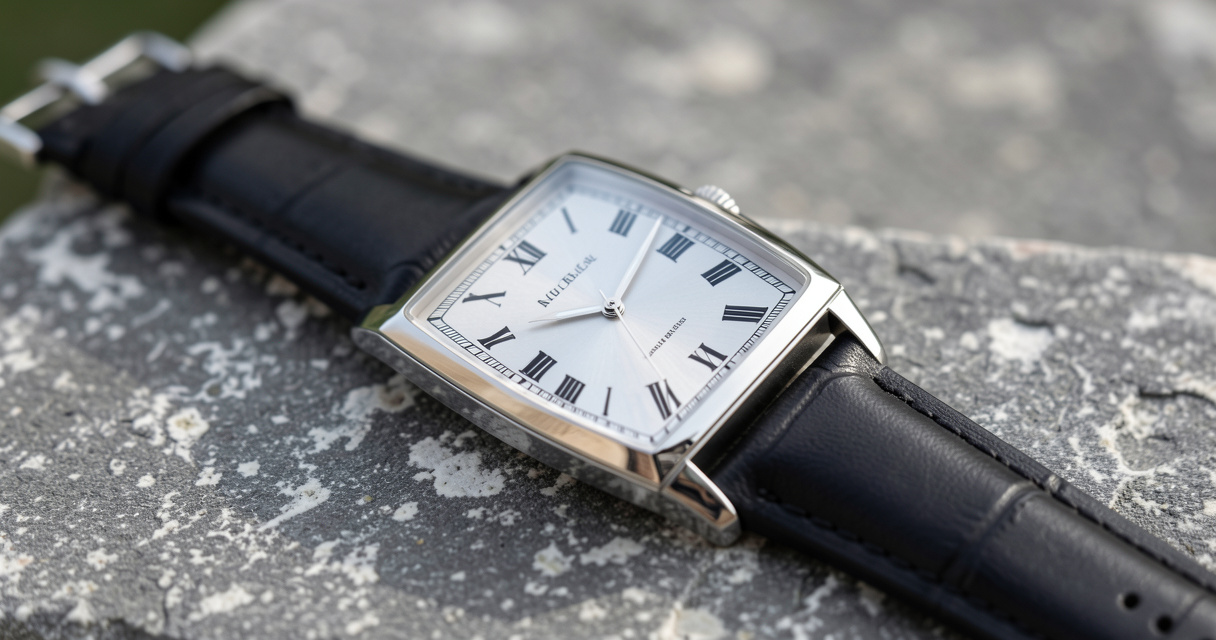
The second is dial layout. On a narrow rectangular dial, a railroad minute track and applied Roman numerals provide the visual scaffolding a round dial naturally has. Remove them and the proportions collapse; this is why so many generic rectangular watches feel unfinished.
The third is thinness. A rectangular case is dress-leaning by temperament. A bulky rectangular watch fights its own geometry, which is why the best examples stay under 9 mm thick.
Definition: A tank-shaped case refers to a rectangular watch case with straight or gently curved lugs, a flat profile and a dial that runs parallel to the strap. Cartier, Fossil and Peugeot all use the term. A shaped-case watch is the broader industry term for any non-round case — rectangular, square, cushion or tonneau.
Get these three signatures right and you have filtered out most of the market. What remains is a short, specific list of references worth owning.
Top Men’s Rectangular Watches in 2026
Ask ten retailers what the best rectangular watch 2026 has to offer and you will get ten catalogues back. Here is the edit, grouped by price band and use rather than brand alphabet.
Under $300: Entry-Level and Microbrand Picks
For most buyers, the entry tier is where the category’s value proposition lives — a rectangular case at this price looks far more considered than a round sport watch of the same cost.
At the very accessible end, Peugeot offers rectangular references in four documented sizes — 33 mm, 38×24 mm, 40×24 mm and 43×30 mm — with brown leather, suede or metal panther-link bracelets. The brand backs every watch with free shipping, free returns (U.S. only), a lifetime warranty and free battery replacement. For a first rectangular watch, that combination is difficult to argue with.
The Hamilton Boulton is the one to know at the top of this band. A quartz rectangular reference with an art-deco dial, it regularly appears on affordable rectangular watch shortlists and justifies the reputation. The Casio Edifice Rectangle plays a different game: stainless steel, mineral crystal, chronograph sub-dials, closer to a sport watch in character than a dress watch. For a rectangular watch you can wear to the gym in the morning and a dinner in the evening, it works.
The Fossil rectangular line and the Bulova and Citizen rectangular references round out the entry tier — all widely available, easy to service and easy to compare in person.
$300 to $1,000: The Sweet Spot
This is where materials, movements and finishing take a step up and the value calculation changes.
The Söner rectangular collection is the specialist here. The brand is built entirely around the rectangular case and fits Swiss movements into every watch — unusual at this price, where generic quartz is the norm. If you want a rectangular automatic without stepping into heritage pricing, this is where the search starts.
The Urban Ace Apex sits in the same territory, with a more contemporary dial design and a similar ambition.
Just above $800, the Raymond Weil Toccata anchors the practical luxury entry. Named after a Bach fugue and produced by a brand founded in Geneva in 1976, the Toccata runs on a quartz movement and starts around $810. Note the word around — Raymond Weil’s own reference pricing has shifted with precious-metal prices. And note, too, that the Toccata is mostly marketed toward women, with the larger references working perfectly well for men or reading as gender-neutral on the wrist. Nobody has said this loudly; the wrist does not require a label.
$1,000 and Up: Heritage and Haute Horlogerie
Above $1,000 the conversation shifts from specification to history, and the references here have earned their place.
Longines and its DolceVita rectangular line offer the most accessible entry into Swiss heritage. NOMOS with the Tetra is the Bauhaus answer — clean, Germanic, unmistakable. Jaeger-LeCoultre with the Reverso owns the mechanical rectangular automatic niche almost by itself. And the trio of Cartier Tank, Cartier Santos and Patek Philippe Gondolo represent the pinnacle: heirlooms, not purchases.
The TAG Heuer Monaco and the Glashütte Original Seventies Chronograph sit slightly outside the dress category — squares and cushions rather than true rectangles — but they belong in any serious conversation about non-round cases.
| Brand / Reference | Case Size (mm) | Movement | Strap | Approx. Price Band | Best Wrist Size |
|---|---|---|---|---|---|
| Peugeot Contour Case Remote Sweep | 38 × 24 | Quartz | Leather | Under $300 | 15–18 cm |
| Peugeot Vintage Tank Black | 43 × 30 | Quartz | Leather | Under $300 | 17–20 cm |
| Casio Edifice Rectangle | ~ 40 × 30 | Quartz | Steel bracelet | Under $300 | 16–19 cm |
| Hamilton Boulton | ~ 33 × 27 | Quartz | Leather | Under $500 | 15–18 cm |
| Söner Rectangular (Swiss) | Various | Swiss automatic | Leather / steel | $500–$1,000 | 16–20 cm |
| Raymond Weil Toccata | ~ 38 × 25 | Swiss quartz | Leather | ~ $810 | 16–19 cm |
| Longines DolceVita | ~ 37 × 23 | Swiss quartz / auto | Leather / steel | $1,000–$2,500 | 15–18 cm |
| NOMOS Tetra | ~ 33 × 33 | Manual / automatic | Leather | $2,000–$4,000 | 15–19 cm |
| Jaeger-LeCoultre Reverso | ~ 45 × 27 | Manual / automatic | Leather / steel | $6,000+ | 17–21 cm |
| Cartier Tank | ~ 33 × 25 | Quartz / automatic | Leather / steel | $3,000+ | 15–19 cm |
Quick-pick checklist
- Choose Peugeot if you want a first rectangular watch with lifetime aftercare and a low price of entry.
- Choose Casio Edifice Rectangle if you want a rectangular case that survives an active week.
- Choose Hamilton Boulton if you want art-deco character at under $500.
- Choose Söner if you want a Swiss movement inside a genuinely rectangular case.
- Choose Raymond Weil Toccata if you want a recognised Swiss brand at the practical luxury entry point.
- Choose Longines DolceVita or NOMOS Tetra if you want heritage without haute-horlogerie pricing.
- Choose Jaeger-LeCoultre Reverso, Cartier Tank or Patek Philippe Gondolo if you are buying for the next generation.
The price bands tell you what you can afford. History tells you what you should want.
Iconic Rectangular Watches That Defined the Shape
The rectangular case was not a fashion decision. It was engineered — first for aviation, then for polo, and only later repurposed for the drawing rooms and boardrooms where it spends most of its life today. Understand the original function and the shape’s hold on the market becomes easier to explain.
Cartier Santos and Tank: The Origin of the Shape
According to Chrono24 Magazine, Louis Cartier built the Santos for Alberto Santos-Dumont in 1904, making it the oldest watch in Cartier’s catalogue and widely credited as the first men’s wristwatch. The problem it solved was practical: a pilot could not safely fumble for a pocket watch mid-flight, so Cartier gave him a rectangular case strapped to the wrist.
That single ask established the blueprint. Flat case. Thin profile. Legible dial. Leather strap. Everything that followed — the Tank, the Reverso, the Tetra, the DolceVita, the Toccata — is a variation on a utilitarian idea that turned out to be beautiful.
The Cartier Tank arrived a few years later, inspired — as the story goes — by the Renault tanks seen on the Western Front. Its case is more overtly rectangular than the Santos, its lugs straighter, its dial cleaner. Where the Santos says aviator, the Tank says diplomat. If you had to name one men’s tank watch that still defines the shape for the widest audience, it is the Tank.
Jaeger-LeCoultre Reverso: Built for Polo, Worn in Offices
The Reverso was introduced in the early 1930s, and its origin story is the most unusual in watchmaking. According to Chrono24 Magazine, the reversible case was designed specifically to protect the crystal during polo matches — the case physically flips over, presenting a solid metal back when play starts and the dial when the match ends.
Picture the scene: a British officer in colonial India, mid-chukka, flipping his watch face-down to survive a strike from a mallet. Now picture the same watch worn under a crisp navy shirt cuff at a Geneva board meeting. That contrast is the entire modern appeal of the rectangular case — legitimate sport credentials disguised as pure formality.
The Reverso was later discontinued and then revived — the 2011 Reverso Ultra-Thin Tribute to 1931 marked the model’s 80th anniversary and formally returned the design to its earliest proportions. Today the Reverso is the definitive automatic rectangular watch, virtually uncontested in its tier.
Modern Icons: Monaco, DolceVita, Tetra and Toccata
The post-war period added to the canon without replacing it.
The TAG Heuer Monaco arrived in 1969 as a square waterproof chronograph, popularised by Steve McQueen in the 1971 film Le Mans. It is not strictly rectangular, but it belongs to the shaped-case lineage and demonstrates that a non-round case can carry chronograph complexity as confidently as it carries a dress dial.
The Longines DolceVita, released in 1997, brought the tank aesthetic to a broader mid-market audience with Swiss quartz and mechanical movements and a softer, more contemporary case profile.
The NOMOS Tetra arrived in 1992 with hard Bauhaus geometry and remains the cleanest expression of the shaped case in German watchmaking.
The Oris Rectangular and the Patek Philippe Gondolo complete the canon — one accessible, one aspirational.
And the Raymond Weil Toccata, named after a Bach fugue by a brand founded in Geneva in 1976, brings the whole story into the present. It is not trying to out-Cartier Cartier; it is doing something different, with a rectangular case designed for today’s proportions rather than 1919’s. For the vintage rectangular watch buyer who wants contemporary reliability instead of restoration headaches, it becomes a genuine option.
| Model | Debut Year | Original Purpose | Why It Still Matters |
|---|---|---|---|
| Cartier Santos | 1904 | Aviation — readable time for pilots | First men’s wristwatch; oldest Cartier in catalogue |
| Cartier Tank | 1917–1919 | Military inspiration, formal wear | Defines the tank-shaped case standard |
| Jaeger-LeCoultre Reverso | Early 1930s | Polo — reversible case to protect crystal | Only serious rectangular automatic lineage |
| TAG Heuer Monaco | 1969 | Waterproof square chronograph | Proves shaped cases work with sport complexity |
| Raymond Weil Toccata | Modern | Bach-inspired formal design | Practical luxury entry with Swiss quartz |
| NOMOS Tetra | 1992 | Bauhaus geometry | German design benchmark for shaped watches |
History is seductive. Fit is decisive. Here is how to match a rectangular case to the wrist you actually have.
How to Choose the Right Rectangular Watch for Men
Measure your wrist and match it to the watch’s lug-to-lug length, not its width. Most men’s rectangular watches measure 24 to 30 mm wide and 36 to 47 mm long. Wrists under 17 cm should generally stay below 42 mm lug-to-lug, since a rectangular case reads larger than a round one at the same dimensions.
Measuring Your Wrist Correctly
Wrap a soft measuring tape around the wrist bone, just below the hand, and note the circumference in centimetres. If you do not have a tape, a strip of paper wrapped around the same point and then held against a ruler does the same job.
For rectangular watches, the wrist circumference is only half the calculation. What matters more is the flat top of the wrist — the distance across which the watch case actually sits. Measure this by pressing a ruler across the top of the wrist and reading the flat span in millimetres. That number, not the circumference, tells you which lug-to-lug measurement will work.
Case Dimensions Explained: Width vs Length vs Thickness
Three numbers describe any rectangular case, and buyers routinely mistake one for another.
- Width — the short axis, usually 24 to 30 mm on men’s references. This is the number most listings show first, and it is the least relevant for fit.
- Length (lug-to-lug) — the long axis including lugs, usually 36 to 47 mm. This is the number that determines whether the watch overhangs the wrist.
- Thickness — usually 6 to 9 mm on dress references. A rectangular watch over 10 mm starts to feel like it fights its own proportions.
| Wrist Size (cm) | Recommended Lug-to-Lug (mm) | Case Height Guidance |
|---|---|---|
| Under 15 cm | 34–38 mm | 34–36 mm case length |
| 15–17 cm | 38–42 mm | 36–40 mm case length |
| 17–19 cm | 42–46 mm | 40–43 mm case length |
| Over 19 cm | 46–52 mm | 43–47 mm case length |
Dial Legibility on a Narrow Case
Narrow dials compress information. Roman numerals and railroad minute tracks exist precisely because a rectangular dial without them becomes unreadable at a glance. When comparing two references at the same price, favour the one with the clearer dial architecture — applied indices over printed ones, and Roman numerals over sticks on a dress design.
Legibility is not a luxury feature. On this case shape, it is the feature. Which is also why a rectangular watch with Roman numeral dial markings and a clean train track remains the safest first purchase.
Warning: Do not size a rectangular watch using the round-watch diameter you normally wear. A man comfortable in a 40 mm round case should start his rectangular search around 30 mm wide and 42 mm lug-to-lug — not at 40 mm on the width axis, which will look enormous.
Once fit is settled, the next question is what sits inside the case. That answer changes everything about price.
Movements and Materials: What Your Money Actually Buys
Rectangular movements are harder and more expensive to produce than round ones. That single fact explains most of the pricing structure in this category.
Quartz, Swiss Quartz and Automatic: The Real Differences
The reason automatics are rare in rectangular watches is mechanical, not commercial. A round watch accepts a round movement with no wasted space. A rectangular case forces manufacturers either to squeeze a round movement inside (leaving dead corners) or to build a rectangular movement from scratch (expensive, low-volume). Most brands choose the first option at accessible prices and the second only above $5,000.
Three movement categories dominate.
- Standard quartz — battery-powered, accurate to within a few seconds per month, serviceable by replacing a battery. Casio, Fossil and Peugeot use this at entry level.
- Swiss quartz — same technology, Swiss-assembled and typically better regulated. Raymond Weil’s Toccata and much of the Longines DolceVita range use Swiss quartz.
- Automatic — wound by wrist movement, requires periodic servicing every five to seven years, and typically signals a serious purchase. Söner uses Swiss automatic movements across its rectangular collection. The Jaeger-LeCoultre Reverso is the reference at the top.
| Movement Type | Accuracy | Service Needs | Typical Price Band |
|---|---|---|---|
| Standard quartz | Seconds per month | Battery every 2–3 years | Under $500 |
| Swiss quartz | Seconds per month, better regulated | Battery every 2–3 years | $500–$2,000 |
| Automatic | Seconds per day | Service every 5–7 years | $1,000+ |
| Manual wind | Seconds per day | Service every 5–7 years | $4,000+ |
Case Materials and Finishes Compared
PVD coating — physical vapour deposition — is the finish used on almost every gold-tone and two-tone rectangular watch under $1,500. Chrono24 notes that Raymond Weil’s gold and two-tone Toccata variants use PVD rather than solid gold. PVD is durable, convincing at arm’s length, and does not weigh four figures.
Solid precious metal — actual gold or platinum — appears only above $5,000 and communicates a different order of value. Stainless steel sits between the two, with its own logic: neutral, honest, long-lived.
PVD vs solid gold: PVD uses a thin vapour-deposited layer over steel to imitate gold. It resists wear for years but can flake if chipped. Solid gold is the metal itself — heavier, more expensive, and immune to colour loss. On a $1,500 two-tone watch, PVD is the correct reading; on a $15,000 Cartier, solid gold is the only honest finish.
Crystal and Strap: Where Brands Cut Corners
Two places to look when comparing at the same price.
The first is the crystal. Sapphire crystal resists scratching to near-imperviousness; mineral glass scratches visibly within a year of daily wear. Sapphire is disproportionately valuable on a rectangular watch because the flat crystal is more prone to surface damage than a domed round one.
The second is the strap. A leather strap thinner than 2 mm feels insubstantial, and a poorly stitched strap ruins the impression of an otherwise good watch. Alligator at the top, calfskin in the middle, and textured or suede leather strap as the wildcard that makes the same case work everywhere.
With movements and materials in hand, spending decisions become clear. Here is what each band actually buys.
Budget Guide: Rectangular Watches Under $300, $1,000 and Beyond
How much should you spend on a rectangular watch? Less than the brands would like. More than some of them justify. The honest answer depends on which of three tiers you belong to — and the middle tier has quietly become the most interesting of the three.
Under $300
At this level, the priority is a brand that stands behind its product. Peugeot offers free shipping, free returns (U.S. only), a lifetime warranty and free battery replacement across its rectangular collection — a support structure that most rivals at this price do not match. Casio and Fossil are the alternatives if you prefer a wider range of finishes, and Bulova and Citizen cover the middle ground.
Buy this tier if you are exploring the shape for the first time, need a single reliable rectangular watch for a wedding suit, or want to test a colour — gold-tone, two-tone, steel — without committing the price of a used car to the experiment.
$300 to $1,000
This is the sweet spot, and it has gotten better in the last five years.
Söner’s rectangular collection pairs Swiss movements with cases built exclusively around the rectangular form — no compromise geometry, no round-movement-in-a-rectangle fudge. Urban Ace and the Hamilton Boulton cover different aesthetic angles at similar prices. At the top of the band, the Raymond Weil Toccata at around $810 merges a Swiss brand’s reputation with a quartz movement that will outlast its first owner.
Choose this tier if you want a rectangular watch you can wear three days a week for a decade without thinking about it. That is affordable rectangular watches in the truest sense — not cheap, but priced so the enjoyment does not come with anxiety.
Above $1,000 and Total Cost of Ownership
Above $1,000 you are buying history, movement quality or both. Longines and NOMOS deliver genuine Swiss and German manufacture between $2,000 and $4,000. Jaeger-LeCoultre, Cartier and Patek Philippe live beyond that, with the Reverso, Tank and Santos defining the ceiling of the category.
But the purchase price is not the total cost. Budget for a battery replacement every two to three years on quartz (Peugeot’s is free), a strap replacement every 18 to 24 months on leather, and a movement service every five to seven years on any automatic — typically $400 to $800 for entry-level automatic, and considerably more for haute horlogerie.
| Price Band | What You Get | Example Models | Watch Out For |
|---|---|---|---|
| Under $300 | Quartz movement, mineral or basic crystal, house leather strap | Peugeot 38×24, Casio Edifice Rectangle, Fossil rectangular | Mineral glass; check crystal specs |
| $300–$1,000 | Swiss quartz or Swiss automatic, sapphire sometimes | Söner, Urban Ace Apex, Hamilton Boulton | Verify sapphire vs mineral; automatic at this price uses small round movements |
| ~ $810 | Swiss quartz, recognised brand, PVD finishes available | Raymond Weil Toccata | PVD gold wears eventually; solid gold is not offered here |
| $1,000–$4,000 | Swiss-made quartz or automatic, sapphire, refined finishing | Longines DolceVita, NOMOS Tetra | Servicing costs; strap replacement frequency |
| $4,000+ | Haute horlogerie, in-house or historic movement, investment-grade | Jaeger-LeCoultre Reverso, Cartier Tank, Cartier Santos, Patek Philippe Gondolo | Service intervals; resale depends on documentation and box |
Spend informed. Then wear it well.
How to Style a Rectangular Watch: Dress Code, Straps and Occasions
The rectangular case skews formal by default. Skews — not commits. With the right strap, the same watch that reads as black-tie accessory on one wrist reads as graphic minimalist on another. The rectangular dress watch men actually wear three days out of five is a different object from the one that lives in a drawer waiting for weddings.
Formal and Business Settings
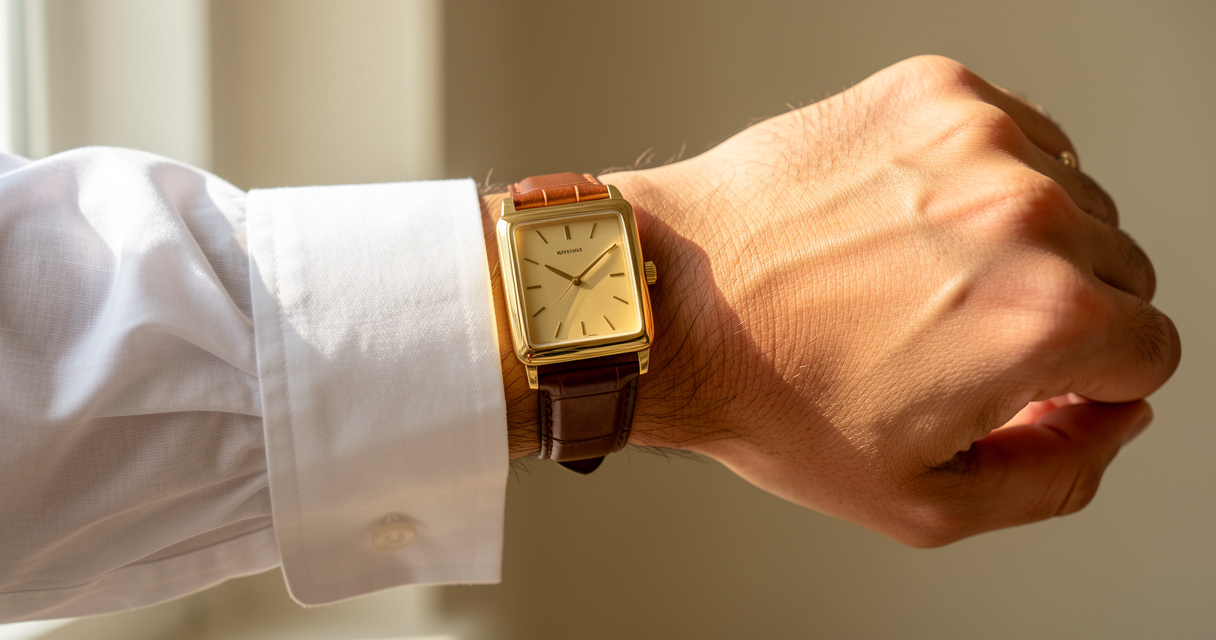
Black leather strap, polished case, restrained dial. This is the rectangular watch in its native habitat, and it works with tuxedos, business suits and the smartest end of your rotation. Under a shirt cuff, a rectangular case disappears more gracefully than a round one because its profile is thinner and its width tucks below the cuff edge without bulge.
Casual and Weekend Wear
Swap the glossy black leather for suede or textured calfskin and the entire register changes. A brown suede strap turns the same rectangular case into something that works with denim, knitwear, a blazer over a T-shirt. Rectangular watches with brushed steel cases and metal bracelets go further still, edging into casual territory that glossy round dress watches cannot reach.
Strap and Bracelet Options
Three strap families matter here.
- Leather — glossy black alligator for formal, brown calf for daily, suede for casual.
- Metal — panther-link or Milanese bracelets for a graphic, modernist effect.
- Textile — a wildcard that rarely works on rectangular cases; the contrast in texture is too strong.
Occasion-to-strap checklist
- Office day: brown calfskin, Roman numeral dial, steel case.
- Wedding: glossy black leather, gold-tone or steel case, thin profile under 8 mm.
- Weekend: suede strap, brushed steel case, minimal dial.
- Travel: metal bracelet, quartz or automatic, one watch that covers every scenario.
The most common remaining questions have short answers. Here they are.
Frequently asked questions
Are rectangular watches in style in 2026?
Yes. Shaped cases remain one of the strongest alternatives to round sport watches, driven by the enduring popularity of the Cartier Tank, Santos and Jaeger-LeCoultre Reverso. The 2026 collections from Longines, NOMOS, Söner and Peugeot confirm the shape is not a trend but a category.
Do rectangular watches look bigger than round watches?
Yes. The eye reads total case length, not width, so a rectangular case appears larger than a round case at the same nominal dimensions. Compare lug-to-lug length first and choose a slightly smaller nominal size than you would in a round watch.
Is a tank watch the same as a rectangular watch?
Tank is a specific style inspired by the Cartier Tank — a rectangular case with a thin profile, straight lugs and a clean dial. Rectangular is the broader category, and it also includes squarer shapes, cushion-adjacent cases and chronograph designs such as the TAG Heuer Monaco.
What is the best affordable rectangular watch for men?
At entry level, Peugeot rectangular models offer lifetime warranty, free shipping and free battery replacement, while the Casio Edifice Rectangle and Hamilton Boulton are widely recommended for quality at a reasonable price. Casio, Citizen, Seiko, Fossil and Bulova are all worth comparing from the same shelf.
Do rectangular watches come with automatic movements?
Some do, but they are less common because rectangular movements are harder and more expensive to manufacture than round ones. Quartz dominates the accessible price points; automatics appear mainly in the upper tiers, such as the Jaeger-LeCoultre Reverso or the Söner rectangular collection.
Can you wear a rectangular watch with casual clothes?
Yes, if the strap matches the setting. A glossy black leather strap reads formal, while suede, textured leather or a metal bracelet makes the same case work with denim and knitwear.
Which rectangular watch is the most iconic?
The Cartier Santos, developed in 1904 for aviation pioneer Alberto Santos-Dumont, is widely cited as the oldest watch in Cartier’s catalogue and the first men’s wristwatch. The Cartier Tank and Jaeger-LeCoultre Reverso are the two models most often named alongside it.
Five-point buying checklist before checkout
- Measure your flat wrist span and match it to lug-to-lug, not width.
- Confirm whether the crystal is sapphire or mineral.
- Verify the movement type — quartz, Swiss quartz or automatic.
- Read the strap spec: leather grade, thickness and stitching.
- Price in the next five years of maintenance, not just today’s receipt.
Every serious rectangular watch you can buy in 2026 traces a line back to a practical problem solved more than a century ago — a pilot who could not check the hour mid-flight, a polo player who needed his crystal to survive a mallet. The shape was not designed to be elegant. It became elegant because it worked.
If you take one idea from this guide, take this: measure your wrist before you shop. Not the width you think you want, but the lug-to-lug length you can actually wear. Wrists under 17 cm should stay under roughly 42 mm lug-to-lug; larger wrists can carry 47 mm and beyond. Everything else — movement, material, price band — follows from there.
The category spans Peugeot at under $300 and Patek Philippe at ten times ten thousand without contradiction, held together by a shared geometry that has outlived every fashion cycle since 1904. Heritage drives value in this niche: the Santos of 1904 and the polo-proof Reverso of the early 1930s still set the design language of every rectangular timepieces for men on the market today.
So if the shape has already outlasted a century of round-case dominance, how unconventional is a rectangular timepiece for men really?