

Reading time: 6 min
Table of Contents
Key Takeaways
- Chef’s Philosophy: Julien Binz champions flavor clarity — every ingredient announced on the menu must be immediately recognizable and understood.
- Exceptional Value: The €115 Binz’tronome dinner menu includes selected wine pairings, making it one of the best-value Michelin-starred experiences in France.
- Distinctive Interior: Designed by co-owner Sandrine Kauffer-Binz, the dining room melds black lacquer, brass, velvet, and gold accents with Alsatian artisan touches.
The kind of evening that lingers long after the last mignardise has disappeared. I found myself at Restaurant Julien Binz, a one-Michelin-star address tucked into the Alsatian wine village of Ammerschwihr, and the experience redefined what a Michelin-starred dinner can be — not a clinical tasting note, but a warm, deeply personal celebration of craft.
The discerning traveler knows that Alsace’s greatest asset is its ability to marry precision with soul. Julien Binz exemplifies this. His cooking is a masterclass in classical French technique, yet every course speaks of the region: the vine-draped hills, the half-timbered houses, the pungent Munster cheese. This is not a restaurant that hides behind abstraction. It announces its intentions, then delivers them with breathtaking clarity.
Binz’s journey reads like an apprenticeship through the hallowed kitchens of Alsace. Born and raised in the region, he trained under Philippe Gaertner at Aux Armes de France, then at the three-Michelin-starred Le Buerehiesel under Antoine Westermann, and later as second chef at the legendary L’Auberge de l’Ill alongside Marc Haeberlin. That lineage — a direct link to France’s greatest culinary minds — is audible in every plate.
The Setting: Ammerschwihr’s Quiet Grandeur
Just outside Colmar, on the Alsace Wine Route, Ammerschwihr is the sort of village that seems designed by a painter — vineyards stepping up gentle slopes, timbered houses leaning into cobblestone streets. The restaurant occupies a corner building that once housed L’Arbre Vert, a historic inn. In the evening, warm light spills from the windows onto the pavement, and the golden glow promises something extraordinary within.
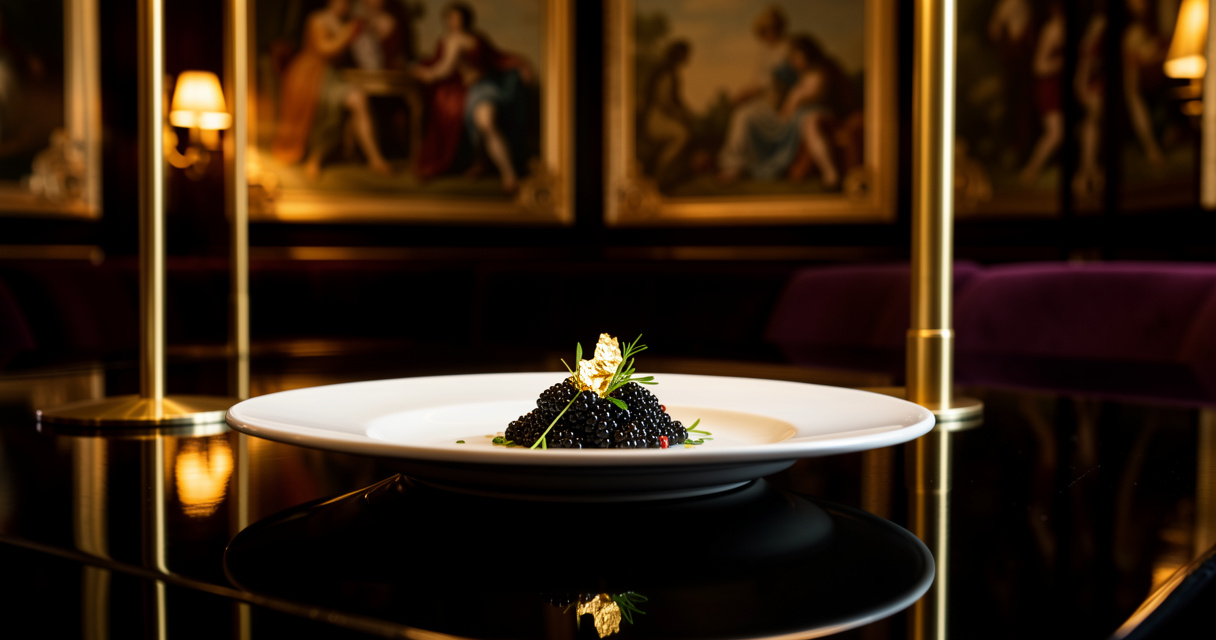
Of course, the real drama begins inside. The interior, conceived by Binz’s wife and co-owner Sandrine Kauffer-Binz, is a deliberate departure from the minimalist temples that dominate the Michelin landscape. Here, black lacquer meets brass accents, velvet seating, and mirrors that multiply the light. Gold is everywhere — not gaudy, but intentional, like a thread of saffron through a dish. A large Fragonard-inspired painting anchors one wall, while a symbolic “tree of life” installation nods to the building’s former identity. Every piece, from the service consoles to the staff uniforms, was commissioned from local artisans. The effect is theatrical yet intimate, opulent but never oppressive.
The Art of Flavor Readability
“Diners should immediately recognize and understand the ingredients announced on the menu,” Binz has said. This philosophy is the Antithesis of deconstruction. Instead of obfuscation, he offers reductions, jus, layered sauces — the French repertoire applied to Alsatian bounty. The result is food that tastes exactly as it sounds: a sea bream carpaccio that sings of lime and smoke, a white asparagus variation that dances between real and faux textures, a charolais beef fillet whose barbecued crust yields to flesh as tender as memory.
The Binz’tronome menu — my choice for the evening — is a seven-course parade of such discipline. At €115, with selected glasses of Alsatian wine woven into the meal, it ranks among the finest values in Michelin-starred dining. The edit: caviar tasting with minute-smoked sea bream, white asparagus with smoked beef fillet and anchovy-mustard condiment, an onion-coffee cappuccino that masquerades as a cappuccino yet delivers savory depth, tortellini flooded with butter broth and Tartuffon cream. A dessert of Tanariva chocolate crisp with lychee sorbet closes the arc. Each course is a sentence in a coherent paragraph — nothing is incidental.
The Insider Detail Others Miss
What elevates the experience beyond the plate is the rhythm of the room. Service is precise but unhurried, with each course announced by a server who clearly understands the story behind it. The wine pairings — curated from the region’s great producers — are poured in silence, allowing the flavors to speak. By the evening’s end, the mignardises arrive not as afterthoughts but as a gentle farewell.
“The rabbit with almonds — the waiter simply placed it and stepped back, letting the moment breathe. That’s the kind of service that deserves a Bessoneau handkerchief, not applause.”
Book it. Now. This is an address that belongs not just on a gastronomic itinerary but on any journey through France that values memory over checklist. Julien Binz Restaurant has achieved something rare: a Michelin star that feels earned, intimate, and unmistakably Alsatian — worth every mile from Colmar, from Strasbourg, from anywhere.
Follow me on Instagram, YouTube, Twitter or Facebook for a daily moment of travel inspiration.