


Reading time: 15 min
Table of Contents
- Key Takeaways
- Why Men Choose Diamond Watches: Status, Style, and Investment
- The Symbolism of a Diamond Watch
- Diamond Watches as Investments
- Types of Diamond Watches for Men: Bezels, Dials, and Bracelets
- Bezel-Set Diamonds
- Diamond Dials and Pavé
- Diamond-Encrusted Bracelets
- Top Brands and Models in Men’s Diamond Watches (2026 Update)
- Rolex Custom Diamond Watches
- JBW Bold Diamond Timepieces
- Paul Rich Moissanite Alternatives
- Breitling and Luxurman
- Key specs to compare when choosing a brand:
- Diamond Quality in Watches: What to Look For (Cut, Clarity, Carat)
- The 4Cs for Watch Diamonds
- Why Clarity Matters Less in Bezel Settings
- Diamond Certification – IGI vs GIA
- Lab-Grown vs Natural Diamonds for Men’s Watches: Pros, Cons, and Savings
- Moissanite: The Brighter Alternative
- Lab-Grown Diamonds: Ethical and Affordable
- Resale Value Comparison
- How to Choose the Perfect Diamond Watch for Men: A Step-by-Step Guide
- Step 1: Set Your Budget
- Step 2: Choose Diamond Type
- Step 3: Select Brand and Movement
- Step 4: Verify Authenticity and Warranty
- 10-point checklist before buying a diamond watch:
- Custom Diamond Watches: Rolex, Patek Philippe, and Aftermarket Options
- How Custom Diamond Watches Are Made
- Reputable Custom Shops (TraxNYC, WatchGuyNYC)
- Factory vs Aftermarket: Which Is Better?
- Maintaining Your Diamond Watch: Cleaning, Servicing, and Insurance
- Daily Wear and Tear Precautions
- Professional Maintenance Schedule
- Insurance and Valuation
- Frequently Asked Questions
- Your Diamond Watch Awaits
Key Takeaways
- Diamond type matters: Natural, lab-grown, and moissanite each offer distinct value, brilliance, and resale potential.
- Budget is your compass: From $2,000 moissanite to $15,000+ custom Rolex, the perfect watch exists at every price point.
- Certification is non-negotiable: Always demand IGI or GIA certification for diamonds, especially above $5,000.
- Maintenance protects your investment: Professional servicing every 1-2 years keeps diamonds secure and the movement precise.
Why Men Choose Diamond Watches: Status, Style, and Investment
The average man’s diamond watch carries a price tag of $11,536 according to 2025 catalog data from ItsHot.com. Yet the same head-turning sparkle can be achieved for under $2,000 with moissanite. So why does a diamond watch for men command such a premium? The answer lies in three interlocking motives: status, style, and investment. A diamond bezel on a Rolex Daytona isn’t just an accessory — it’s a declaration. The discerning traveler knows that an iced out watch is a passport to a different kind of attention. But beyond the confidence boost, certain models from Rolex and Patek Philippe have appreciated 10-15% annually over the past decade, transforming a luxury purchase into a tangible asset.
The Symbolism of a Diamond Watch
When John, a London-based entrepreneur, strapped on his father’s vintage Rolex after having it custom-ice-packed with aftermarket diamonds, he didn’t just inherit a watch — he inherited a story. “Every time I glance at my wrist, I remember the path that got me here,” he told me. That emotional resonance is the true currency of a men’s diamond watch. Brands understand this. Rolex has built an empire on the idea that time is the ultimate luxury, and adorning it with diamonds simply amplifies that message.
Diamond Watches as Investments
Factory-set Rolex diamond watches — like the Datejust with a diamond bezel or the Daytona with diamond markers — have historically held their value better than almost any other luxury good. A 2025 industry report noted that certain pre-owned Rolex models with original diamond dials can fetch 20-30% above retail after five years. However, aftermarket customizations can dent resale value. The distinction is critical: buy factory-certified if you care about future returns; buy custom if you want artistry.
Did You Know? Rolex diamond watches have appreciated 10-15% annually in specific models (e.g., the Rolex Day-Date with factory diamond baguettes). Always check the model’s auction history before investing.
The choice is not binary. Whether you seek a symbol or an investment, the men’s diamond watches market today offers more transparency and variety than ever. But before you spend a single dollar, understand the canvas on which those diamonds will dance.
Types of Diamond Watches for Men: Bezels, Dials, and Bracelets
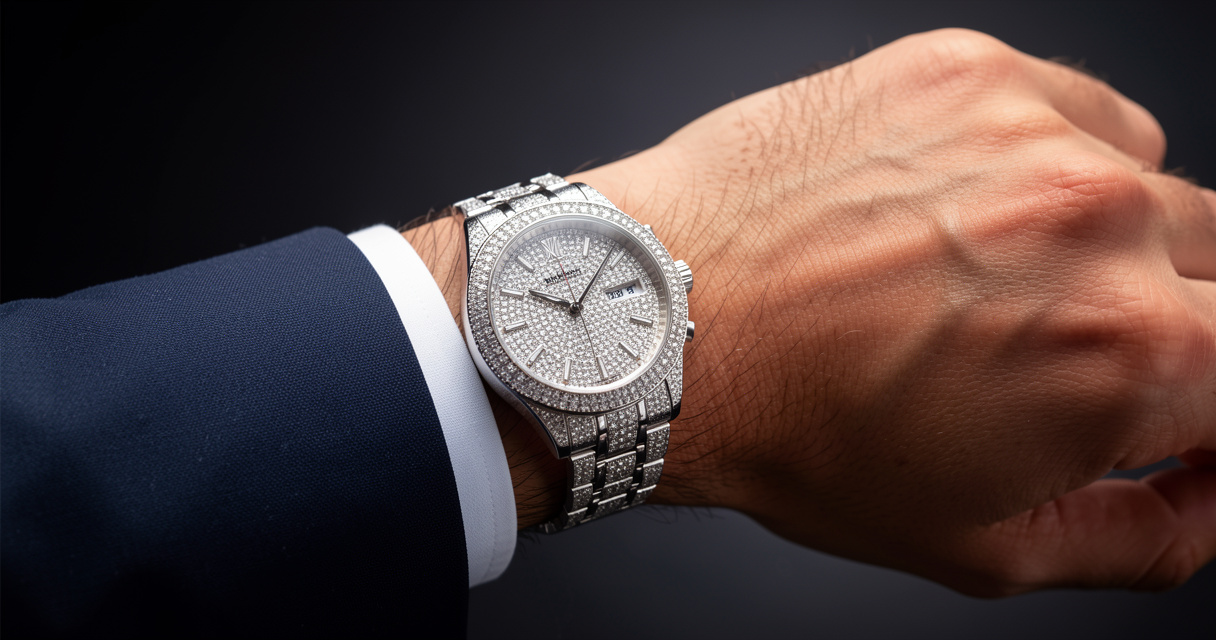
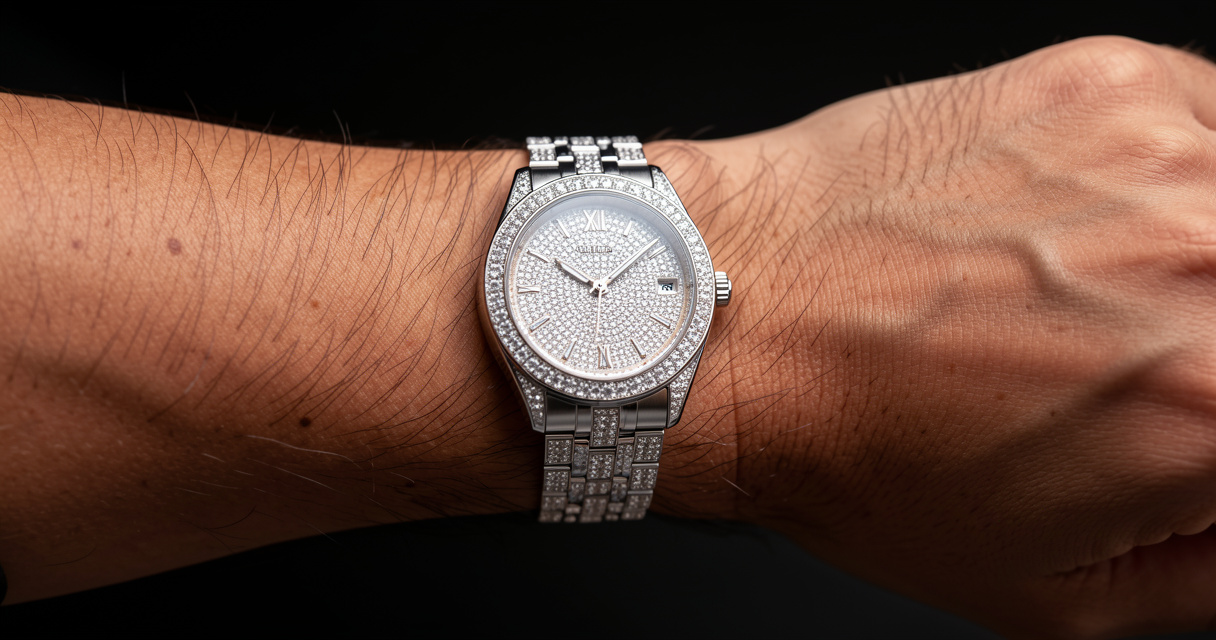
Diamonds can adorn a watch in three primary ways: the bezel, the dial, and the bracelet. Each placement dramatically changes the watch’s character, weight, and price. A diamond bezel watch — like the Rolex Datejust with a round diamond bezel — adds a subtle halo of brilliance. A fully pavéd dial turns the entire watch face into a glittering canvas, while a diamond-encrusted bracelet (often called “full ice”) is the most extravagant (and expensive) option. Understanding these types is the first step in finding your perfect iced out watches for men.
Bezel-Set Diamonds
The bezel is the most common placement for diamonds in luxury watches. Diamonds are individually set into the metal ring surrounding the crystal. This layout strikes a balance between visibility and practicality — the bezel sees less daily impact than the dial or bracelet. Brands like Breitling and Rolex offer exquisite bezel-set options. Bezel diamonds are typically smaller (0.5–2 carats total) but their uniform arrangement creates a cohesive sparkle.
Diamond Dials and Pavé
Pavé setting involves covering the entire dial surface with dozens of tiny diamonds, held in place by small beads of metal. This technique maximizes brilliance but requires careful craftsmanship; poorly set pavé stones can loosen over time. The Rolex Daytona with a pavé diamond dial is a collector’s dream, often exceeding $50,000 at auction. For a more affordable entry, Paul Rich offers moissanite pavé dials starting under $1,000.
Diamond-Encrusted Bracelets
Also known as “full ice,” these watches feature diamonds set into the metal links of the bracelet. Brands like JBW specialize in this style, creating watches that look like a continuous river of diamonds. A JBW full diamond bracelet watch can carry 10-15 carats total, priced between $5,000 and $20,000. The durability of bracelet settings depends on the quality of the channel work — always inspect the edges for evenness.
| Type | Typical Carat Weight | Price Range | Sparkle Level (1-5) | Durability |
|---|---|---|---|---|
| Bezel | 0.5–2 ct | $2,000–$15,000 | 3 | High |
| Dial / Pavé | 1–5 ct | $3,000–$50,000+ | 5 | Medium |
| Bracelet | 5–15 ct | $5,000–$20,000+ | 4 | Medium |
| Full Iced-Out | 10–20+ ct | $10,000–$100,000+ | 5 | Low (requires careful wear) |
Choosing between these types depends on your lifestyle. A bezel-set watch can be worn daily with a suit; a full-iced bracelet is reserved for evenings and statement events. The next section will guide you through the brands that master each style.
Top Brands and Models in Men’s Diamond Watches (2026 Update)
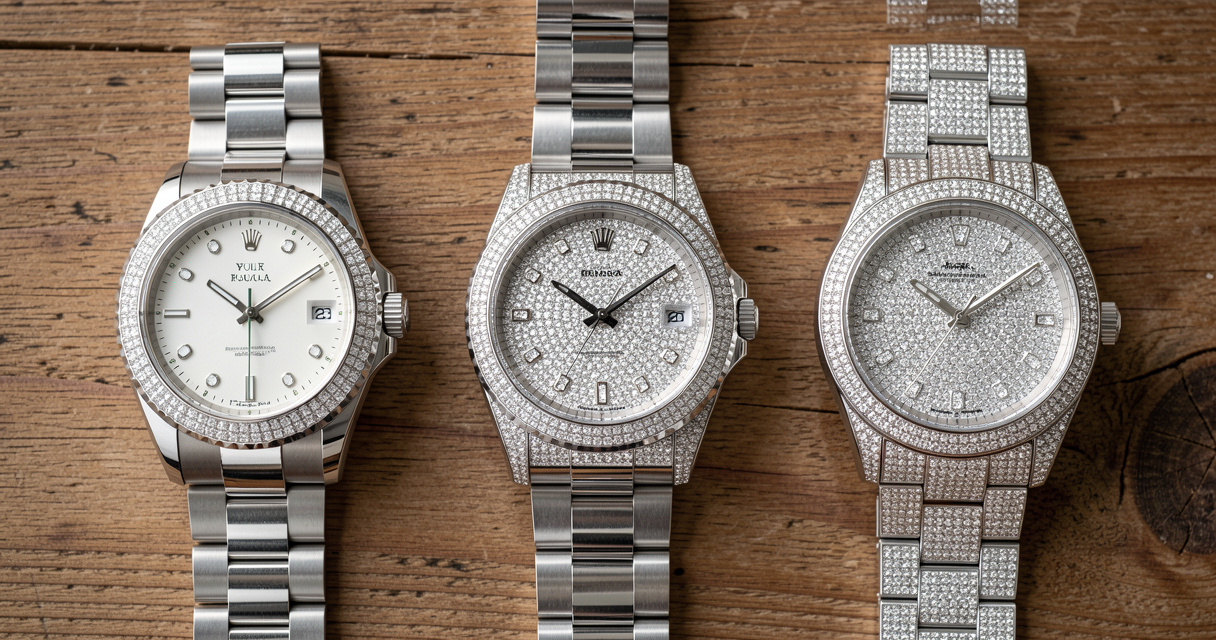
According to 2025 catalog analysis by ItsHot.com, the most popular brands for luxury diamond watches men are Rolex, Breitling, and Luxurman. But the market has expanded. In 2026, we’re seeing a surge in moissanite and lab-grown diamond watches from direct-to-consumer brands like Paul Rich, which boasts a 4.8/5 rating from over 220,000 customers. Below, we curate the essential names and models that define the current landscape of men’s diamond watches.
Rolex Custom Diamond Watches
Rolex dominates the conversation. The Datejust with a factory diamond bezel (approx. $15,000–$25,000) and the Daytona with diamond dial ($30,000–$60,000) are the most sought-after luxury diamond watches men consider. Buying from a certified Rolex dealer ensures authenticity and future resale value. However, the waitlist for new models can stretch years — many collectors turn to the aftermarket.
JBW Bold Diamond Timepieces
JBW (Jacob & Co. inspired) offers aggressively styled diamond watches at a fraction of Rolex’s cost. Their full diamond bracelet models start around $5,000 and feature high carat weights. JBW uses natural diamonds of moderate clarity (SI1-SI2) but sets them in reliable bezel and channel settings. For the man who wants maximum sparkle without the Rolex premium, JBW is a compelling choice.
Paul Rich Moissanite Alternatives
Paul Rich has disrupted the market with moissanite watches. Their flagship Chrono Sport model with a pavé moissanite bezel retails for under $600, yet delivers more fire than natural diamonds. “Moissanite’s brilliance is 2.4 times that of diamond, and its price is a fraction,” a Paul Rich product manager told us. With a 4.8/5 customer rating and 30-day return policy, Paul Rich is the top pick for budget-conscious buyers seeking affordable diamond watches men can sport daily.
Breitling and Luxurman
Breitling offers diamond bezel options on models like the Navitimer and Superocean, typically with GIA-certified diamonds. Prices range $8,000–$20,000. Luxurman, a lesser-known but respected name, specializes in full-iced watches with Swiss movements and natural diamonds, filling the gap between JBW and high-end custom shops.
Key specs to compare when choosing a brand:
- Movement: Swiss automatic or Japanese quartz? Swiss movement adds prestige and serviceability.
- Warranty: At least 1 year; Paul Rich offers 30-day return, JBW 2-year warranty.
- Diamond certification: IGI or GIA for natural stones; moissanite should come with a certificate of authenticity.
- Return policy: Essential for online purchases — 30 days is industry standard.
Each brand serves a different buyer. The next section will help you decode the diamonds themselves so you can compare apples to apples.
Diamond Quality in Watches: What to Look For (Cut, Clarity, Carat)
Diamonds in watches are subject to the same 4Cs — cut, color, clarity, carat — as engagement rings, but the rules shift. Because watch diamonds are often small (1-2mm each), their inclusions are less visible to the naked eye. This means you can prioritize cut (for sparkle) over clarity without sacrificing appearance. The discerning buyer focuses on diamond clarity that is VS1 or VS2 for bezel sets, while pavé diamonds can be SI1 or even SI2. Color should stay in the G-H range to avoid a yellowish tint under bright light.
The 4Cs for Watch Diamonds
Cut is everything. A well-cut diamond, even if slightly included, will outshine a flawless but poorly cut stone. In watches, round brilliant cuts are most common for bezels, while baguette cuts create linear accents. Clarity: VS2 or above is ideal for stones over 0.5 carat each. For melee diamonds (under 0.1 carat), SI1 is perfectly acceptable. Color: D-E-F is top tier but expensive; G-H offers excellent value. Carat: Total carat weight varies from 0.5ct (subtle bezel) to over 20ct (full ice). Remember that the number of diamonds affects price more than weight — 50 small diamonds can cost more than 10 large ones due to labor.
Why Clarity Matters Less in Bezel Settings
In a bezel setting, the diamond is partly covered by metal, which can hide minor inclusions or color tints. This makes SI1 or even I1 diamonds viable for bezels, saving 20-30% compared to pavé stones. The same logic applies to channel settings on bracelets. A reputable custom shop will grade each stone individually — ask for a diamond map of your watch.
Diamond Certification – IGI vs GIA
GIA (Gemological Institute of America) is the gold standard for natural diamonds. IGI (International Gemological Institute) is widely accepted and often used by watch brands like Paul Rich. For lab-grown diamonds, IGI or GCAL certification is sufficient. Always request certification for watches over $5,000. “Without a report, you’re buying a story, not a gem,” warns diamond grader Sarah Levenson.
Warning: Beware of watches with ungraded diamonds — always ask for certification paperwork, especially for watches over $5,000. Some online retailers sell “diamond” watches with industrial-grade stones that lack sparkle.
Understanding the 4Cs empowers you to judge value independently. Now let’s explore the most disruptive trend in the watch world: lab-grown and moissanite alternatives.
Lab-Grown vs Natural Diamonds for Men’s Watches: Pros, Cons, and Savings
The question is no longer if lab-grown diamonds are good enough for watches, but how much you can save. Lab-grown diamonds are chemically identical to natural diamond — same carbon structure, same hardness (10 on Mohs scale), same sparkle. Yet they cost 30-40% less. Moissanite, though not a diamond, is a distinct gemstone that often outperforms natural diamond in brilliance due to its higher refractive index. For buyers seeking lab grown diamond watches men can afford, the savings are transformative.
Moissanite: The Brighter Alternative
Paul Rich’s moissanite watches have taken the market by storm. Moissanite scores 9.25 on the Mohs scale (diamond is 10) but delivers more fire — the rainbow dispersion that catches the eye. At a fraction of the price (a 2-carat moissanite costs around $100, vs $4,000 for a natural diamond), moissanite is ideal for moissanite watches men who want maximum visual impact without the investment risk. A Paul Rich Chrono Star with moissanite bezel retails for $499, compared to a similar Rolex at $15,000.
Lab-Grown Diamonds: Ethical and Affordable
Lab-grown diamonds offer the same prestige as natural, minus the mining footprint. Brands like Luxurman now offer lab-grown diamond watches starting at $2,500. “Our customers want the real thing, but they also want a clear conscience,” a Luxurman spokesperson said. Lab-grown diamonds hold the same certification standards and are indistinguishable from natural under a loupe. The only downside? Resale value is lower because lab-grown diamonds are not scarce.
Resale Value Comparison
Factory-set natural diamond Rolex watches hold value best. Custom aftermarket diamond watches (even with natural stones) lose 30-50% of their value immediately. Lab-grown diamond and moissanite watches have negligible resale value — they are bought for personal enjoyment, not investment. If resale matters, stick with Rolex factory diamonds. If not, moissanite or lab-grown offers unbeatable value.
| Feature | Natural Diamond | Lab-Grown Diamond | Moissanite |
|---|---|---|---|
| Price per carat | $4,000–$10,000 | $800–$3,000 | $50–$150 |
| Hardness (Mohs) | 10 | 10 | 9.25 |
| Fire/Brilliance | High | High | Very high (2.4x) |
| Ethical Score | Variable (depends on mining) | Excellent | Excellent |
| Resale Value | Moderate (Rolex: High) | Low | Low |
| Certification | GIA, IGI | IGI, GCAL | Moissanite certificate |
With this comparison, you can decide which stone aligns with your priorities. Next, a practical step-by-step guide to making your final choice.
How to Choose the Perfect Diamond Watch for Men: A Step-by-Step Guide
Follow this 4-step framework to match your budget, style, and values with the ideal timepiece:
- Set your budget – Under $2,000: moissanite (Paul Rich, JBW). $2,000–$10,000: lab-grown or pre-owned Rolex with factory diamonds. $10,000+: custom Rolex or new Breitling with natural diamonds.
- Choose diamond type – Natural if resale matters; lab-grown for ethics; moissanite for maximum sparkle per dollar.
- Select brand and movement – Swiss automatic for longevity, Japanese quartz for budget. Trust brands like Rolex, Breitling, Paul Rich, JBW, Luxurman.
- Verify authenticity and warranty – Demand certification (IGI/GIA), read return policies, and check service plans.
Step 1: Set Your Budget
Your budget is the single most important factor. Moissanite allows a spectacular look under $1,000. Lab-grown diamonds open the door to a full iced-out watch for $3,000–$5,000. Natural diamonds on a Swiss movement start around $8,000. Be realistic: a watch you love and wear daily is worth more than a watch you leave in a safe.
Step 2: Choose Diamond Type
If your goal is pure visual impact and you don’t care about resale, moissanite is the clear winner. If you want the cachet of “real diamonds” but can’t stomach the markup, lab-grown is perfect. For investment or heirloom potential, natural factory-set diamonds from Rolex or Patek Philippe.
Step 3: Select Brand and Movement
Movement reliability matters — a diamond watch without a ticking heart is just jewelry. Swiss automatic (ETA, Sellita) is the benchmark. Brands like Paul Rich use Japanese Miyota movements, which are reliable and affordable. For formal wear, a quartz movement ensures accuracy with less maintenance.
Step 4: Verify Authenticity and Warranty
Before buying, confirm the diamond certification, the brand’s warranty length, and the return policy. For custom watches, get a written guarantee that the diamonds are genuine and the settings are inspected. Pro tip: Request a video of your watch under a loupe before shipment.
10-point checklist before buying a diamond watch:
- Budget defined
- Diamond type (natural/lab/moissanite)
- Movement (Swiss/Japanese)
- Brand reputation (verified reviews)
- Diamond certification (IGI/GIA)
- Return policy (minimum 30 days)
- Warranty (1 year minimum)
- Sizing (wrist measurement)
- Style match (sporty, dressy, casual)
- Resale considerations (if applicable)
Armed with this checklist, you’re ready to shop with confidence. Now, let’s explore the fascinating world of custom diamond watches — where your personal story meets the jeweler’s art.
Custom Diamond Watches: Rolex, Patek Philippe, and Aftermarket Options
Custom diamond watches offer a level of personalization that factory production cannot match. Craftsmen like those at TraxNYC and WatchGuyNYC will take a standard Rolex Submariner — retail $10,000 — and encrust it with diamonds, transforming it into a one-of-a-kind piece for $25,000. The process involves removing the original bezel, dial, and sometimes bracelet, then setting diamonds by hand. However, this voids the original warranty and can affect water resistance. The discerning buyer weighs artistry against authenticity.
How Custom Diamond Watches Are Made
First, the watch is stripped down to the movement. Diamonds are individually set into the metal using a hammer or pressure setting. A typical custom Rolex Submariner requires 8-12 carats of diamonds, taking two to four weeks. The result: a watch that reflects exactly your vision. “It’s like commissioning a painting instead of buying a print,” says custom jeweler Mike from TraxNYC.
Reputable Custom Shops (TraxNYC, WatchGuyNYC)
TraxNYC is known for high-carat iced-out pieces, often used by celebrities. WatchGuyNYC specializes in vintage Rolex modifications. Both have strong online presences and customer portfolios. Always request before-and-after photos and a diamond certification for each stone. Prices for a full custom Rolex start around $15,000 and can exceed $50,000.
Factory vs Aftermarket: Which Is Better?
Factory-set diamonds (like the Rolex Datejust with factory diamond bezel) preserve the manufacturer’s warranty and retain higher resale value. Aftermarket customizations offer greater design freedom and often lower cost for the same carat weight. The trade-off: diminished resale. If you plan to pass the watch down, factory is safer. If you want a piece that is truly yours, aftermarket wins. Meet John, who turned his father’s vintage Rolex into a diamond-studded heirloom — the aftermarket diamonds cost $8,000, and the watch is now valued at $15,000. “It’s worth every mile.” John smiles.
Custom watches represent the pinnacle of personalization. But no matter your choice — factory or aftermarket — proper care ensures your investment endures.
Maintaining Your Diamond Watch: Cleaning, Servicing, and Insurance
A diamond watch is a miniature machine with dozens of moving parts and hundreds of delicate gem settings. Without regular care, diamonds can loosen, and the movement can wear. The best practice? Professional servicing every 1-2 years, and gentle at-home cleaning every month. Here’s how to preserve that first-day sparkle.
Daily Wear and Tear Precautions
Avoid wearing your diamond watch during heavy physical activity or exposure to chemicals (perfume, cleaning sprays). Diamonds are hard but brittle — a sharp impact can chip a stone. When not in use, store the watch in a padded case, separate from other jewelry to prevent scratches on the metal.
Professional Maintenance Schedule
Have your watch serviced annually if worn daily, or every two years for occasional use. A professional will check diamond tension, clean the movement, and replace gaskets to maintain water resistance. For men’s diamond watches with pavé dials, the jeweler should inspect each stone individually — expect to pay $200–$500 for a full service.
Insurance and Valuation
A diamond watch is a significant asset; insure it. Most home insurance policies cover jewelry up to a limit, but a dedicated rider is recommended. Get a replacement-value appraisal from a certified gemologist every 3-5 years. Brands like ItsHot offer 1-2 year warranties; Paul Rich includes a 30-day return policy but recommends third-party insurance for theft or loss.
Pro tip: Never use ultrasonic cleaners on watches with loose stones or vintage pieces — opt for a soft brush and mild soap instead. For moissanite watches, an ultrasonic is safe because the stones are tightly set and less prone to loosening.
From cleaning to insurance, these steps safeguard your timepiece for decades. Now, let’s address the most common questions buyers ask.
Frequently Asked Questions
Are diamond watches for men worth the investment?
Yes, if you choose a reputable brand and high-quality diamonds. Rolex diamond watches often retain or appreciate value, while custom or lab-grown options offer more sparkle for less. Consider your personal style and budget.
Do diamond watches hold their value?
Factory-set Rolex diamond watches generally hold value well. Aftermarket customizations can decrease resale value. Lab-grown diamonds and moissanite watches do not hold value as they are not scarce.
What is the most popular men’s diamond watch?
The Rolex Datejust with diamond bezel is one of the most popular models. Other top choices include the Rolex Daytona with diamond dial and the Breitling Navitimer with diamond markers.
How are diamonds set in watches?
Common settings include bezel setting (diamonds encircle the watch face), pavé setting (diamonds cover the dial), and channel setting (diamonds are set into the bracelet). Each affects sparkle and security.
Can I wear a diamond watch every day?
Yes, but choose a durable setting and avoid high-impact activities. Bezel-set diamonds are more secure than pavé. Regular maintenance every 1-2 years ensures stones stay tight.
What is the difference between moissanite and diamond watches?
Moissanite is a lab-grown stone with more fire (rainbow sparkle) than diamond, costs 90% less, and scores 9.25 on Mohs scale. Diamonds are natural or lab-grown carbon, score 10, and hold traditional value.
How do I clean a diamond watch at home?
Use a soft brush dipped in mild soapy water, gently scrub the case and bracelet, then rinse with lukewarm water. Dry with a microfiber cloth. Avoid ultrasonic for vintage or loosely set stones.
How often should I service a diamond watch?
Every 1 to 2 years, depending on wear. Professional inspection checks diamond security, movement lubrication, and water resistance.
What is a custom diamond Rolex?
A standard Rolex that has been modified by a third-party jeweler to add diamonds to the bezel, dial, or bracelet. It voids the Rolex warranty but offers unique personalization.
Is Paul Rich a good diamond watch brand?
Yes, especially for moissanite watches. With a 4.8/5 rating from 220,000+ customers, 30-day returns, and affordable pricing (under $1,000), it’s a top choice for budget-conscious buyers.
Your Diamond Watch Awaits
We have traversed the landscape of men’s diamond watches — from the hallowed bezel of a Rolex Datejust to the brilliant fire of a Paul Rich moissanite piece. The key points to remember: decide on diamond type (natural, lab-grown, or moissanite) based on budget and values; focus on reputable brands or certified custom shops; always verify diamond certification and warranty; and maintain your watch properly to preserve its brilliance and value.
Whether you choose a classic Rolex or a dazzling moissanite marvel, your diamond watch is a reflection of your journey. Make sure it shines as bright as your ambitions.