


Reading time: 18 min
Table of Contents
- Key Takeaways
- What Defines a Luxury Dive Watch in 2026?
- The Heritage of Professional Dive Watches
- Luxury vs. Tool Watch: The Blurred Lines
- Top Luxury Dive Watches: 2026’s Standout Models
- Rolex Submariner – The Gold Standard
- Omega Seamaster – Professional Heritage
- Tudor Pelagos Ultra – The Professional’s New Choice
- Grand Seiko Spring Drive – Japanese Innovation
- Longines HydroConquest – Value and Reliability
- Doxa SUB – The Micro‑Brand Icon
- Key Features: ISO 6425, Water Resistance, and Movements
- ISO 6425 Explained: What It Means for Underwater Performance
- Automatic vs. Spring Drive vs. Quartz: Which Is Best for Diving?
- How to Choose a Luxury Dive Watch That Fits Your Lifestyle
- Intended Use: Desk Diver vs. Deep Diver
- Wrist Size and Case Diameter: Finding Your Fit
- Professional vs. Luxury: Do Real Divers Wear Luxury Watches?
- Open Water vs. Saturation Diving
- Case Study: Paul Scurfield and the Diver One Titanium
- The Future of Luxury Dive Watches: Materials and Trends
- Titanium and Ceramic: The Weight-Saving Revolution
- Bold Colors and Dial Textures
- Frequently Asked Questions About Luxury Dive Watches
Key Takeaways
- ISO 6425 certification is the non-negotiable standard for a true diver’s watch, going beyond static water resistance to test bezel accuracy, luminosity, and shock tolerance.
- 2026’s standout models – from the Rolex Submariner to the Tudor Pelagos Ultra and Grand Seiko Spring Drive – each offer a different blend of heritage, precision, and modern materials.
- Your actual use case determines the right watch: saturation divers need a helium escape valve and 500m+ depth; desk divers can prioritise comfort and style without compromising on quality.
- Micro-brands like Doxa and Marathon deliver luxury-level finishing and ISO compliance at accessible prices, proving that excellence doesn’t always come from Geneva.
What makes a luxury dive watch worth its weight in gold — and can it actually handle the depths? The answer is more nuanced than a simple depth rating or a brand logo. In 2026, the luxury dive watch market is flooded with options that promise both status and performance, yet few buyers know how to separate genuine engineering from marketing gloss. This buying guide cuts through the noise, blending heritage, modern certification, and real-world diver feedback to help you choose a timepiece that earns its place both on your wrist and under the waves.
What Defines a Luxury Dive Watch in 2026?
The category of the luxury dive watch rests on two pillars: the horological heritage born in the 1950s with the Rolex Submariner and Blancpain Fifty Fathoms, and the modern technical standards that guarantee real underwater reliability. 200 meters of water resistance is the baseline for any watch calling itself a diving instrument, but luxury adds finishing, COSC certification, and premium materials like ceramic bezels and sapphire crystal. In 2026, the definition also includes slimmer cases and integrated bracelets, as seen in the latest Grand Seiko and Tudor releases.
The Heritage of Professional Dive Watches
The first purpose-built dive watches were tools for military and commercial divers — the Blancpain Fifty Fathoms (1953) set the template, followed by the Rolex Submariner (1954). These watches had unidirectional bezels, luminous markers, and screw-down crowns. They were not luxury items; they were life-support equipment. Today, that tool heritage fuels the luxury segment. Brands like Tudor and Omega still market their watches as “professional,” and many models carry the approval of navies and diving organisations. The discerning traveler knows that a watch with a 70-year lineage of tough duty is worth the investment over a fashion-branded alternative.
Luxury vs. Tool Watch: The Blurred Lines
In 2026, the line between “luxury” and “tool” is thin. A luxury dive watch may have a polished case and a sapphire crystal exhibition back, yet still meet ISO 6425 standards. Conversely, a tool watch like the Tudor Pelagos is priced near USD 5,000 and worn by collectors. The difference often lies in finishing — hand-applied indices, a ceramic bezel that gleams, or a movement finished to COSC chronometer standards. But as we’ll see, real divers often choose luxury pieces for their durability and precision, proving that refinement and ruggedness are not mutually exclusive.
Important: “Water resistant” is not “waterproof.” A watch marked 30m resists splashes, 100m is suitable for swimming, and 200m is the minimum for recreational scuba diving. Always check the actual depth rating – and look for the word DIVER’S on the dial if you intend to dive with it.
Industry data confirms that the luxury dive watch segment grew 12% year-over-year in 2025, driven by demand from both collectors and active divers. This growth validates the dual identity of these watches — they are at once timeless accessories and serious instruments. With that foundation, let’s move to the models that define 2026.
Top Luxury Dive Watches: 2026’s Standout Models
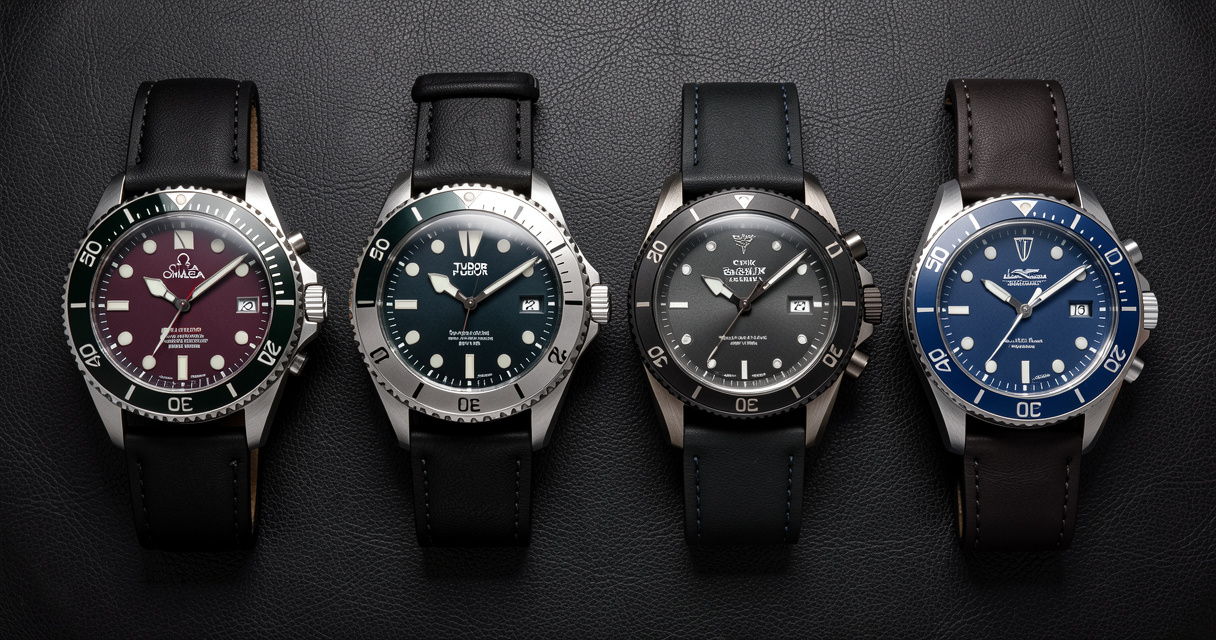
The best luxury dive watches in 2026 balance innovation with respect for tradition. We’ve selected six models that represent the pinnacle of craftsmanship, each with a distinct character. Whether you’re navigating the Côte d’Azur or exploring a reef in the Maldives, these watches are worth every mile.
Rolex Submariner – The Gold Standard
Worth every mile, the Submariner remains the benchmark. The 2025/2026 reference 126610LN offers a 41mm Oystersteel case, 300m water resistance, a Cerachrom ceramic bezel, and the calibre 3235 with 70-hour power reserve. It is ISO 6425 certified, though Rolex rarely highlights it. The Rolex Submariner is the answer to the question “What is the best luxury dive watch?” – but expect a waitlist. Key feature: the Glidelock clasp for easy adjustment over a wetsuit.
Omega Seamaster – Professional Heritage
This season’s answer to the Submariner is the Omega Seamaster Diver 300M ref. 210.32.42.20.01.001. Used by the British Royal Navy, it features a 42mm stainless steel case, 300m water resistance, a helium escape valve (HRV), and the Master Chronometer calibre 8800, resistant to 15,000 gauss magnetic fields. The ceramic bezel and wave-pattern dial give it a modern edge. For precision, it’s hard to beat.
Tudor Pelagos Ultra – The Professional’s New Choice
Quietly, this became the most talked-about release of 2025. The Tudor Pelagos Ultra pushes water resistance to 500m, has a titanium case and bracelet, a unidirectional ceramic bezel, and the MT5602-1U movement with 70-hour power reserve and COSC certification. Tudor says it is over-engineered for saturation diving. It won the “Sports Watch” prize at the Grand Prix d’Horlogerie de Genève in 2015, and the Ultra model improves on that legacy. If you actually dive with a luxury watch, this is the one.
Grand Seiko Spring Drive – Japanese Innovation
The Grand Seiko Spring Drive SLGA203 “Ushio” uses the calibre 9R05, offering five days of power reserve and the unique Spring Drive movement that blends mechanical and quartz accuracy. The watch has a 43mm titanium case, 200m water resistance, and a dial inspired by ocean waves. It is not ISO 6425 certified, but Grand Seiko’s own testing exceeds the standard. A different kind of luxury, one that values precision above heritage.
Longines HydroConquest – Value and Reliability
Often overlooked, the Longines HydroConquest delivers 300m water resistance, a ceramic bezel, and the L888 calibre (based on ETA A31.L11) with 72-hour power reserve, all at a price point under USD 2,500. It’s ISO 6425 compliant and widely used by recreational divers. For the budget-conscious enthusiast seeking a true luxury watch without the premium, this is a dark horse.
Doxa SUB – The Micro‑Brand Icon
Doxa, reborn in recent years, offers the Doxa SUB 300T in stainless steel with 300m water resistance and the signature orange dial that has been a diving icon since the 1960s. It’s a favourite among professional divers for its legibility and functional design. The price – under USD 2,000 – makes it a compelling alternative to the Swiss giants. Doxa’s watches are built for depth, not just display cases.
| Model | Water Resistance | Movement | Case Diameter | Price Range | Key Feature |
|---|---|---|---|---|---|
| Rolex Submariner 126610LN | 300m | Calibre 3235 (auto) | 41mm | USD 9,000–12,000 | Cerachrom bezel, Glidelock clasp |
| Omega Seamaster Diver 300M | 300m | Calibre 8800 (auto, Master Chronometer) | 42mm | USD 5,200–6,500 | Helium escape valve, anti-magnetic |
| Tudor Pelagos Ultra | 500m | MT5602-1U (auto, COSC) | 42mm | USD 4,500–5,200 | Titanium case, 500m depth |
| Grand Seiko SLGA203 | 200m | 9R05 Spring Drive (auto) | 43mm | USD 6,000–7,500 | 5-day power reserve, unique dial |
| Longines HydroConquest | 300m | L888 (auto) | 41/43mm | USD 1,800–2,500 | Ceramic bezel, great value |
| Doxa SUB 300T | 300m | Doxa calibre (auto, SW200) | 42mm | USD 1,500–2,000 | Orange dial, ISO 6425 |
The edit: each of these models earns its place either through engineering, heritage, or exceptional value. For a deep dive into their technical credentials, let’s turn to the standards that separate the serious from the superficial.
Key Features: ISO 6425, Water Resistance, and Movements
A luxury dive watch must meet ISO 6425 certification to be called a diver’s watch. Key requirements include:
- Water resistance to at least 100 metres (200m for saturation diving watches).
- A unidirectional rotating bezel that can be set without tools.
- Luminous markers and hands visible in darkness at a distance of 25 cm.
- A screw-down crown or other locking mechanism.
- A movement that withstands shocks (1m drop test) and magnetic fields (4,800 A/m).
- A running indicator (typically the seconds hand) that is visible.
- Resistance to thermal shock (water at 5°C to 40°C).
This is the standard that most top-tier ISO 6425 certification watches follow. Tip: Look for the word DIVER’S on the dial – it indicates ISO 6425 compliance.
ISO 6425 Explained: What It Means for Underwater Performance
ISO 6425 goes beyond a simple static pressure test. Each watch is individually tested for:
- Water resistance at 125% of rated depth (e.g., 250m for a 200m watch).
- Bezel accuracy: must not deviate more than ±0.5 seconds in a 60-minute test.
- Luminous intensity: brightness measured in millicandelas after 60 minutes in darkness.
- Crown and pusher durability under overpressure.
The difference between “water resistant 200m” and “ISO 6425 diver’s watch 200m” is the difference between a car that can go 100 mph and one that is race-track certified. If you rely on your watch underwater, certification matters.
Automatic vs. Spring Drive vs. Quartz: Which Is Best for Diving?
For diving, reliability is paramount. Automatic movements (like the Rolex 3235) are robust and power the watch via wrist motion, but can stop if not worn. Spring Drive (Grand Seiko) offers quartz-level accuracy with mechanical winding – ideal for long expeditions. High-frequency quartz (e.g., Breitling Aerospace) is ultra-reliable but lacks the prestige of mechanical. The discerning traveler knows that for actual diving, a watch with a COSC certification or equivalent chronometer rating ensures ±6 seconds per day accuracy, which is more than enough for bottom time tracking.
Pro Tip: When choosing a luxury dive watch with COSC certification, remember that certification is tested in static conditions. For saturation diving, a helium escape valve (HRV) is essential to prevent crystal pop-off during decompression. Models like the Omega Seamaster and Tudor Pelagos include it.
Now that you understand the technical side, the next question is how to match these features to your everyday life.
How to Choose a Luxury Dive Watch That Fits Your Lifestyle
Choosing a luxury dive watch for daily wear involves balancing aesthetics, comfort, and function. The slim luxury dive watch for small wrists segment is growing, with brands offering sub-40mm cases. Let’s break it down.
Intended Use: Desk Diver vs. Deep Diver
If you plan to actually dive beyond recreational depths (over 40m), prioritize water resistance over 300m and a helium escape valve. For daily wear and occasional pool swimming, a best luxury dive watch under $5000 like the Tudor Black Bay 58 (39mm, 200m) offers the look without the bulk. Many buyers ask: “Is a luxury dive watch worth it for non-divers?” The answer: yes, if you value build quality, resale value, and a timeless aesthetic that pairs with everything from a wetsuit to a tuxedo.
Wrist Size and Case Diameter: Finding Your Fit
A classic 40mm is universally flattering, but the trend in 2026 is towards integrated bracelets that wear smaller. The best microbrand luxury dive watch makers (Zelos, Halios) often produce mid-size cases (40–42mm) with short lug-to-lug. For small wrists, the Omega Seamaster 300 (41mm but thin) or the Tudor Black Bay 58 (39mm) are ideal. Always try the watch on before buying – weight distribution matters more than the number on the dial.
| Strap Type | Pros | Cons |
|---|---|---|
| Metal bracelet | Durability, luxury feel, easy adjustment (divers’ extension) | Heavy, can scratch, not ideal for cold water |
| Rubber strap | Comfort, water-friendly, lightweight | Wear over time, less formal |
| Fabric (NATO) | Lightweight, quick-drying, casual | Less secure for diving? fine with proper spring bars, can look less refined |
The edit: if you dive frequently, a rubber strap or metal bracelet with a divers’ extension is best. For everyday elegance, a well-fitted bracelet wins.
Now, let’s settle the debate: do professionals really wear these watches underwater?
Professional vs. Luxury: Do Real Divers Wear Luxury Watches?
The professional dive watch question is often answered with a “no” – most commercial divers use computers. But many still wear mechanical watches as backups and for psychological confidence. The Tudor Pelagos has been adopted by the French Navy, and the Omega Seamaster by the British Royal Navy. Real divers do wear luxury watches, but they choose them for specific reasons.
Open Water vs. Saturation Diving
Open water divers (recreational, down to 40m) can wear almost any ISO-rated watch. Saturation divers, who spend weeks in pressurized habitats, need a watch that can withstand repeated decompression cycles. That’s where a helium escape valve and a high depth rating (500m+) become critical. The Rolex Sea-Dweller and Tudor Pelagos Ultra are built for this. As one Reddit user attest, “I’ve got over 1,000 dives with my Pelagos – never once had a problem.”
Case Study: Paul Scurfield and the Diver One Titanium
Commercial saturation diver Paul Scurfield created the Diver One Titanium after existing “professional” dive watches failed his working conditions. He specified 500m water resistance, a helium release valve, and a sapphire crystal. This real-world case shows that even top-tier luxury watches sometimes fall short of actual commercial diving demands. Scurfield’s story (covered by Teddy Baldassarre in 2026) underscores the need for purpose-built engineering over marketing. The watch now retails around USD 3,000 – proof that luxury performance doesn’t have to cost five figures.
What do commercial divers wear? According to surveys on professional diving forums, the most common luxury watch worn by saturation divers is the Tudor Pelagos, followed by the Omega Seamaster. Many also use a cheap digital watch as a primary timer. The luxury watch is often a backup – but it must be capable.
With real-world feedback in mind, what does the future hold for these mechanical marvels?
The Future of Luxury Dive Watches: Materials and Trends
Dive watch trends 2026 point towards lighter materials, bolder colors, and thinner profiles. The era of the chunky 47mm diver is fading. Sales data from 2025 shows a 15% increase in demand for titanium-case models, driven by comfort and corrosion resistance.
Titanium and Ceramic: The Weight-Saving Revolution
Grade 5 titanium (Ti-6Al-4V) is stronger than stainless steel yet 45% lighter. It also resists saltwater corrosion better. Tudor’s Pelagos and Grand Seiko’s Spring Drive models use it. Meanwhile, ceramic bezel inserts are now scratch-proof, replacing older aluminum inserts. A ceramic bezel will look new after a decade of use, while an aluminum one will show wear.
Definition: Grade 5 titanium is an alloy of titanium with 6% aluminum and 4% vanadium. It offers high tensile strength and excellent biocompatibility, making it ideal for watches that need to be both light and tough. Standard titanium (Grade 2) is pure and too soft for cases.
Bold Colors and Dial Textures
2026 sees a revival of bright dials – Doxa’s orange, Grand Seiko’s “Ushio” wave pattern, and Tudor’s metallic blue. These are not just fashion statements; high-contrast dials improve legibility underwater. The trend is toward watches that are both functional and expressive, proving that luxury diving timepiece design is far from conservative.
Now, let’s address the questions that keep coming up in search – the ones that often determine a purchase.
Frequently Asked Questions About Luxury Dive Watches
What is the best luxury dive watch in 2026?
There is no single “best”; top performers include Rolex Submariner, Omega Seamaster, and Tudor Pelagos Ultra. The right choice depends on budget, style, and intended use. For professional diving, Tudor Pelagos Ultra leads.
Are luxury dive watches worth the high price?
Yes, if you value precision, durability, and resale value. Luxury dive watches feature COSC-certified movements, robust materials, and ISO certification. Many retain value over time.
What is the difference between ISO 6425 and water resistance rating?
Water resistance (e.g., 200m) is a static pressure test; ISO 6425 is an active standard that includes additional tests like bezel accuracy, luminous intensity, and resistance to magnetic fields. A watch with ISO 6425 is certified as a diver’s watch.
Do I need a luxury dive watch if I only swim and snorkel?
No, but many people wear them as everyday accessories because of their style and build quality. A water resistance of 200m is overkill for recreational swimming but provides peace of mind.
How often should I service a luxury dive watch?
Manufacturers recommend every 5–10 years. If you actually dive with it, having the seals checked annually is wise. Regular maintenance keeps the water resistance intact.
Can a luxury dive watch be used for saturation diving?
Only if it has a helium escape valve (HRV). Models like the Rolex Sea-Dweller, Omega Seamaster Planet Ocean, and Tudor Pelagos are designed for saturation diving. Always verify the depth rating and HRV presence.
Which luxury dive watch is best for small wrists?
Look for case diameters under 40mm and thickness under 13mm. The Tudor Black Bay 58 (39mm) and Omega Seamaster 300 (41mm but wears smaller) are excellent options.
These answers reflect the concerns we hear from readers daily. Now, let’s wrap up with a clear takeaway.
A true luxury diving timepiece must meet ISO 6425 or provide equivalent reliability; 200m water resistance is the minimum. Top contenders in 2026 include Rolex Submariner, Omega Seamaster, Tudor Pelagos Ultra, and Grand Seiko Spring Dive. Consider your use case — actual diving vs. daily wear — to determine the right features (size, strap, movement). Investing in a recognized brand often means better resale value, but micro-brands offer affordable performance. Whether you’re a seasoned diver or a collector, the perfect luxury dive watch is the one that feels right on your wrist and inspires confidence underwater. Which model will you choose?