


Reading time: 20 min
Table of Contents
- Key takeaways
- Why Leather Strap Watches Still Win in 2026
- The case for a swappable strap
- Where leather sits between steel bracelets and rubber
- Leather Grades Explained: Full-Grain, Calfskin, Cordovan and Alligator
- Bonded, corrected-grain and genuine leather: what you actually get
- Full-grain and calfskin: the daily-wear workhorses
- Shell cordovan and alligator: the formal tier
- Plant-based and apple-skin alternatives
- Movements That Suit a Leather Strap: Quartz, Automatic and Hand-Wound
- Quartz: thin, accurate, affordable
- Automatic: weight, presence and service cost
- Hand-wound: the slimmest formal option
- The Best Watches With a Leather Strap in 2026, by Budget
- Under $250: everyday value picks
- $250 to $1,000: the sweet spot
- $1,000 to $5,000: entry Swiss and independent
- Above $5,000: high horology and pre-owned access
- How to Match a Leather Strap to Your Outfit and Occasion
- Black leather: evening and formal
- Brown and tan leather: business and weekend
- Stitching, taper and texture as formality signals
- How to Choose a Watch With a Leather Strap: Fit, Lug Width and Clasp
- Step 1: Measure your wrist and lug width
- Step 2: Match case diameter to wrist size
- Step 3: Choose buckle, deployant or quick-release
- Step 4: Confirm water resistance and warranty
- Leather Strap Care: Making a Strap Last Three Years or More
- Daily care in under 30 seconds
- Conditioning by leather grade
- When to replace the strap instead of the watch
- New, Pre-Owned or Vegan Leather: What to Buy in 2026
- New versus pre-owned: value and risk
- What plant-based leather still cannot do
- The Edit: How to Buy a Watch on a Leather Strap in 2026
- Frequently Asked Questions
Key takeaways
- Leather grade beats brand name. A $180 full-grain strap on a $400 watch will outlive a $90 bonded strap on a $3,000 case, and it will look better doing it.
- Lug width is the only measurement that matters first. 18 mm, 20 mm and 22 mm cover the overwhelming majority of watches with a leather strap, and a strap bought in the wrong width cannot be made to fit.
- Clasp type changes your cost of ownership. A deployant clasp removes the repeated bending at the buckle that kills straps earliest, and quick-release spring bars turn a swap into a ten-second decision.
- Leather is not waterproof, whatever the case rating says. Sweat, showers and swimming degrade leather faster than anything else you will do to a watch, and the case rating does not protect the strap.
Which part of a watch do you touch more than any other? Not the dial. Not the crown. The strap — the piece that meets your skin every morning, absorbs your summer, and carries the evidence of how you actually live. And yet most pages about watches with a leather strap treat it as packaging for the case: an unedited product listing with a photograph and a price.
This guide starts at the other end. We begin with the leather strap itself — the grade, the tannage, the lug width, the clasp — and work outward to the case, the movement and the budget. Because a leather grade you cannot name is a leather grade you cannot evaluate, and a strap bought in the wrong width is money already lost.
By the end you will know what full-grain actually means, why 20 mm is the most common lug width in the world, how much a strap costs you per year of wear, and which watches at four price tiers are worth shortlisting in September 2026. The discerning buyer reads the spec sheet in a specific order. Here is that order.
Why Leather Strap Watches Still Win in 2026
Walk into any watch salon in Zurich, Milan or Tokyo this September and the proportion is unchanged. The majority of dress and smart-casual references on display are fitted with leather — not because steel has fallen out of favour, but because leather is the one component of a watch that can be revised in ninety seconds with a spring bar tool. That single fact quietly governs how people actually buy.
Timex, which states more than 165 years of watchmaking heritage and positions itself as a leading brand for men’s leather watches, builds its catalogue around exactly this logic: quartz, automatic and hand-wound movements, fitted with black, brown, croco-pattern, distressed and apple-skin leather straps. That spread is the market in miniature.
Now look at the other end of the same shelf. Pre-owned listings at The 1916 Company carry IWC, Jaeger-LeCoultre, Vacheron Constantin and Patek Philippe on alligator, authenticated and warranty-backed. Cartier and Daniel Wellington sit at opposite poles of the same idea — one a jeweller’s case architecture, the other a thin quartz profile that made a generation of buyers comfortable with a strap-first watch. All of them are answering the same question: which leather, which clasp, which wrist.
The case for a swappable strap
A steel bracelet is a commitment. It is sized to your wrist, finished to the case, and expensive to alter. A leather strap is a decision you can reverse. That is why leather survived quartz, survived the smartwatch, and survived the entire rubber renaissance.
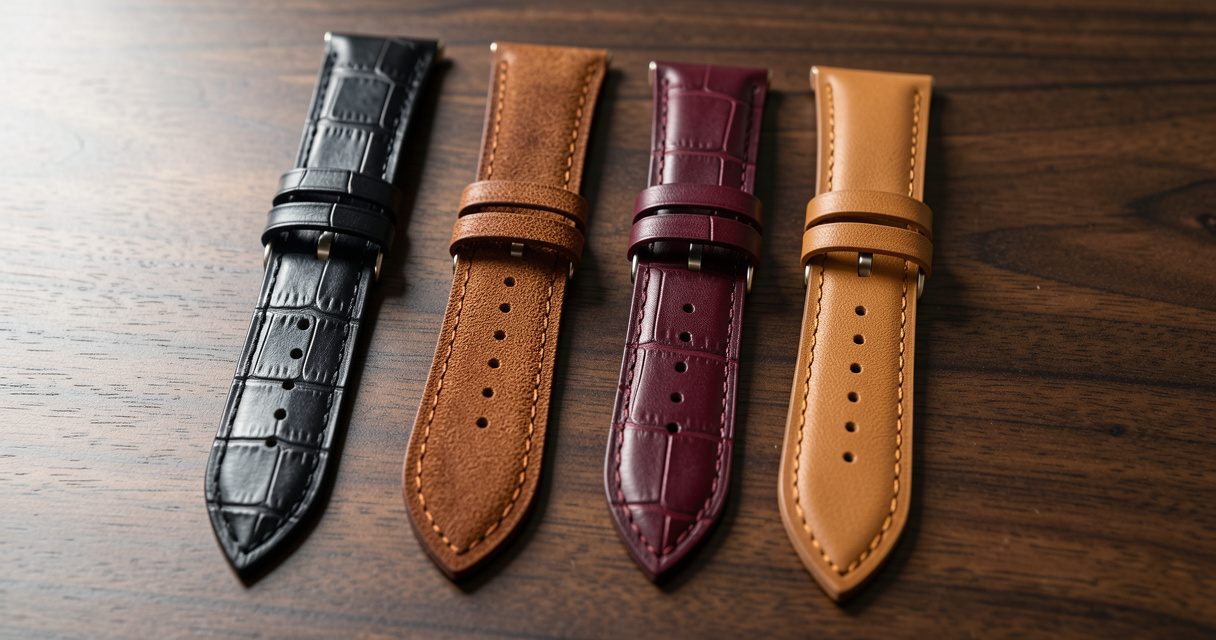
Rotate two straps and one watch becomes three. Black alligator for the evening, dark brown calfskin for the office, tan full-grain with contrast stitching for the weekend. Add quick-release spring bars and none of those changes requires a tool, a jeweller or a conversation.
There is a financial argument underneath the stylistic one. Replacing a strap costs a fraction of servicing a bracelet or replacing a watch outright. We will quantify that later in a cost-per-year table, but the principle holds from day one of ownership.
Where leather sits between steel bracelets and rubber
Think of the three materials as a formality axis rather than a quality ranking. Rubber and integrated sport straps sit at the casual end. Steel is the generalist — correct almost everywhere, memorable almost nowhere. Leather occupies the dress and smart-casual register.
A 38 mm dress watch on black alligator reads as evening. The same case on a distressed brown strap reads as Sunday morning with coffee. Nothing else about the watch changed. That is the leverage a strap gives you: one case, many registers.
The trade-off is exposure. Leather is the only one of the three that actively dislikes water, and it is the only one that visibly records how you have worn it. That does not make it fragile. It makes it specific.
Definition: a leather strap watch is any watch fitted with a strap cut from animal or plant-based hide, held by spring bars through the lugs. The three constructions you will encounter are the stitched strap (two layers sewn at the edges, the most common), the padded strap (a raised centre section, deliberately dressier), and the quick-release strap (a built-in sliding lever on the spring bar, removable by hand). Quick-release is a construction detail, not a leather grade — any hide can be built that way.
Before you can compare a Timex to a Patek, though, you need the vocabulary of the material itself. That is the part almost every competitor leaves out, and it is where the real money sits.
Leather Grades Explained: Full-Grain, Calfskin, Cordovan and Alligator
Leather grade determines three things no photograph can show you: how the strap feels on day one, how it looks on day nine hundred, and what it costs to replace. There are five tiers worth knowing, and the price gap between the bottom and the top is wider than the gap between an entry watch and a luxury one.
Bonded, corrected-grain and genuine leather: what you actually get
Bonded leather is not a hide at all in the structural sense. Leather fibres and offcuts are shredded, mixed with a binder, and glued to a fabric or paper core. It is uniform, cheap, and it fails predictably: the surface splits at the fold, the edges fray, and by month eight the strap is shedding. If a listing says “100% leather” without further qualification at a very low price, bonded is the likely reality.
Corrected-grain leather starts as a real hide, but the top surface is sanded away and replaced with an embossed pattern — usually a crocodile or alligator print. It feels identical across every square centimetre, which is precisely the tell. Natural hide varies in pore size and density. Corrected grain does not, because the variation has been removed by machine. It resists patina almost entirely, which some buyers want and most eventually regret.
And the phrase buyers most often misread: genuine leather. It is a legal descriptor, not a quality grade. It asserts only that the material contains real leather. A bonded strap can carry the term. So can a corrected-grain strap. Treat “genuine leather watch strap” as the beginning of a question, never as the answer.
Full-grain and calfskin: the daily-wear workhorses
Full-grain leather keeps the entire top surface of the hide intact — pores, grain, small scars and all. Nothing has been sanded, filled or printed. That intact fibre structure is why it behaves so well against skin: it breathes, it flexes, and it develops a genuine patina rather than a uniform sheen.
The tactile signature is easy to learn. Run a thumb across full-grain and you feel slight irregularity — a grain pattern that changes as your finger moves. Corrected grain feels identical in every direction. Once you have felt the difference twice, you will never be fooled by a product photograph again.
Calfskin is the same idea applied to a younger, finer hide. The grain is smaller and tighter, the hand is softer from the first wear, and it takes a polish beautifully — which is why polished calfskin, not alligator, is the traditional choice for a slim black-tie watch. It scuffs more visibly than full-grain, but the scuff burns off with a thirty-second buff.
Both belong in the daily-wear category. Neither enjoys sweat. Both will give you two to three years of regular wear if you rotate and condition them, and far less if you do not.
Shell cordovan and alligator: the formal tier
Shell cordovan is not a hide in the conventional sense. It is the dense connective membrane from the rump of a horse, vegetable-tanned over months and finished by hand. It does not crease. It rolls — broad, soft waves instead of hard folds — and its surface takes a near-mirror gloss that resists water spotting better than any other leather on this list. It is also the strap most likely to outlive the watch it was bought for.
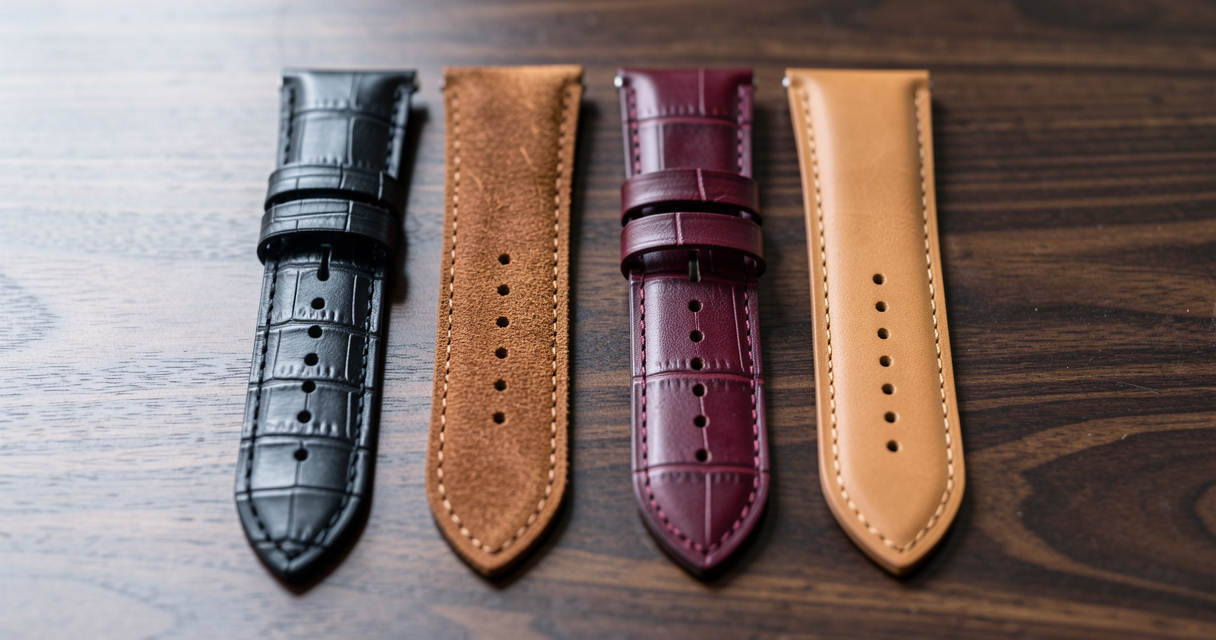
Alligator is the formal register in physical form. Belly scales are arranged in those unmistakable rectangular tiles, and the leather is usually split thin, which is why alligator suits a slim case far better than a thick one. Expect a stiff first fortnight — alligator needs to be worn into submission — followed by years of controlled, architectural elegance.
Is alligator worth it? On a watch that lives in a safe and appears three times a year, no. On a dress watch worn to dinners and ceremonies, yes — because nothing else communicates formality as quickly, and because a fitted alligator strap is the single cheapest way to raise the perceived value of a modest case.
Plant-based and apple-skin alternatives
Timex is the one major brand in the leather-watch conversation that names an apple-skin strap outright, and the category has moved quickly. Apple-skin, cactus, grape and mycelium leathers are now genuinely wearable rather than merely defensible. They hold colour well, take a clean edge, and appeal to buyers whose objection is ethical rather than financial.
What they still cannot do: patina. A plant-based strap at eighteen months looks approximately like it looked at eighteen days, only softer. It also creases and wears at the edges faster than full-grain or shell cordovan under heavy daily use. For a weekend watch or a colour-matched summer strap, that trade is entirely reasonable. For a strap you intend to hand down, it is not.
| Leather type | Feel and break-in | Aging and patina | Best use case | Relative cost band |
|---|---|---|---|---|
| Bonded | Uniform, slightly plastic | None; cracks and peels | Short-term or disposable wear | $ |
| Corrected grain | Stiff, identical across surface | Minimal; sheen dulls | Budget everyday, wet climates | $$ |
| Full-grain | Firm, softens in 2-3 weeks | Strong, darkens at flex points | Daily wear, casual to business | $$$ |
| Calfskin | Soft from day one | Moderate, takes polish | Business, formal, slim cases | $$$ |
| Shell cordovan | Dense, rolls rather than creases | Exceptional, near-mirror gloss | Heirloom wear, all occasions | $$$$ |
| Alligator | Rigid first two weeks | Controlled, architectural | Evening, black-tie, ceremonies | $$$$$ |
| Apple-skin / plant-based | Soft, consistent | Colour stable, little patina | Casual, vegan, colour-led design | $$ |
How to spot a bonded strap dressed up as genuine. Three checks. First, look at the edge: a bonded strap shows a fabric or paper core sandwiched between two thin leather-looking layers, while a full-grain strap shows solid fibre all the way through. Second, look at the lining: an unlined or fabric-lined strap at a luxury price is a warning. Third, check for repetition — if the grain pattern repeats across the strap, it was printed, not grown.
Once you can grade leather by touch, the next variable is what sits behind it. Movement type dictates case thickness, service cost and, ultimately, how a tapered strap drapes on the wrist.
Movements That Suit a Leather Strap: Quartz, Automatic and Hand-Wound
Movement choice is not an abstract preference. It changes case height, weight distribution, service intervals and price — and all four of those things determine whether a watch on a leather strap feels right after eight hours on the wrist.
Quartz: thin, accurate, affordable
A quartz leather strap watch is the natural dress-watch formula. With no rotor and no mainspring, the case can be built remarkably thin — 6 to 8 mm is entirely normal — and a thin case is what allows a leather strap to sit flat and elegant rather than perched on a wedge.
Movado, for instance, lists quartz leather strap watches in its Heritage line at $850.00, including the Heritage Calendoplan on a brown leather strap with a blue dial and the Heritage Kingmatic at 35 mm. That is a useful benchmark: quartz at this level is a deliberate design decision about slimness and price, not a compromise.
Automatic: weight, presence and service cost
An automatic leather strap watch adds roughly 1.5 to 3 mm of case height and a small, pleasant weight that sits low on the wrist. That extra mass matters: it makes a casual leather strap look intentional, and it makes a very slim alligator strap look under-supported.
The cost is maintenance. A mechanical movement wants a service every five to eight years, and that service will typically cost more than every strap you will ever fit to the watch, combined. Budget for it before you buy, not after.
Hand-wound: the slimmest formal option
Hand-wound movements strip the rotor out and return to the thinnest possible mechanical case. Timex builds hand-wound references in its leather catalogue precisely for this reason. For a formal watch under 39 mm on black alligator or polished calfskin, hand-wound remains the connoisseur’s answer — you trade convenience for a profile nothing else can match.
| Movement type | Typical case thickness | Service interval | Price impact | Best pairing with leather |
|---|---|---|---|---|
| Quartz | 6-8 mm | Battery every 2-4 years | Lowest entry point | Slim dress cases, alligator or polished calfskin |
| Hand-wound | 7-9 mm | 5-8 years | Moderate | Formal, under 39 mm, black leather |
| Automatic | 10-13 mm | 5-8 years | Moderate to high | Casual and business, full-grain or calfskin |
| Automatic with date and complications | 12-14 mm | 5-8 years | High | Everyday leather, padded construction |
With the material and the mechanism settled, the only remaining variable is money — and this is where the tiers separate sharply.
The Best Watches With a Leather Strap in 2026, by Budget
What follows is not a list of everything available. It is a shortlist built on four criteria: a leather strap fitted as original equipment, a lug width you can actually buy replacements for, a movement appropriate to the price, and a case diameter that suits a real wrist rather than a display stand.
Under $250: everyday value picks
At this level, buy the strap and the case geometry, not the badge.
- Timex Marlin Automatic, 40 mm. Automatic, 20 mm lug width, leather strap, 50 m water resistance, roughly $250-270. The reference for anyone who wants a mechanical movement on leather without spending four figures.
- Timex Easy Reader, 35 mm. Quartz, 18 mm lug width, leather strap, 30 m. Around $50. The best small-wrist entry point on the market.
- Daniel Wellington Classic Sheffield, 40 mm. Quartz, 20 mm lug width, black leather, 30 m. Roughly $199-229. Thin case, clean dial, enormous strap availability.
- Orient Bambino 38. Automatic, 20 mm lug width, leather strap, 30 m. Around $200-250. A genuinely classical dial at a price that leaves budget for a second strap.
Buyers searching for watches with a leather strap under 500 will find almost everything they need inside this tier and the next. The mistake at this level is spending the entire budget on the case and accepting a bonded strap. Reserve $60 for a full-grain replacement before you order.
$250 to $1,000: the sweet spot
This is where movements get serious and leather gets honest. Almost every reference here ships with a genuine calfskin or full-grain strap rather than a printed substitute.
- Hamilton Jazzmaster Auto, 40 mm. Automatic, 20 mm lug width, leather strap, 50 m. Roughly $745-945. The archetype of the business leather watch.
- Seiko Presage Cocktail Time, 40.5 mm. Automatic, 20 mm lug width, leather strap, 50 m. Around $425. Best dial finishing per dollar in the tier.
- Movado Heritage Calendoplan. Quartz, brown leather strap, blue dial. Listed at $850.00. Slim, architectural, and a reminder that quartz can be a design language.
- Movado Heritage Kingmatic, 35 mm. Quartz, leather strap, around $850. One of the better sub-36 mm leather options for smaller wrists.
- Hamilton Jazzmaster Skeleton Lady Auto. Automatic, fitted with a reversible two-tone pink and purple leather strap against a purple cut-out dial. The clearest proof that colour-matched leather is now a design feature rather than an afterthought — and one of the few leather strap watches for women that is not simply a smaller men’s model.
$1,000 to $5,000: entry Swiss and independent
Here the straps become the specification. Expect hand-finished edges, tapered profiles and clasps that cost more than an entire entry-level watch.
- Longines Master Collection, 38.5 mm. Automatic, 20 mm lug width, alligator or calfskin strap, 30 m. Roughly $2,200-2,900. The safest first Swiss leather watch.
- Longines Heritage Classic, 38.5 mm. Automatic, slim lug profile, leather strap, 30 m. Around $2,000-2,600. Sector dials, restrained sizing, excellent strap proportions.
- Nomos Tangente, 38 mm. Hand-wound or automatic, 19 mm lug width, shell cordovan or calfskin, 30 m. Roughly $2,200-3,000. The purest expression of the thin-case, thin-strap formula.
- Oris Big Crown Pointer Date, 40 mm. Automatic, 20 mm lug width, leather strap, 50 m. Around $1,900-2,400. Casual leather done properly.
- Cartier Tank Must, large. Quartz, slim rectangular case, narrow leather strap, 30 m. Around $3,200-3,600. A formality statement that no round case replicates.
Above $5,000: high horology and pre-owned access
At this altitude you are not buying leather. You are buying a case architecture and a movement, with leather as the correct historical accompaniment.
- Jaeger-LeCoultre Reverso Classic. Hand-wound, rectangular reversible case, alligator strap, 30 m. From roughly $7,500. The most distinctive leather watch in production.
- Patek Philippe Calatrava, reference 6119. Hand-wound, 39 mm, alligator strap, 30 m. From roughly $30,000. The benchmark dress watch.
- Vacheron Constantin Patrimony. Hand-wound or automatic, ultra-slim case, alligator strap. From roughly $25,000.
- Pre-owned IWC, Jaeger-LeCoultre, Vacheron Constantin and Patek Philippe via The 1916 Company. Offered with expert authentication and a 2-year warranty. This is where most first-time buyers of high horology should actually start.
| Watch | Movement | Case size | Lug width | Leather type | Clasp | Water resistance | Price band |
|---|---|---|---|---|---|---|---|
| Timex Easy Reader | Quartz | 35 mm | 18 mm | Genuine leather | Pin buckle | 30 m | Under $100 |
| Timex Marlin Automatic | Automatic | 40 mm | 20 mm | Full-grain | Pin buckle | 50 m | $250-270 |
| Daniel Wellington Classic Sheffield | Quartz | 40 mm | 20 mm | Genuine leather | Pin buckle | 30 m | $199-229 |
| Seiko Presage Cocktail Time | Automatic | 40.5 mm | 20 mm | Calfskin | Pin buckle | 50 m | $400-450 |
| Hamilton Jazzmaster Auto | Automatic | 40 mm | 20 mm | Calfskin | Pin buckle | 50 m | $745-945 |
| Movado Heritage Kingmatic | Quartz | 35 mm | 18 mm | Calfskin | Pin buckle | 30 m | Around $850 |
| Longines Master Collection | Automatic | 38.5 mm | 20 mm | Alligator | Deployant | 30 m | $2,200-2,900 |
| Nomos Tangente | Hand-wound | 38 mm | 19 mm | Shell cordovan | Pin buckle | 30 m | $2,200-3,000 |
| Jaeger-LeCoultre Reverso Classic | Hand-wound | Rectangular | 18-20 mm | Alligator | Pin buckle | 30 m | From $7,500 |
- Verify the lug width in millimetres before ordering — measure between the lugs, not the case.
- Confirm quick-release compatibility if you intend to rotate straps yourself.
- Check the strap taper — a strap that narrows from 20 mm to 16 mm reads dressier than a straight 20 mm.
- Read the warranty terms on the strap itself, which is frequently excluded from case and movement coverage.
- Price a replacement strap before you buy the watch so the second purchase is never a surprise.
Shortlists only solve half the problem. The other half is matching the strap you choose to what you actually wear — and that is a question of colour, texture and formality signalling.
How to Match a Leather Strap to Your Outfit and Occasion
The brown versus black question is the one readers ask most, and the answer is narrower than most guides admit. Black leather is evening and formal. Dark brown is business and tailoring. Tan and honey are smart casual. Distressed is weekend. That is the whole map, and everything else is texture.
Black leather: evening and formal
Black alligator or polished black calfskin on a slim case under 40 mm is the traditional evening pairing, and it remains correct with a dinner jacket, a black suit or a dark navy one. If you own one leather strap for formal occasions, make it black and make it alligator or calfskin — never corrected grain, whose uniform surface reads as synthetic under evening light.
Brown and tan leather: business and weekend
Dark brown — mahogany, espresso, oxblood — is the most versatile leather colour in existence and pairs with navy, charcoal and most tailoring. Can you wear brown leather with black shoes? The old rule says no; the modern answer is that a brown strap with black shoes is acceptable when the brown is dark enough to read as near-black and the belt matches the shoes rather than the watch. Tan and honey belong to linen, denim and unstructured jackets.
Stitching, taper and texture as formality signals
Three details do more work than colour. Contrast stitching pushes a strap casual — white thread on tan leather is a weekend signal. Tonal stitching keeps it formal. Taper matters just as much: a strap narrowing from 20 mm at the lugs to 16 mm at the buckle reads far dressier than a straight profile, because it visually slims the case.
Colour matching is also now an explicit design decision rather than an accessory choice. Hamilton describes the Jazzmaster Skeleton Lady Auto as fitted with a reversible two-tone pink and purple leather strap matched to a purple cut-out dial — the strap is the design, not the finishing touch. Expect more of this, not less.
| Occasion | Recommended leather colour | Recommended leather grade | Case metal pairing |
|---|---|---|---|
| Black-tie and evening | Black | Alligator or polished calfskin | Yellow or white gold, platinum |
| Business and tailoring | Dark brown, oxblood | Calfskin or full-grain | Steel, rose gold |
| Smart casual | Tan, honey, cognac | Full-grain | Steel, bronze |
| Weekend and travel | Distressed brown, olive | Full-grain or plant-based | Steel, titanium |
| Ceremony and celebration | Burgundy, deep green | Shell cordovan | Rose gold, steel |
Colour settles the styling question. Fit settles whether you will actually wear the watch — and fit is almost entirely a matter of three measurements.
How to Choose a Watch With a Leather Strap: Fit, Lug Width and Clasp
Choose a watch with a leather strap by matching the strap width to your watch’s lug width, usually 18 mm, 20 mm or 22 mm, then confirming the case diameter suits your wrist. Pick leather by use: full-grain or calfskin for daily wear, alligator for formal occasions. Check clasp type and water resistance before buying.
Step 1: Measure your wrist and lug width
Wrap a soft tape measure snugly around your wrist bone and note the figure in centimetres. Then measure the gap between the two lugs — the horns that hold the spring bars — in millimetres. The three numbers that cover the overwhelming majority of watches are 18 mm, 20 mm and 22 mm. A 20 mm lug width is the modern default; 18 mm appears on smaller and vintage-inspired cases; 22 mm sits on larger sport and field watches.
Strap length is a separate decision from lug width, and it follows wrist circumference rather than case size. A 15 cm wrist and a 21 cm wrist can share the same 20 mm case and require entirely different strap lengths. Order the length first, the width second.
Step 2: Match case diameter to wrist size
Case diameter is the headline number; lug-to-lug is the number that actually decides comfort. A 40 mm case with a 44 mm lug-to-lug sits comfortably on wrists from 16 cm upward. A 40 mm case with a 50 mm lug-to-lug will overhang a 16 cm wrist no matter what the diameter suggests.
For a 15 to 17 cm wrist, look for 34 to 39 mm cases with lug-to-lug under 46 mm. For 17 to 19 cm, 38 to 42 mm is comfortable. Above 19 cm, almost nothing is off the table — but the strap taper should be reduced so the watch does not visually float.
Step 3: Choose buckle, deployant or quick-release
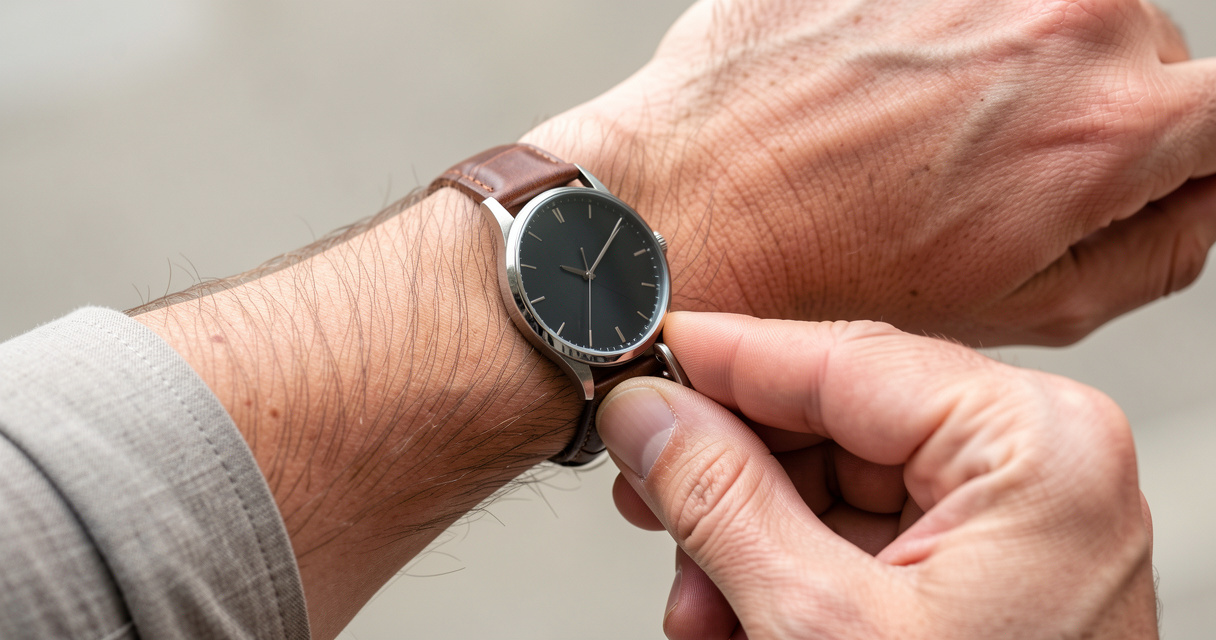
The pin buckle is the classic, the cheapest, and the hardest on leather: every fastening bends the strap at the same point, and that fold is where straps fail first. The deployant clasp folds the strap onto itself rather than creasing it, distributing the stress across a longer section. In practice it extends strap life substantially and is the single best upgrade you can make to any leather watch. The quick-release spring bar is a separate feature and answers a separate question: can you swap the strap without a tool?
Step 4: Confirm water resistance and warranty
Water resistance is rated in ATM and applies to the case, never to the strap. 3 ATM covers rain and hand-washing splash. 5 ATM is rated for showering — which does not mean you should shower in leather. 10 ATM is rated for swimming. 20 ATM and above is dive territory.
Then read the warranty. Straps are frequently excluded from coverage even when the movement is guaranteed for two or five years. Knowing that before purchase is the difference between a considered buy and a complaint.
Are leather strap watches waterproof? No. Even a watch rated to 10 ATM has a leather strap that will absorb water, swell, stiffen and discolour the moment it is submerged. A dive-rated case protects the movement, not the leather. If the plan involves swimming or showering, fit a rubber or steel strap and leave the leather at home. Sweat is the subtler enemy here — it is acidic, it is constant, and it attacks the lining of the strap before it ever touches the outer surface.
Five-point fit checklist:
- Lug width measured in millimetres and written down, not estimated.
- Lug-to-lug length checked against wrist circumference, not case diameter.
- Strap length ordered for your wrist, with the buckle hole landing mid-pattern.
- Clasp type chosen deliberately — buckle, deployant or quick-release.
- Water resistance understood, and the leather accepted as dry-wear only.
Get the fit right and the strap becomes invisible in the best sense. Keep it that way, and it will last considerably longer than the three-year mark most owners assume is the ceiling.
Leather Strap Care: Making a Strap Last Three Years or More
Nobody in the top-ranking results tells you this, and it is the cheapest money you will ever save on a watch. A leather strap does not die of age. It dies of moisture, friction and neglect — three things you control.
Daily care in under 30 seconds
Wipe the strap with a dry, lint-free cloth when you take the watch off. That is it. Oils, sweat salts and dust come off at the surface before they migrate into the lining, and the lining is where deterioration always begins. Then let the strap dry fully, flat or on a stand, away from radiators, hairdryers and direct sunlight — heat does more damage in an hour than moisture does in a week.
Conditioning by leather grade
Conditioning frequency should follow the leather, not the calendar. Full-grain and shell cordovan benefit from a small amount of neutral conditioner every three to four months — a pea-sized quantity, worked in with a fingertip, excess wiped away. Calfskin wants less, roughly twice a year, because it is more absorbent and over-conditioning softens the structure. Corrected grain and bonded leather should be left alone entirely; conditioner sits on the printed surface and accelerates edge lifting.
For odour — the question nobody answers honestly — the cause is trapped moisture and bacteria in the lining, not the leather itself. Rotating between two straps so each dries completely between wears is the single most effective fix. A sparing application of a leather-safe antibacterial wipe to the lining once a month handles the rest. Never soak a strap. Never put one in a washing machine.
When to replace the strap instead of the watch
Replace when the lining cracks at the flex point, when the edge finish lifts along more than a third of the strap, or when the buckle hole closest to your fit has stretched enough to slip. Repair — restitching, edge re-sealing — is worth it on shell cordovan and alligator, rarely worth it below $100 of leather.
This is the anecdote I keep coming back to, and it is the reason I rotate straps instead of replacing watches. Two years ago I fitted a pale tan full-grain strap to an everyday automatic. On day one it was almost orange, stiff enough to hold its own shape, and faintly waxy to the touch. Within six weeks it had softened and darkened at the two flex points. By the second summer it had gone a deep tobacco brown, glossy where my wrist rubs it, matte at the tail, and it had taken the shape of my wrist so completely that the watch needed no adjustment to sit correctly. Nothing about that evolution can be bought. It can only be earned — and it is the entire argument for full-grain over corrected grain, in one object.
| Leather type | Typical lifespan (daily wear, no rotation) | Replacement cost band | Cost per year | Notes |
|---|---|---|---|---|
| Bonded | 6-12 months | $20-40 | $30-60 | Cheapest per purchase, expensive per year |
| Corrected grain | 12-18 months | $30-70 | $25-55 | Resists water, shows no patina |
| Full-grain | 2-3 years | $60-180 | $25-70 | Best value overall with rotation |
| Calfskin | 2-3 years | $70-200 | $30-80 | Scuffs, but polishes out |
| Shell cordovan | 3-5 years | $150-400 | $40-110 | Rolls rather than creases |
| Alligator | 3-4 years | $400-1,200 | $120-350 | Formal use only, extends life dramatically |
Two modifiers change these figures materially. Adding a deployant clasp costs $100-400 upfront and can extend strap life by a third or more, because the leather no longer bends at a single repeated point. Adding quick-release spring bars costs almost nothing and removes the tool friction that stops people rotating straps in the first place — and rotation is the single biggest lifespan multiplier available.
Care extends the life of what you own. The final question is whether you should own it new, pre-owned, or in a plant-based alternative.
New, Pre-Owned or Vegan Leather: What to Buy in 2026
New versus pre-owned: value and risk
Pre-owned leather strap watches from IWC, Jaeger-LeCoultre, Vacheron Constantin and Patek Philippe are offered with expert authentication and a 2-year warranty, which matters far more than the strap itself. The strap is the one component you will replace regardless; the case, dial and movement are what you are actually buying, and those are what authentication protects.
One caution: a strap swap can affect resale. If you buy pre-owned and fit a third-party strap, keep the original — particularly on Cartier, Jaeger-LeCoultre and Patek Philippe, where an original buckle and signed strap are expected at resale. A correct original strap can be worth several hundred dollars in a future transaction, and a mismatched one raises a question you would rather not answer.
What plant-based leather still cannot do
Apple-skin and other plant-based straps are durable enough for daily wear in the casual register, and they suit anyone who objects to animal leather on principle. What they cannot do is age. There is no patina, no darkening, no moulding to the wrist over years. Under heavy daily use they crease and edge-wear faster than full-grain or shell cordovan. Buy them for colour, ethics and weekend wear; do not buy them expecting a strap to inherit.
Before buying pre-owned on a leather strap: confirm the case and movement serial numbers match the documentation, ask whether the original strap and buckle are included, verify what the warranty actually covers and for how long, and request a photograph of the lug area to check for previous strap-rub damage. Lug scratches are cosmetic; bent or worn spring bar holes are not.
That closes the loop on the buying decision. What remains is the part most owners only appreciate a year in.
The Edit: How to Buy a Watch on a Leather Strap in 2026
Here is what a decade of covering this category has taught, compressed into four points.
- Leather grade drives comfort, aging and replacement cost more than brand name does. Full-grain for daily wear, calfskin for business, shell cordovan if you want one strap for a decade, alligator for the evenings you remember.
- Lug width, case diameter and clasp type determine whether the watch fits well enough to wear daily. 18 mm, 20 mm and 22 mm cover most cases; lug-to-lug decides comfort; a deployant clasp decides how long the leather survives.
- Budget tiers from entry quartz to pre-owned Swiss each offer a legitimate path into leather strap ownership. A $250 Timex Marlin and a pre-owned Reverso are answering different questions, and both answers can be correct.
- Care and rotation are the cheapest ways to extend the life of a watch you already own. Thirty seconds a day, two straps instead of one, and a dry place to rest.
Book nothing yet. Measure your wrist, note your lug width, and decide which leather you actually want against your skin. Then ask yourself the only question that survives the first scratch: which strap would you still be happy to wear two years from now, once the shine has gone and all that is left is patina?
Frequently Asked Questions
Are leather strap watches waterproof?
No. Water resistance ratings apply to the case, not the strap, so even a 10 ATM watch has leather that will swell, stiffen and discolour once submerged. Remove the watch before swimming or showering and fit a rubber or steel strap for water activity.
How long does a leather watch strap last?
Bonded and corrected-grain straps can fail within a year of daily wear. Full-grain, calfskin and shell cordovan typically last two to four years with conditioning and rotation between two straps. A deployant clasp and a dry resting place extend that further.
What size leather watch strap do I need?
Measure the distance between the lugs in millimetres. 18 mm, 20 mm and 22 mm cover most watches, with 20 mm the modern default. Choose strap length from your wrist circumference, not from the case diameter.
Can I put a leather strap on any watch?
Yes, provided the lug width matches and the spring bars are compatible. Quick-release spring bars make swapping tool-free. Very thick dive cases can look disproportionate on a slim leather strap, so match profile to profile.
Is a leather strap watch suitable for formal occasions?
Leather is the traditional formal pairing, especially black alligator or polished calfskin on a slim case under 40 mm. Steel bracelets read more casually, which is why a formal watch almost always arrives on leather.
Why does my leather watch strap smell?
Odour comes from moisture, sweat and bacteria trapped in the lining rather than from the outer leather. Wipe the strap after each wear, let it dry completely away from heat, rotate between two straps, and condition sparingly rather than generously.
Are vegan leather watch straps as durable as real leather?
Apple-skin and other plant-based straps have improved considerably and are entirely suitable for casual daily wear. Under heavy use they generally crease and edge-wear faster than full-grain or shell cordovan, and they do not develop patina.