


Reading time: 18 min
Table of Contents
- Key Takeaways
- What Is a Dress Watch?
- The Classic Definition
- Modern Versatility
- Key Characteristics of a True Dress Watch
- Case & Thickness
- Dial Design
- Strap & Bracelet Options
- Why a Dress Watch Belongs in Every Collection
- From Suits to Sweats
- The Confidence Factor
- Iconic Dress Watches Through History
- The Timeless Cartier Tank
- A. Lange & Söhne Lange 1 – Modern Masterpiece
- Best Affordable Dress Watches (Under $1,000)
- Seiko Presage – Best Value
- Junghans Max Bill – Bauhaus Beauty
- Timex Marlin – Vintage Vibe
- High-End Dress Watches: Investment Pieces for Collectors
- The Art of Haute Horlogerie
- Independent Brands to Watch: Moser, F.P. Journe
- How to Choose the Right Dress Watch for Your Wrist
- Understand Proportions
- Strap and Bracelet Choices
- Caring for Your Dress Watch
- Water Resistance Reality
- Leather Strap Care
- Frequently Asked Questions
Key Takeaways
- Definition: A dress watch is defined by its slim profile, clean dial, and leather strap – not its price.
- Versatility: Dress watches elevate both suits and casual wear – they are far more versatile than tradition suggests.
- Options for all: Iconic models from Cartier to Junghans offer options at every budget.
- Fit matters: Choosing the right size and strap ensures your dress watch fits your lifestyle.
What Is a Dress Watch?
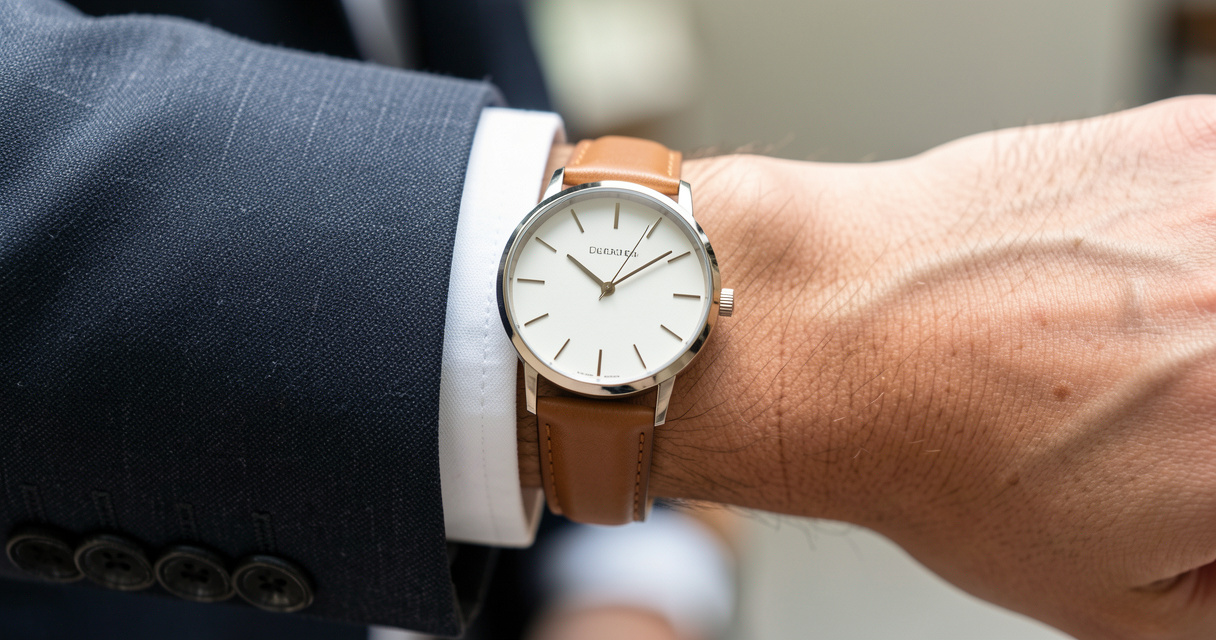
A dress watch is a formal timepiece characterized by its slim case, minimalist dial, and leather strap. Designed to be worn with suits or elegant attire, it prioritizes understated elegance over complications or sporty features. Modern dress watches are also versatile enough to complement casual outfits. That is the essence: a watch that whispers refinement rather than shouting for attention. The kind of timepiece that earns its place on your wrist not through bulk but through balance.
The Classic Definition
Historically, a dress watch was conceived exclusively for black-tie events and formal boardrooms. Its job was simple: tell the time without drawing attention to itself. No chronograph, no rotating bezel, no dive ratings. Just hours, minutes, and perhaps a small seconds subdial. The case had to glide under a shirt cuff, which meant thickness under 10 mm and diameter rarely exceeding 40 mm. As Exquisite Timepieces noted in 2025, “a good dress watch is versatile enough to elevate even your more casual fits” – a sentiment that hints at the shift underway.
Modern Versatility
The strict boundaries have blurred. Today, the same slim steel watch you wear with a tuxedo can look just as intended with raw denim and a linen shirt – provided the details are right. The key is to choose a model with a clean dial and a strap that straddles formality: smooth calfskin for evenings, suede for afternoons. That flexibility is precisely why the men’s dress watch category has experienced a renaissance. It is no longer a specialist item; it is an everyday companion. The rule: understatement, not utility, defines the dress watch. If your watch has a dive bezel or a chronograph, it is not a pure dress watch.
Key Characteristics of a True Dress Watch
Case & Thickness
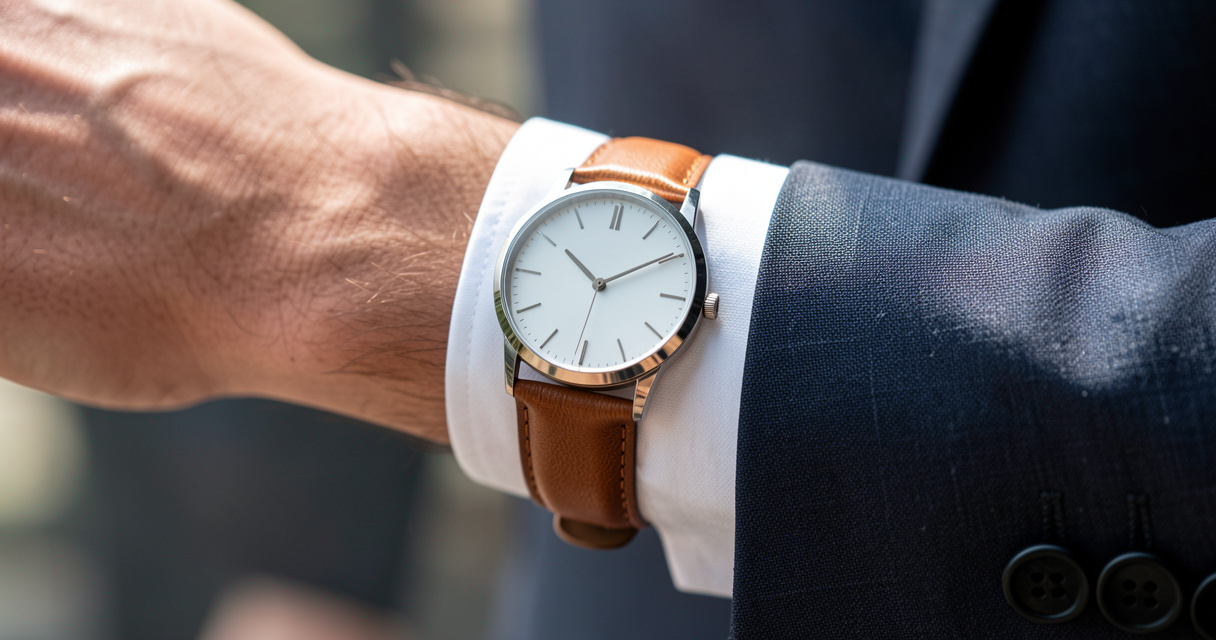
Slim dress watch is not a marketing term – it is a functional necessity. A true dress watch measures between 6 mm and 10 mm in thickness. Case diameters range from 34 mm to 42 mm, with most purists settling on 38 mm as the Goldilocks size. Anything above 10 mm risks catching on the cuff and losing the dress-watch silhouette. Lug-to-lug is equally critical: a 46 mm lug span is the maximum for smaller wrists.
Dial Design
The dial should be uncluttered. Minimalist indices – baton, Roman, or simple dots – replace numerals. No date window is ideal, though many fine examples include one discreetly at 3 o’clock. The colour palette is restrained: black, white, silver, deep blue, or champagne. A moonphase or small seconds adds character without becoming a sport complication.
Strap & Bracelet Options
Leather is the traditional choice, but metal bracelets are increasingly accepted if the bracelet is integrated and thin. Crocodile, alligator, calfskin, or suede – each changes the watch’s personality. A brown suede strap relaxes a formal watch; a black alligator strap sharpens it. Do not underestimate the power of a strap swap to transform your dress watch buying guide from theoretical to practical.
| Characteristic | Typical Range |
|---|---|
| Case Diameter | 34–42 mm |
| Case Thickness | 6–10 mm |
| Lug-to-Lug | 40–48 mm |
| Water Resistance | 30–50 m |
| Strap Width | 18–22 mm |
Now that you know the anatomy, let us explore why this watch deserves a permanent spot in your rotation.
Why a Dress Watch Belongs in Every Collection
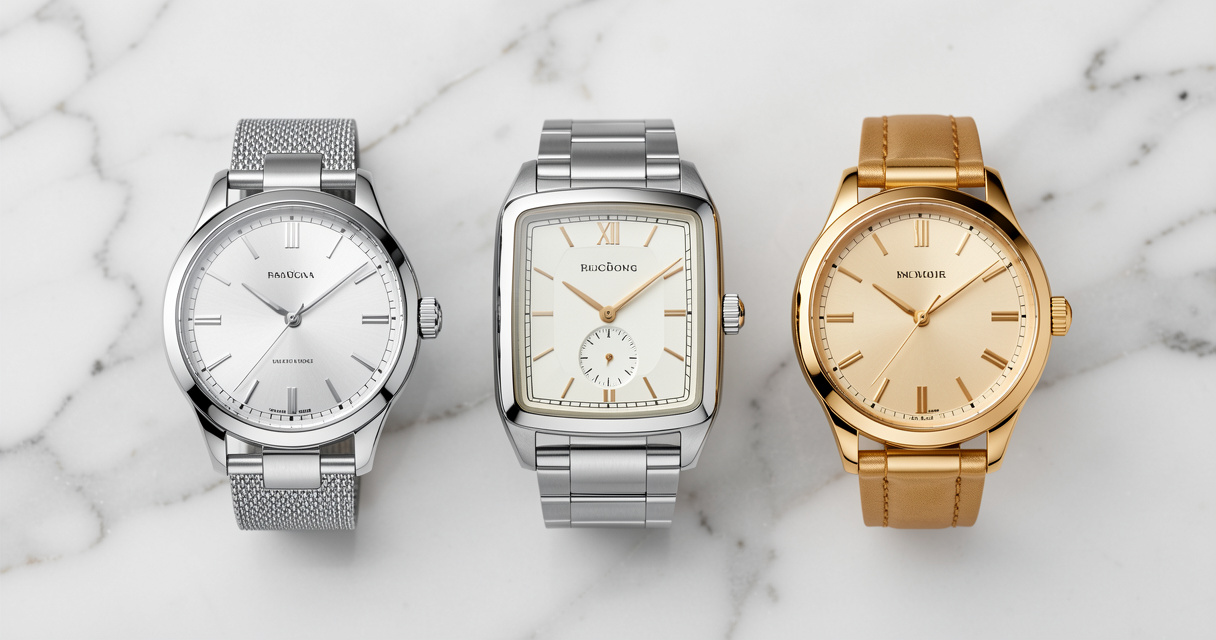
Many buyers still believe a dress watch is too formal for daily wear – a misconception that costs them one of the most versatile pieces they could own. According to Teddy Baldassarre (2026), “most watch aficionados consider a go-to dress watch to be a necessary addition to any collection.” That is not hyperbole; it is a statement rooted in the watch’s ability to bridge worlds.
From Suits to Sweats
The same Grand Seiko SBGW231 that accompanies a CEO to a merger meeting can look equally compelling with a cashmere sweater and jeans on a Sunday. The secret lies in contrast: a refined piece against an casual outfit creates a deliberate tension that elevates both. The dress watch vs everyday watch debate is therefore a false dichotomy. The dress watch is the everyday watch – at least for those who value subtlety over spectacle.
The Confidence Factor
We once saw a collector wear a vintage Jaeger-LeCoultre Reverso with a faded denim jacket and a white T‑shirt at a Parisian café. It stole the show not because it was loud, but because it was quietly perfect. That is the confidence a dress watch instils: you do not need a tool watch to prove your capability. Sometimes the most powerful statement is a 38 mm circle of steel and leather that simply tells the time. The hill we will die on: a dress watch is the most versatile watch you can own.
Iconic Dress Watches Through History
Certain names transcend trends. They define the category. Here, drawn from SwissWatchExpo’s 2026 retrospective, are the non‑negotiable references every collector should know.
The Timeless Cartier Tank
Introduced in 1917, the Cartier Tank is the dress watch that needs no introduction. Its square case and Roman numerals are the blueprint for rectangular watch design. Worn by everyone from Andy Warhol to Jackie Kennedy, the Tank remains the benchmark for understated luxury. A high-end dress watch by any measure, yet accessible entry‑level models make it an aspirational goal.
A. Lange & Söhne Lange 1 – Modern Masterpiece
Debuting in 1994, the Lange 1 introduced an asymmetric dial with outsized date and power‑reserve indicator that became instantly recognisable. It proves that a dress watch can be avant‑garde without sacrificing elegance. This is the kind of timepiece that makes you rethink what is possible within a formal framework.
- Cartier Tank (1917) – Rectangular icon, Roman numerals.
- Patek Philippe Calatrava (1932) – The quintessential round dress watch.
- Jaeger‑LeCoultre Reverso (1931) – Art Deco ingenuity with a reversible case.
- A. Lange & Söhne Lange 1 (1994) – Asymmetric brilliance.
- Rolex Day‑Date (1956) – The “President’s watch” – dressy with a bracelet.
These icons set the standard. But what if your budget is more down‑to‑earth? Let us turn to the best affordable options.
Best Affordable Dress Watches (Under $1,000)
You do not need a five‑figure budget to own a genuine dress watch. The affordable dress watches segment is rich with horological pedigree – from Japanese automatics to German Bauhaus minimalism. The editor’s picks below prove that refinement is not a matter of price but of design intent.
Seiko Presage – Best Value
The Seiko Presage line offers automatic movements, sapphire crystal, and exquisite dials (the “Cocktail Time” series) for around $400–$600. Its 40.5 mm case is borderline large for purists, but the overall proportions are elegant. An outstanding entry point for those asking, “Are Seiko dress watches good?” – the answer is a definitive yes.
Junghans Max Bill – Bauhaus Beauty
Designed by Max Bill, a Bauhaus student, this 38 mm hand‑winding watch is the epitome of “form follows function.” Clean dial, domed plexiglass, and a slim profile (9 mm) make it the smallest‑wrist‑friendly pick. At $700–$900, it is the best dress watch under 1000 dollars for those who value design history.
Timex Marlin – Vintage Vibe
The Timex Marlin (re‑edition) channels 1960s charm with a 34 mm case and hand‑winding movement. At under $200, it is the most affordable genuine dress watch on the market. It is also a favourite strap‑modding platform – swap the leather for a suede strap, and you have an instant casual companion.
| Model | Price | Case Size | Movement | Key Feature |
|---|---|---|---|---|
| Seiko Presage | $450–$650 | 40.5 mm | Automatic | “Cocktail Time” dial |
| Junghans Max Bill | $700–$900 | 38 mm | Hand‑winding | Bauhaus design |
| Timex Marlin | $180–$220 | 34 mm | Hand‑winding | Vintage re‑edition |
| Orient Bambino | $150–$200 | 40 mm | Automatic | Classic domed crystal |
According to market data from 2025, the average price of an entry‑level automatic dress watch now sits at $380 – a 12% increase from 2020, driven by demand for quality at a reasonable price.
High-End Dress Watches: Investment Pieces for Collectors
At the opposite end of the spectrum lie the grails. High-end dress watches are more than timekeepers – they are engineering statements and cultural artefacts. Prices begin at $5,000 and climb into six figures for rare pieces. But the value is not always monetary; it is the pleasure of wearing a perfectly finished micro-rotor or a hand‑guilloché dial.
The Art of Haute Horlogerie
Jaeger‑LeCoultre Master Ultra Thin, Patek Philippe Calatrava, Vacheron Constantin Patrimony – these names represent the summit of dress‑watch making. The Calatrava, for example, has been produced since 1932 and remains the benchmark for a round, three‑hand dress watch. A steel Calatrava 5119 starts around $12,000. The finishing, the movement, the feel on the wrist – every detail justifies the price.
Independent Brands to Watch: Moser, F.P. Journe
H. Moser & Cie. offers the Endeavour Centre Seconds with a fumé dial and a price tag of around $22,000. F.P. Journe’s Chronomètre Souverain is a grail for connoisseurs. These independents challenge the establishment with bold design and exceptional finishing. Note: luxury dress watches often have limited water resistance (30 m max) – handle with care and avoid swimming.
Now that you know the extremes, let us help you find your perfect fit.
How to Choose the Right Dress Watch for Your Wrist
A dress watch that feels oversized or too thick will never be worn. The dress watch case thickness guide is straightforward, but proportions matter more than any single number. Here is a practical checklist.
Understand Proportions
Measure your wrist circumference. For a 6‑inch wrist, look for cases 34–38 mm with a lug‑to‑lug under 46 mm. The Junghans Max Bill 38 mm (lug‑to‑lug 40 mm) is a textbook example. For a 7‑inch wrist, 38–42 mm works. Thickness should be under 10 mm – ideally 7–9 mm – to slide under a shirt cuff.
Strap and Bracelet Choices
Leather is classic; a thin metal bracelet (like the one on a vintage Omega De Ville) can be equally dressy. The colour should complement your wardrobe: black for formal, brown for versatility, grey or navy for a modern twist. Do not forget that a strap change can repurpose the same watch for different occasions. That is the value of a dress watch buying guide that goes beyond specs.
- Lug‑to‑lug: Must be ≤ 46 mm for small wrists.
- Thickness: Under 10 mm, ideally ≤ 9 mm.
- Weight: Light feel is part of the dress‑watch experience.
- Strap type: Calfskin, alligator, or suede – avoid rubber.
- Colour: Match to your most frequent attire.
Once you have the right watch, caring for it ensures it lasts a lifetime.
Caring for Your Dress Watch
Dress watches are delicate machines. Their slim cases and leather straps require thoughtful maintenance.
Water Resistance Reality
Most dress watches are rated 30 m, meaning splash resistance – not immersion. Washing hands is fine; swimming in a dress watch is asking for trouble. Even a 50 m rating does not guarantee diving. Always check the gaskets during servicing. If you need a water‑ready watch, keep a sports watch for the beach. The best dress watch maintenance tips start with knowing your limits.
Leather Strap Care
Leather absorbs sweat and moisture. Rotate straps to let them dry between wears. Avoid prolonged sun exposure. Use a leather conditioner every few months. A well‑cared‑for strap can last 2–3 years; a neglected one cracks in months. When the strap goes, replace it – a fresh strap makes even a vintage watch feel new.
Servicing schedule: Automatic dress watches should be serviced every 4–5 years. Quartz movements need a battery change every 2–3 years. Store the watch in a dry, cool place – ideally in a watch box or pouch.
Frequently Asked Questions
What is a dress watch?
A dress watch is a formal timepiece designed for elegant occasions. It typically features a slim case, a clean dial with minimal complications, and a leather strap. It prioritizes understated style over utility features like diving bezels or chronographs.
Can I wear a dress watch with jeans?
Yes, absolutely. Modern style has made dress watches incredibly versatile. Many collectors wear them with casual outfits like jeans and a blazer. The key is to choose a model with a less formal strap (like suede or a metal bracelet) and a simple dial.
Are dress watches waterproof?
Most dress watches have minimal water resistance, often 30 meters (splash resistant) or none at all. They are not intended for swimming or diving. Always check the specific model’s rating and avoid exposing it to water unless explicitly rated higher.
What size dress watch is best for a small wrist?
For small wrists (6‑6.5 inches), look for cases 34‑38 mm in diameter with a lug‑to‑lug under 46 mm. Thickness should ideally be under 10 mm. Models like the Junghans Max Bill (38 mm) or vintage‑inspired Timex Marlin are excellent choices.
Should I buy an automatic or quartz dress watch?
It depends on your priorities. Automatic movements are prized by enthusiasts for their craftsmanship and sweeping seconds hand, but they require regular wearing or a winder. Quartz dress watches are more affordable, accurate, and low‑maintenance, ideal for occasional wear.
What is the difference between a dress watch and a sports watch?
Dress watches are slim, elegant, and designed for formal settings, while sports watches are larger, more durable, and built for specific activities (diving, piloting, etc.). A dress watch prioritizes refinement; a sports watch prioritizes functionality and robustness.
How much should I spend on a good dress watch?
You can find excellent dress watches from around $150 (Timex, Orient) to $500 (Seiko Presage, Junghans) for quality automatic options. Luxury pieces from brands like Jaeger‑LeCoultre or Patek Philippe can cost tens of thousands. Define your budget and prioritize a classic design that will last.
Now, take a look at your collection – which spot is waiting for that refined, all‑occasion timepiece?