


Reading time: 15 min
Table of Contents
- Key Takeaways
- What Are Sun Spots and Why Do They Appear?
- How UV Rays Trigger Melanin Overproduction
- Common Misconceptions About Sun Spots and Cancer
- Prevention: The Non-Negotiable First Step
- How to Choose the Right Sunscreen for Your Skin Type
- Beyond Sunscreen: Protective Clothing and Seek Shade (10 AM – 4 PM)
- At-Home Skincare Ingredients That Fade Sun Spots
- Retinoids: Prescription vs. Over-the-Counter Retinols
- Vitamin C Serums: L-Ascorbic Acid vs. Derivatives
- Niacinamide and Alpha Arbutin: Gentle Alternatives for Sensitive Skin
- Clinical Treatments: What Your Dermatologist Can Do
- Intense Pulsed Light (IPL): The Multi-Wavelength Workhorse
- Laser Resurfacing: Fraxel and CO2 for Deeper Pigmentation
- Chemical Peels: Light vs. Medium-Depth for Sun Damage
- Photodynamic Therapy (PDT): Activating Healing with Light
- How to Choose the Right Treatment for Your Skin Type
- Fitzpatrick Skin Types and Laser Safety
- Mild Spots: Start with Topicals
- Moderate to Severe: Consider Combination Therapy
- Natural and DIY Remedies: What Works and What Doesn’t
- Licorice Extract and Bearberry: Traditional Ingredients with Science
- The Dangers of Unsupervised Acids and Citrus Juices
- The Cost of Treatment: A Breakdown
- Average Price per Procedure (2025 US Data)
- At-Home Products vs. Clinic: Cost per Month Comparison
- When to See a Dermatologist – And Why It Matters
- The ABCDE Rule for Early Detection of Skin Cancer
- What to Expect During a Dermatologist Visit for Pigmentation
- Questions fréquentes
- Take the First Step Today
Key Takeaways
- Sun spots are treatable – With the right combination of prevention, topical ingredients, and professional procedures, you can significantly reduce or eliminate solar lentigines.
- Protection is non-negotiable – Daily broad-spectrum SPF 30+ sunscreen is the foundation of any treatment plan; without it, results will be temporary.
- Choose treatment by skin type – Darker skin tones (Fitzpatrick IV–VI) require gentler lasers and lower acid concentrations to avoid post-inflammatory hyperpigmentation.
- See a dermatologist first – Self-diagnosis can miss skin cancer; a board-certified specialist can confirm the spots are benign and tailor a safe protocol.
What Are Sun Spots and Why Do They Appear?
Tired of those stubborn brown spots that appeared after years of fun in the sun? You’re not alone – nearly 90% of people over 60 have solar lentigines, the medical name for what we casually call sun spots, age spots, or liver spots. But here’s the good news: you don’t have to live with them. Understanding the biology behind these spots is the first step to erasing them.
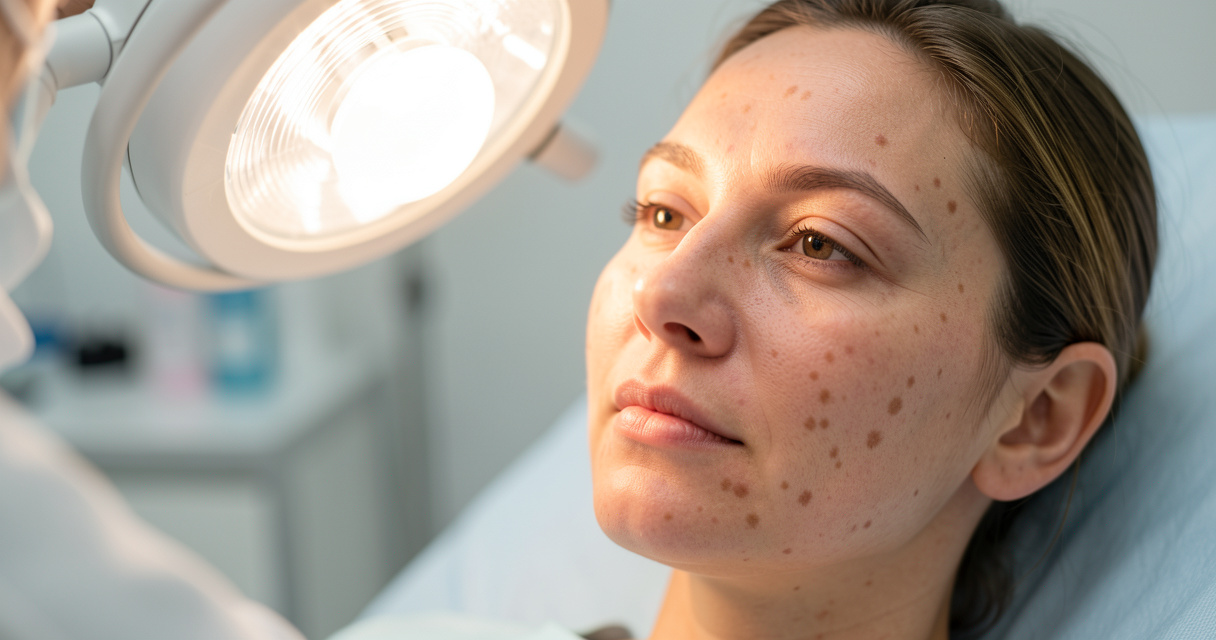
Sun spots are flat, brown patches that form on sun-exposed areas – face, hands, chest, shoulders. They develop when cumulative ultraviolet (UV) radiation triggers melanocytes (pigment-producing cells) to overproduce melanin. Unlike freckles, which fade in winter, solar lentigines are persistent. Unlike melasma, which often appears in symmetrical patterns on the cheeks and forehead, sun spots are scattered and clearly linked to sun exposure.
How UV Rays Trigger Melanin Overproduction
When UVB rays penetrate the epidermis, they damage DNA in keratinocytes. In response, the skin activates melanocytes – housed in the basal layer – to produce extra melanin as a protective shield. This melanin is then transferred to neighboring skin cells in pigment packets called melanosomes. Over years of repeated exposure, some melanocytes become permanently hyperactive, depositing excess pigment in a localized area. The result: a flat brown spot that doesn’t fade.
We can illustrate this at the cellular level: UV rays upregulate the enzyme tyrosinase, the rate-limiting step in melanin synthesis. Tyrosinase converts the amino acid tyrosine into DOPA and then into melanin. Any ingredient that inhibits tyrosinase – like vitamin C or kojic acid – directly reduces pigment production.
Common Misconceptions About Sun Spots and Cancer
Let’s address the elephant in the room: Are sun spots cancerous? Most solar lentigines are benign – they are simply cosmetic. However, they can resemble early melanoma or actinic keratosis (a precancerous lesion). The key difference: sun spots remain flat, uniform in color, and stable over time. Malignant lesions often show asymmetry, irregular borders, multiple colors, and change in shape or size. The discerning traveler knows to apply the ABCDE rule. If a spot changes, bleeds, or becomes raised, see a board-certified dermatologist immediately.
This is also the right moment to connect sun spots to related conditions: post-inflammatory hyperpigmentation (PIH) can look similar but results from trauma (acne, laser) rather than sun. Melasma is hormonally driven and requires different treatments. Understanding these distinctions prevents wasted time on the wrong therapy.
Transition: Now that we know what sun spots are, we must lock in the only non-negotiable step before any treatment can work.
Prevention: The Non-Negotiable First Step
No matter how powerful a retinol or how expensive a laser, every treatment fails without broad-spectrum sunscreen. The American Academy of Dermatology (AAD) recommends SPF 30 or higher, broad-spectrum (UVA + UVB), and water resistance. Why? Because 90% of visible skin aging – including sun spots – comes from UV exposure, and even the best in-office treatment can’t prevent new spots without daily protection.
How to Choose the Right Sunscreen for Your Skin Type
| Sunscreen Attribute | Why It Matters | Recommended Products (Examples) |
|---|---|---|
| SPF 30+ | Blocks 97% of UVB rays; SPF 50 blocks 98% | La Roche-Posay Anthelios SPF 50, Supergoop Unseen SPF 40 |
| Broad-spectrum (UVA+UVB) | UVA causes premature aging and deep pigmentation | EltaMD UV Clear SPF 46, SkinCeuticals Physical Fusion |
| Water-resistant (40 or 80 min) | Stays effective during sweat or swimming | Neutrogena Hydro Boost SPF 50, Blue Lizard Sensitive SPF 50 |
For oily or acne-prone skin, choose a gel or mineral formula. For dry skin, look for added ceramides or hyaluronic acid. For darker skin tones, avoid white casts – iron oxide–tinted sunscreens or micro-ionized zinc oxide blend seamlessly.
Beyond Sunscreen: Protective Clothing and Seek Shade (10 AM – 4 PM)
Think of sunscreen as your first layer, not your only defense. Wear a wide-brimmed hat when walking the Capri coastline. Choose UPF 50+ rash guards for the Maldives. Sit under umbrellas between 10 AM and 4 PM – peak UV hours. The question “Do I need to wear SPF indoors?” is worth asking: if you sit near a window (UVA penetrates glass), or if you drive a lot, yes – make it a habit.
Transition: With protection locked in, we can now turn to the ingredient arsenal that works from your bathroom counter.
At-Home Skincare Ingredients That Fade Sun Spots
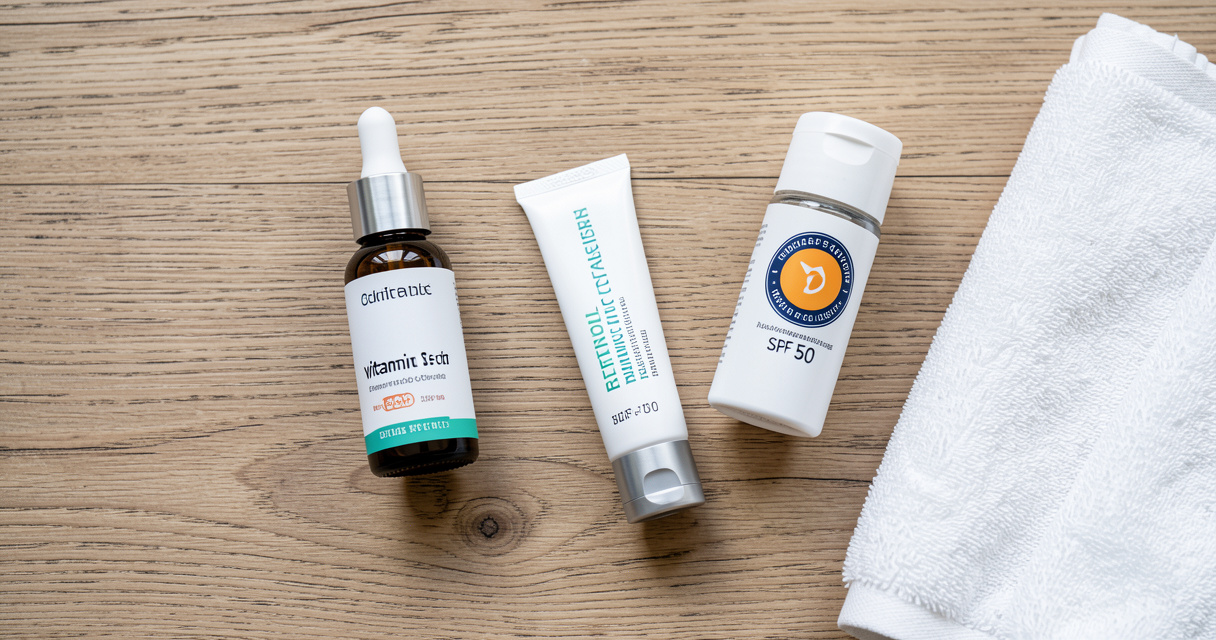
Before diving into dermatologist visits, know that the right routine can yield significant improvement – if you are patient. Here are the five evidence-based ingredients that target sun spots at the cellular level, presented in order of potency.
- Retinoids (retinol or prescription tretinoin): Speed up cell turnover and fade spots over 8–12 weeks.
- Vitamin C (L-ascorbic acid): Inhibits melanin production and brightens skin.
- Niacinamide: Blocks transfer of pigment to skin cells.
- Alpha arbutin and kojic acid: Gently exfoliate and lighten dark areas.
- Always pair these ingredients with a broad-spectrum SPF 30+ sunscreen.
According to The Ordinary’s clinical testing on 46 people, a 5% niacinamide emulsion applied twice daily for three weeks reduced the appearance of dark spots (2024). Retinoids, per Feinstein Dermatology (2025), require 8 to 12 weeks of consistent use before visible improvement. Consistency is everything.
Retinoids: Prescription vs. Over-the-Counter Retinols
Prescription tretinoin is the gold standard for accelerating skin cell turnover, pushing pigmented cells to the surface faster. Over-the-counter retinol is milder and slower but less irritating. Start with 0.2% retinol every third night, then gradually increase. “After eight weeks of using a 0.2% retinol serum at night, one patient reported a 40% visible reduction in her cheek spots – but only because she applied SPF religiously every morning.” That’s the story we hear from dermatology clinics across Europe.
Can you use vitamin C and retinol together? Yes, but not at the same time – vitamin C in the morning, retinol at night. Their pHs conflict; layering them immediately reduces efficacy.
Vitamin C Serums: L-Ascorbic Acid vs. Derivatives
L-ascorbic acid is the pure, most potent form of vitamin C – it directly inhibits tyrosinase. But it’s unstable and can irritate sensitive skin. Derivatives like ascorbyl glucoside or tetrahexyldecyl ascorbate are gentler and more stable, though slower. For sun spots, choose a serum with 10–20% L-ascorbic acid (pH 3.5 or lower) for best results. Apply before sunscreen in the morning.
Niacinamide and Alpha Arbutin: Gentle Alternatives for Sensitive Skin
Niacinamide works by blocking melanosome transfer – it prevents pigment from reaching the skin surface. A 4–5% concentration is effective without irritation. Alpha arbutin (derived from bearberry) inhibits tyrosinase more gently than hydroquinone. Both are excellent for those who cannot tolerate retinoids or have melasma overlap.
Transition: If your sun spots are stubborn or you want faster results, professional treatments deliver dramatic changes in a fraction of the time.
Clinical Treatments: What Your Dermatologist Can Do
Sometimes at-home care isn’t enough – especially for deep, multi-layered pigmentation. Here’s the breakdown of the most effective in-office procedures, along with safety considerations for all skin types.
| Procedure | Mechanism | Avg. Sessions Needed | Downtime | Cost Range (USD, 2025 est.) |
|---|---|---|---|---|
| Intense Pulsed Light (IPL) | Broad-spectrum light targets melanin; heats and destroys pigment cells | 3–5 | 1–2 days (redness, crusting) | $300–$600/session |
| Fractional Laser (Fraxel) | Microscopic columns of laser energy penetrate deep to break up melanin | 2–4 | 5–7 days (swelling, bronzing) | $1,000–$2,500/session |
| Chemical Peel (e.g., VI Peel) | Acid solution exfoliates superficial layers, taking pigment with it | 1–3 | 1 week (peeling, redness) | $150–$600/session |
| Photodynamic Therapy (PDT) | Photosensitizing agent + light destroys precancerous and pigmented cells | 2–3 | 2–3 days (redness, sensitivity) | $400–$1,000/session |
According to SkinLab-NYC (2025), the VI Peel provides dramatic results for sun spots in just one week. For deeper spots, Fraxel remains the gold standard, but requires careful post-care: no sun, gentle cleansing, and SPF 50 every two hours.
Intense Pulsed Light (IPL): The Multi-Wavelength Workhorse
IPL isn’t a laser – it’s a broad-spectrum light that targets melanin and hemoglobin. For sun spots, the light is absorbed by pigment, which then heats and crumbles. Over 3–5 sessions, spots fade significantly. Downtime is minimal: some redness and crusting that resolves in 48 hours. Best for lighter skin types (Fitzpatrick I–III).
Laser Resurfacing: Fraxel and CO2 for Deeper Pigmentation
Fractional lasers create tiny columns of thermal damage that stimulate collagen renewal and push pigment out. CO2 lasers vaporize the top layer of skin. Both are effective for more resistant sun spots. The trade-off? Longer recovery (5–7 days of social downtime) and higher cost. For darker skin, the risk of post-inflammatory hyperpigmentation (PIH) is real – seek a practitioner experienced in treating melanin-rich skin.
Chemical Peels: Light vs. Medium-Depth for Sun Damage
Light peels (glycolic acid 20–35%, lactic acid) remove the outermost layer; they are safe for all skin tones and require no downtime. Medium-depth peels (TCA or phenol) reach the papillary dermis and can clear stubborn spots in one session – but they carry a higher risk of PIH in darker skin. “The VI Peel combines TCA, retinoic acid, and kojic acid, and it’s our go-to for patients who want a noticeable result over a weekend,” says a New York dermatologist we consulted.
Photodynamic Therapy (PDT): Activating Healing with Light
PDT uses a topical photosensitizer (aminolevulinic acid) that accumulates in damaged cells; then a blue or red light activates it, destroying those cells. Originally for actinic keratosis, it also works on pigmented lesions. Two to three sessions spaced a month apart can yield substantial fading.
Transition: With so many options, the choice comes down to your skin type and goals. Let’s build a decision framework.
How to Choose the Right Treatment for Your Skin Type
Not all treatments suit all skin. Here is a structured matrix to help you decide between at-home and professional options based on your Fitzpatrick skin type, severity, budget, and desired speed. The discerning traveler knows that luxury is specificity.
| Skin Type | Mild Spots | Moderate Spots | Severe/Deep Spots |
|---|---|---|---|
| Fair (I–II) | Retinol + vitamin C | IPL or light peel | Fraxel or CO2 laser |
| Medium (III–IV) | Niacinamide + alpha arbutin | Medium peel (TCA) or IPL (low fluence) | Fraxel (with caution) |
| Dark (V–VI) | Gentle vitamin C + niacinamide | Chemical peel (glycolic only) or microneedling with depigmenting agents | Q-switched Nd:YAG laser (PIH-safe) |
Key insight: For Fitzpatrick IV–VI, high-energy lasers and deep peels can trigger PIH – a darker aftermath than the original spot. Always choose a practitioner who has demonstrable experience with melanin-rich skin. Ask these five questions before booking:
- How many patients with my skin type have you treated?
- What is your protocol to prevent PIH?
- Can you show before/after photos of similar skin?
- What downtime should I expect realistically?
- Do you offer a patch test before full treatment?
Fitzpatrick Skin Types and Laser Safety
The Fitzpatrick scale (I–VI) classifies skin’s response to UV. Types I–III (pale to olive) tolerate most lasers well. Types IV–VI (brown to black) need cautious settings: longer wavelengths (like Nd:YAG 1064 nm) that bypass melanin in the epidermis.
Mild Spots: Start with Topicals
If your spots are faint and few, skip the laser suite. A dedicated routine of retinol (0.2–0.5%), vitamin C in the morning, and niacinamide at night will gradually fade them over 3–6 months. Cost: about $50–$100 per month for quality products.
Moderate to Severe: Consider Combination Therapy
For stubborn, dark spots, combine a peel or IPL with at-home topicals. One or two sessions of IPL followed by a nightly retinoid can achieve in weeks what takes months at home alone. Budget: $600–$2,000 total for a course.
Transition: While professional methods are effective, some readers prefer natural alternatives. Let’s separate myth from science.
Natural and DIY Remedies: What Works and What Doesn’t
The internet is full of “miracle” sun spot cures using kitchen staples. We’ve reviewed the evidence (and the risks) so you don’t have to.
| DIY Ingredient | Claimed Benefit | Scientific Evidence (0–3 stars) | Safety Rating |
|---|---|---|---|
| Lemon juice | Lightens spots with citric acid | ★☆☆☆☆ (no evidence; causes photosensitivity) | Dangerous – can cause burns and permanent darkening |
| Apple cider vinegar | Balances pH and exfoliates | ★★☆☆☆ (weak tyrosinase inhibition in vitro | Moderate risk – too acidic, may irritate |
| Aloe vera gel | Soothes inflammation | ★★☆☆☆ (some anti-inflammatory, but no pigment fading) | Safe, but ineffective alone |
| Licorice extract (glabridin) | Inhibits tyrosinase | ★★★☆☆ (shown in vitro and small human studies) | Safe – often found in serums |
| Bearberry (arbutin) | Natural version of hydroquinone | ★★★☆☆ (effective, but slower than synthetic) | Safe in low concentrations |
Bottom line: Licorice extract and bearberry have modest scientific backing and are safe. Lemon juice and apple cider vinegar can damage the skin barrier and worsen pigmentation – avoid them. The question “Does lemon juice really remove dark spots?” has a clear answer: no, and it may cause phototoxic burns.
Licorice Extract and Bearberry: Traditional Ingredients with Science
Glabridin, the active component in licorice, inhibits tyrosinase and also has anti-inflammatory properties. Arbutin (from bearberry, cranberry, or blueberry) is a hydroquinone derivative that slowly releases hydroquinone in the skin – effective but gentler. Both are best used as part of a formulated serum rather than homemade concoctions, to ensure proper concentration and pH.
The Dangers of Unsupervised Acids and Citrus Juices
We cannot overstate this: applying undiluted lemon juice to the face is phototoxic. The psoralens in citrus make skin extremely reactive to UV, often causing a burn that heals as darker spots – the exact opposite of what you want. Similarly, apple cider vinegar’s low pH (around 2–3) can strip the acid mantle, leading to irritation and PIH. Stick to products formulated by cosmetic chemists.
Transition: Now, let’s talk money. How much should you budget for clearer skin?
The Cost of Treatment: A Breakdown
Luxury in skincare isn’t about price alone – it’s about value that lasts. Here are realistic costs based on the American Society for Dermatologic Surgery (ASDS) 2024 cost survey and current clinic pricing.
| Treatment | Cost per Session | Typical # Sessions | Total Estimated Cost |
|---|---|---|---|
| IPL | $300–$600 | 3–5 | $900–$3,000 |
| Fractional Laser (Fraxel) | $1,000–$2,500 | 2–4 | $2,000–$10,000 |
| Chemical Peel (VI Peel) | $150–$600 | 1–3 | $150–$1,800 |
| PDT | $400–$1,000 | 2–3 | $800–$3,000 |
| At-home products (monthly) | $50–$150 | Ongoing | $600–$1,800/year |
Does insurance cover sun spot removal? Rarely, because it’s considered cosmetic. However, if the spots become symptomatic or are biopsied (e.g., actinic keratosis), some costs may be covered. Check with your insurer.
Average Price per Procedure (2025 US Data)
IPL and light peels are the most cost-effective for mild cases. For deep spots, Fraxel is expensive but often requires fewer sessions overall. The question “How many laser sessions do I need for significant results?” averages 3 for IPL, 2–3 for fractional laser.
At-Home Products vs. Clinic: Cost per Month Comparison
If you spread the cost of multiple IPL sessions over a year, it’s roughly $250/month – not far from a high-end serum regime. But the results are faster. For those with patience, a $60 retinol + $50 vitamin C + $30 sunscreen regimen costs about $140/month and can deliver 30–50% improvement in 6 months.
Transition: Regardless of budget, there’s one rule that overrides all: never treat a spot until a dermatologist confirms it’s safe.
When to See a Dermatologist – And Why It Matters
Self-diagnosis is the most dangerous skincare mistake. A flat brown spot could be a benign solar lentigo – or it could be an actinic keratosis or even early melanoma. The AAD recommends an annual skin exam for everyone, and more frequently if you have a history of sunburns or suspicious moles.
The ABCDE Rule for Early Detection of Skin Cancer
Memorize this acronym for checking any spot:
- A symmetry – one half doesn’t match the other.
- B order – edges are irregular, jagged, or blurred.
- C olor – multiple shades of brown, black, red, white, or blue.
- D iameter – larger than 6 mm (pencil eraser) or growing.
- E volving – changing shape, color, or texture; or bleeding.
If you check even one of these boxes, see a board-certified dermatologist without delay. Most sun spots are harmless, but early detection saves lives.
What to Expect During a Dermatologist Visit for Pigmentation
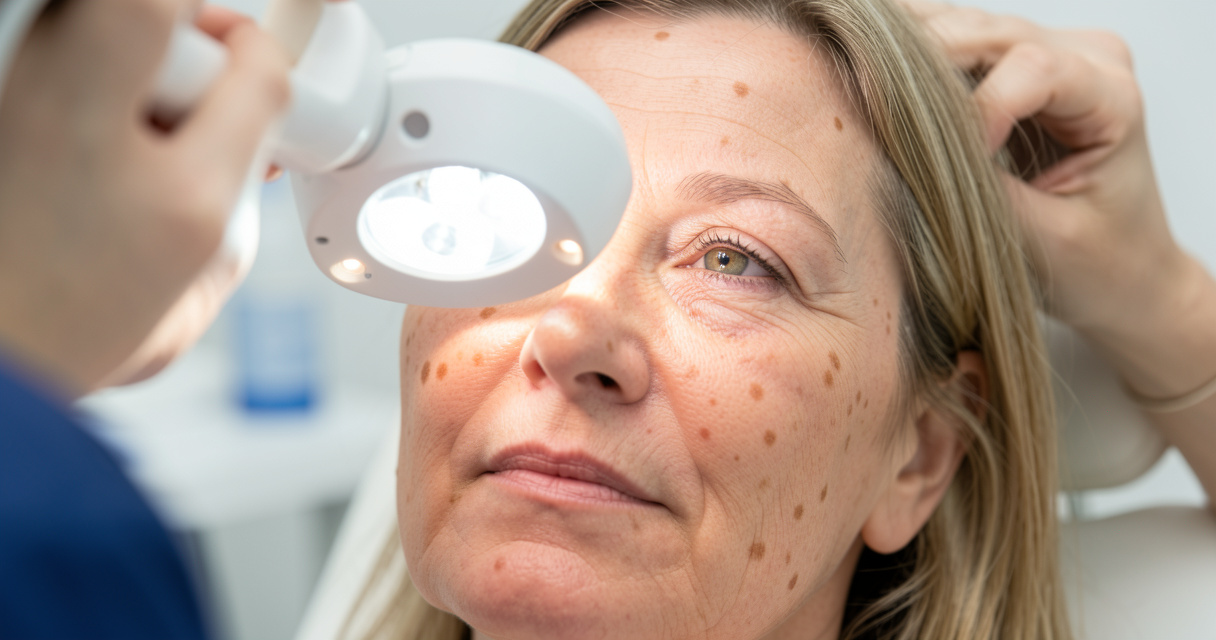
The doctor will examine the spot with a dermatoscope (a handheld microscope) to evaluate pigment patterns. If it looks suspicious, a shave biopsy is done under local anesthesia – quick, in-office, and painless. If it’s benign, they can then recommend treatment options suited to your skin type and severity. “Most of my patients with solar lentigines are relieved to hear they’re harmless – then eager to start our treatment plan,” says a dermatologist from Hôpital Saint-Louis in Paris.
Do sun spots need to be biopsied? Rarely – only if the ABCDE criteria raise suspicion. But never assume a spot is benign just because it looks like your other spots.
Transition: Now that you know when to seek expert care, let’s address the questions that still linger.
Questions fréquentes
How long does it take for sun spots to fade?
Depending on treatment: retinoids may show improvement in 8–12 weeks. Lasers and peels often require 2–3 sessions spaced 4–6 weeks apart. Consistent sun protection is essential to keep them from returning.
Are sun spots permanent?
Sun spots are persistent but not truly permanent – they can be significantly faded or removed with professional treatments and consistent topical care. Without intervention, they typically remain indefinitely.
Can sun spots be removed naturally at home?
Some natural ingredients like licorice extract and vitamin C can help lighten spots, but results are modest and slow. No home remedy has been proven to completely erase sun spots as effectively as clinical treatments.
Is IPL or laser better for sun spots?
Both are effective. IPL uses broad-spectrum light and is good for mild to moderate pigmentation with minimal downtime. Fractional lasers (e.g., Fraxel) penetrate deeper and work better for stubborn spots but require more recovery time.
Do sun spots come back after treatment?
Yes, if you do not protect your skin from the sun. The AAD warns that age spots can return, making daily SPF 30+ use non-negotiable. New spots can also form on unprotected skin.
What is the difference between a sun spot and skin cancer?
Sun spots are flat, brown, uniformly colored, and stable. Skin cancer (melanoma) often shows asymmetry, irregular borders, multiple colors, and changes over time. Always consult a dermatologist for new or changing spots.
Can I use hydroquinone for sun spots?
Hydroquinone is a prescription-only bleaching agent that can effectively lighten sun spots. However, prolonged use may cause ochronosis (skin darkening) in darker skin tones. Use only under dermatologist supervision.
Take the First Step Today
You now have the knowledge to make an informed decision. Let’s recap the essentials: Sun spots are harmless but treatable with a combination of prevention, topicals, and professional procedures. Daily broad-spectrum sunscreen is the foundation of any treatment plan. Consult a board-certified dermatologist for a personalized plan, especially if you have darker skin. Invest in proven treatments – natural remedies are rarely effective enough to deliver visible results.
Book a skin check appointment and pick up a sunscreen with SPF 50. Your future self will thank you.