


Reading time: 21 min
Table of Contents
- Key takeaways
- What Are Acne Dark Spots? The Science of Post-Inflammatory Hyperpigmentation
- How inflammation triggers excess melanin
- What PIH looks like on different skin tones
- Why dark spots are not the same as active acne
- Acne Dark Spots vs. Acne Scars: How to Identify What You Are Treating
- The smooth-versus-textured test
- When a mark is actually a scar
- Why misdiagnosis wastes money and time
- Why Acne Dark Spots Are More Common and More Persistent in Medium to Deep Skin Tones
- Melanin-rich skin and the post-inflammatory response
- Rebound hyperpigmentation and the test spot
- How to choose a skin-tone-aware clinician
- How to Get Rid of Acne Dark Spots: Ingredient-by-Ingredient Treatment Guide
- Azelaic acid and niacinamide: the gentle daily options
- Retinoids and vitamin C: cell turnover and brightness
- Exfoliating acids: when to use them and when to stop
- How to layer actives without irritation
- In-Office Treatments for Stubborn Acne Dark Spots: Peels, Lasers and Microneedling
- Chemical peels for PIH
- Laser and light options
- Microneedling and combination plans
- Questions to ask before booking
- A Realistic Daily Routine to Fade Acne Dark Spots Without Triggering New Breakouts
- Morning routine: protect and prevent
- Evening routine: treat and repair
- The eight-week build, by skin type
- What to skip when skin is irritated
- Prevention and Timeline: How Long Acne Dark Spots Take to Fade and When to See a Dermatologist
- The realistic fading timeline
- How to prevent new PIH
- Red flags that need professional care
- Frequently Asked Questions
- The Edit: Treat the Mark and the Inflammation Behind It
Key takeaways
- Acne dark spots are flat discoloration, not scars. Post-inflammatory hyperpigmentation (PIH) is a melanin deposit left behind by inflammation, and it has texture-free edges you can confirm at home in daylight.
- Treat the acne and the mark at the same time. Controlling new inflammation prevents new marks while a gentle fading active — azelaic acid or niacinamide first — works on the ones you already have.
- Sunscreen is the treatment, not the accessory. Ultraviolet and visible light darken existing pigment and slow fading, which is why a tinted broad-spectrum formula belongs in the routine every single morning.
- Deeper skin tones need a slower, clinician-led plan. Melanin-rich skin responds to the same inflammation with more pigment, and aggressive peels or lasers can trigger rebound darkening without a test spot.
You finally cleared the breakout, so why is your skin still dotted with brown marks months later?
The answer is rarely a failure of your routine. It is a failure of diagnosis. Those flat, shadowy patches are acne dark spots — technically post-inflammatory hyperpigmentation, or PIH — and they behave nothing like the pimples that caused them. They cannot be scrubbed away, they do not surrender to the same actives that flatten a spot overnight, and they deepen in sunlight.
The market has not helped. Shelves are crowded with brightening serums promising visible change in a fortnight, and social feeds are crowded with at-home peels that can leave melanin-rich skin measurably worse. What has been missing is a framework: how to tell a dark spot from a scar, which ingredients earn their place, when to escalate to a clinician, and how long it genuinely takes to fade acne marks.
That is the edit below. The discerning reader will find no promises the biology cannot keep — only the sequence, the ingredients and the timelines that dermatologists actually work with.
What Are Acne Dark Spots? The Science of Post-Inflammatory Hyperpigmentation
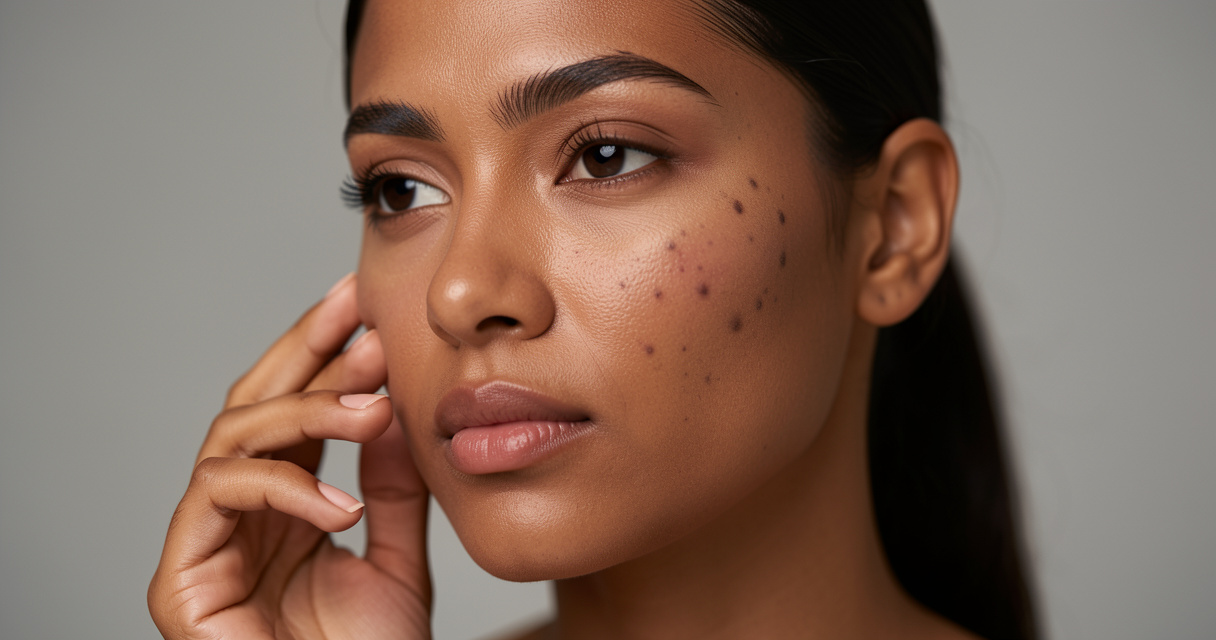
Acne dark spots are flat, discolored patches caused by post-inflammatory hyperpigmentation (PIH). When a pimple triggers inflammation, skin cells produce excess melanin as a protective response. The result is a brown, tan, purple, or gray mark that may last months, and sometimes 12+ months, without treatment, especially in medium to deep skin tones.
Think of a pimple as a small injury. The body rushes blood, immune cells and repair signals to the site — that is inflammation — and in doing so it rouses melanocytes, the cells responsible for pigment. In fair skin the aftermath is often a pink or faint tan trace. In medium and deep skin tones the same event can leave a mark that outlasts the breakout by a year or more.
The mechanism is protective, not pathological. Melanin is the body’s own sunscreen, and inflamed skin produces more of it as a shield. The trouble is that the shield stains. Pigment is transferred from melanocytes into surrounding keratinocytes and, when inflammation runs deep, deposited in the dermis, where it clears far more slowly. That depth is the single most useful thing to understand about your own marks: epidermal pigment responds to topicals in weeks, while dermal pigment is a months-long project.
How inflammation triggers excess melanin
Every inflammatory acne lesion sets off a cascade: cytokine release, oxidative stress and a surge in tyrosinase activity, the enzyme that drives melanin production. The more intense and the longer the inflammation, the larger the pigment deposit. This is why a picked spot, a deeply inflamed cyst or a bout of acne left untreated for months tends to leave a darker, more stubborn mark than a superficial whitehead that resolves in three days.
It also explains why squeezing is so expensive. Mechanical trauma adds a second wave of inflammation to skin already producing pigment, and it can push bacteria and keratin deeper into the follicle. The rule that follows is the least glamorous and the most effective in this entire guide: hands off.
What PIH looks like on different skin tones
Skin tone changes the color of the mark, not the mechanism. On fair skin, acne dark spots usually read as pale brown or pinkish tan. On medium skin they skew olive-brown. On deep skin they can appear dark brown, purple-brown or charcoal gray — and the grayish cast is a useful clue that pigment sits deeper and will take longer to clear. Red, non-pigmented marks are a separate phenomenon altogether (post-inflammatory erythema, a vascular flush rather than a melanin deposit) and respond to a calming, barrier-first routine rather than to lightening acids.
Acne dark spots on dark skin are also more likely to persist. Melanocytes in deeper skin tones are more numerous and more reactive, so an identical pimple produces a larger pigment response. That is not a flaw in your skin. It is a different physiology, and it rewards a different strategy.
Why dark spots are not the same as active acne
A flat mark needs pigment management. An active pimple needs inflammation control. Confusing the two sends people into the most common and costly mistake in skincare: attacking a stain with the same aggressive actives they used on the breakout, irritating the barrier, triggering fresh inflammation and creating new marks to fade. The table below separates the two visually, so your next purchase is the correct one.
| What you may see | Likely cause | What it means |
|---|---|---|
| Flat brown, tan or gray patch | Melanin deposit in the epidermis or dermis | Post-inflammatory hyperpigmentation: treat with fading actives, daily sunscreen and patience |
| Flat red or pink mark | Post-inflammatory erythema (dilated vessels) | Calm and protect the barrier; lightening acids will not help and may irritate |
| Raised bump with pus or a tender red nodule | Active acne lesion | Control inflammation now — this is what prevents the next mark |
| Indented, pitted or firm raised surface | Change in collagen structure | A scar, not PIH: requires a procedural plan rather than a serum |
Definition, in one line: post-inflammatory hyperpigmentation is flat discoloration left by inflammation — it is not a scar, not an infection and not permanent. If the surface is smooth and only the color has changed, you are treating PIH.
Knowing what the mark is made of solves only half the problem. The other half is confirming what it is not — which is where the next section begins.
Acne Dark Spots vs. Acne Scars: How to Identify What You Are Treating
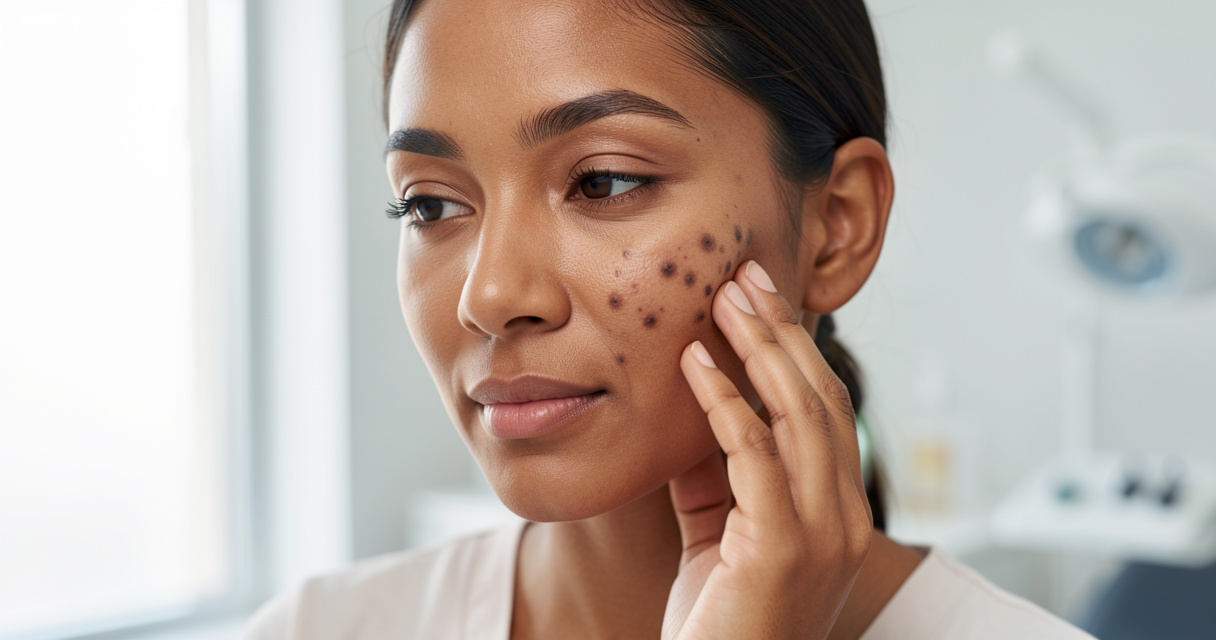
The distinction between acne dark spots vs acne scars decides everything that follows: your budget, your routine and your expectations. One is a pigment problem on an intact surface. The other is a structural problem in the collagen beneath it. No serum closes a divot, and no laser is required to erase a stain.
The smooth-versus-textured test
Clean your face, pat it dry and stand at a window with daylight falling across the skin at an angle rather than straight on. Gently stretch the area between two fingers and look along the surface rather than directly at it. Smooth but discolored points to PIH. Any change in relief — an indent, a ridge, a firm nodule under the surface — points to a scar.
Then run a fingertip across the mark with your eyes closed. Fingers detect texture that mirrors and bathroom lighting hide. If the skin feels level, the mark is color. If it catches, dips or lifts, it is structure.
When a mark is actually a scar
Acne scarring falls into a few recognizable families: icepick scars (narrow, deep punctures), boxcar scars (shallow, defined edges), rolling scars (broad undulations that give skin a wave) and hypertrophic or keloid scars (firm, raised tissue). Raised scarring is more common in medium to deep skin tones and around the jaw, chest and back — and it is the type most likely to worsen with aggressive, repeated trauma.
Why misdiagnosis wastes money and time
We have watched readers spend a year on high-strength brightening acids for what turned out to be boxcar scarring, and others book ablative laser for marks that a 15% azelaic acid gel and daily sunscreen would have resolved. The cost is not only financial. Every month spent on the wrong protocol is a month of pigment consolidating and, often, of the barrier weakening.
| Feature | Dark spot (PIH) | Acne scar |
|---|---|---|
| Texture | Smooth, level with surrounding skin | Indented, pitted or raised |
| Color | Brown, tan, purple-brown or gray | Often similar to skin tone, sometimes pink or hyperpigmented at the edges |
| Lighting effect | Reads darker in bright daylight, flattens in shadow | Reads worse under side lighting; shadowing reveals depth |
| Treatment path | Topical actives, sunscreen, gentle peels | Microneedling, fractional laser, subcision, fillers |
| Realistic timeline | Weeks to 12+ months depending on depth | Procedural series over 6 to 18 months |
Do this tonight: photograph the area in indirect daylight, without flash, at the same distance and angle. Repeat every four weeks. Progress in pigmentation is too gradual to see in a mirror and perfectly visible across a photo series.
Once you know which of the two you are dealing with, the next variable is your own skin tone — and in melanin-rich skin, that variable changes the entire risk profile.
Why Acne Dark Spots Are More Common and More Persistent in Medium to Deep Skin Tones
This is the part of the conversation the internet skips, and it is the part that matters most for readers with deeper complexions. Acne dark spots on dark skin are not simply more visible — they are more frequent, longer-lasting and more easily made worse by the wrong treatment.
Melanin-rich skin and the post-inflammatory response
Melanocytes in skin of color are both more numerous and more responsive to inflammatory signals. The same pustule that leaves a faint trace on Fitzpatrick type II skin can leave a defined brown patch on type V. Post-inflammatory hyperpigmentation is one of the most frequently cited concerns among patients with skin of color in dermatology practice, and it sits at the center of why treating acne early matters more — not less — in deeper skin tones.
Rebound hyperpigmentation and the test spot
Aggressive intervention on reactive skin can produce the opposite of the intended result. High-concentration peels, heat-heavy lasers, over-exfoliation, waxing over active inflammation and compulsive picking can all darken pigment rather than clear it. At the other extreme, poorly calibrated pigment lasers in inexperienced hands can cause hypopigmentation — permanent light patches that are far harder to address than the original mark.
Hence the test spot. A small, discreet area — behind the jaw or below the ear — treated first, then observed for four weeks, tells you how your skin will respond before the full face is committed. Any clinician who resists this step is telling you something useful.
How to choose a skin-tone-aware clinician
Ask directly how many patients with Fitzpatrick types IV to VI they treat each month. Ask what they use to prime skin before a procedure — a short course of a retinoid, azelaic acid or hydroquinone is standard in skin-of-color protocols. Ask what happens if rebound pigmentation occurs and what the aftercare protocol looks like. Specific answers signal experience; vague reassurance does not.
Warning: do not begin aggressive lightening, high-percentage acid peels or laser treatment on melanin-rich skin without professional guidance and a supervised test spot. The risk of rebound hyperpigmentation and permanent lightening is real, and it is higher than most marketing admits.
“In my clinic, the patients who improve fastest are rarely the ones using the most products,” says a board-certified dermatologist and member of the American Society for Dermatologic Surgery who treats acne and pigmentation daily, with a majority of patients in medium to deep skin tones. “They are the ones who stop picking, wear sunscreen every morning, and let one active do its work for twelve weeks before adding another.” In over a decade of reporting from clinics and skincare laboratories, that single sentence has proven more reliable than any launch I have covered.
Which active, though? The next section takes each ingredient in turn — who it suits, how to introduce it and what never to pair it with.
How to Get Rid of Acne Dark Spots: Ingredient-by-Ingredient Treatment Guide
Search how to get rid of dark spots from acne and you will find the same eight ingredients recycled without context. Context is the entire point. An ingredient is only as good as its match to your skin type, your acne activity and your tolerance.
Azelaic acid and niacinamide: the gentle daily options
Azelaic acid for acne dark spots is the ingredient we recommend first to almost everyone, and especially to readers with sensitive or melanin-rich skin. It is anti-inflammatory, antibacterial and it inhibits tyrosinase, which means it addresses the active pimple and the mark it leaves at the same time. Prescription strengths sit at 15 to 20%; over-the-counter formulas typically offer 10%. Use it once daily to begin, on dry skin, and expect a brief tingling phase in the first two weeks.
Niacinamide for post-acne marks works by a different route: it reduces the transfer of melanin from melanocytes to surrounding skin cells, supports barrier lipids and calms inflammation. Concentrations of 2 to 5% are the sweet spot. Higher percentages are not more effective and are more likely to sting on compromised skin. It layers comfortably under sunscreen in the morning and alongside azelaic acid at night.
Retinoids and vitamin C: cell turnover and brightness
Topical retinoids accelerate cell turnover and help move pigmented cells to the surface while simultaneously treating acne — the rare double duty. Adapalene 0.1% is available without a prescription; tretinoin remains the gold standard under medical supervision. Start with three nights per week, buffered over moisturizer, and build slowly. Peeling in week one is expected. Persistent redness in week five is a signal to step back.
Vitamin C is the morning antioxidant, and its role in a pigmentation routine is preventive as much as corrective. A 10 to 15% L-ascorbic acid formula, or a gentler derivative for reactive skin, interrupts the oxidative chain that inflammation sets off. Apply it before sunscreen, never in the same layer as benzoyl peroxide, which oxidizes it on contact.
Exfoliating acids: when to use them and when to stop
Alpha-hydroxy acids lift pigmented surface cells, and mandelic acid — a larger molecule that penetrates more slowly — is the one most often favored for deeper skin tones because it carries a lower irritation risk than glycolic. Beta-hydroxy acid (salicylic) is the better choice when pores are still congesting. Once or twice weekly is the ceiling for most people. Stop entirely if skin stings when you apply moisturizer: that is barrier damage, not progress.
| Ingredient | Best for | How to introduce | Do not mix with |
|---|---|---|---|
| Azelaic acid | Active acne plus marks; sensitive and deeper skin tones | Once daily at night, on dry skin; build to twice daily over 4 weeks | Strong AHA/BHA in the same layer |
| Niacinamide | Barrier support and gradual brightening; almost all skin types | 2 to 5% every morning, under sunscreen | Nothing significant — it layers well with most actives |
| Topical retinoid | Persistent marks, congestion, texture | 3 nights a week, buffered over moisturizer; increase every 2 weeks | Same-night acids and benzoyl peroxide in one layer |
| Vitamin C | Preventing UV-driven darkening; dullness | 10 to 15% each morning before sunscreen | Benzoyl peroxide; copper peptides |
| Exfoliating acids | Surface pigment, congested pores, dullness | 1 to 2 times weekly, evening only | Retinoid on the same night; other acids |
How to layer actives without irritation
The most common mistake is not choosing the wrong ingredient — it is introducing four correct ones in the same month. Two actives used consistently for twelve weeks will outperform six rotated unpredictably, and the barrier will thank you for it. Alternate rather than stack: azelaic acid one night, retinoid the next.
- Introduce one new active every four weeks, never two at once
- Patch test behind the ear or along the jaw for three consecutive nights
- Buffer irritating actives over a ceramide moisturizer in the first weeks
- Wear broad-spectrum sunscreen every morning without exception
- Stop and simplify if stinging, flaking or new redness persists beyond two weeks
- Keep a four-week photo log so you judge progress on evidence, not mood
The target: a routine you can repeat for ninety days. Consistency beats concentration every time, and a calm barrier fades pigment faster than an inflamed one.
For marks that have not moved after four to six months of a disciplined topical routine, the answer is not a stronger serum. It is a different category of treatment entirely.
In-Office Treatments for Stubborn Acne Dark Spots: Peels, Lasers and Microneedling
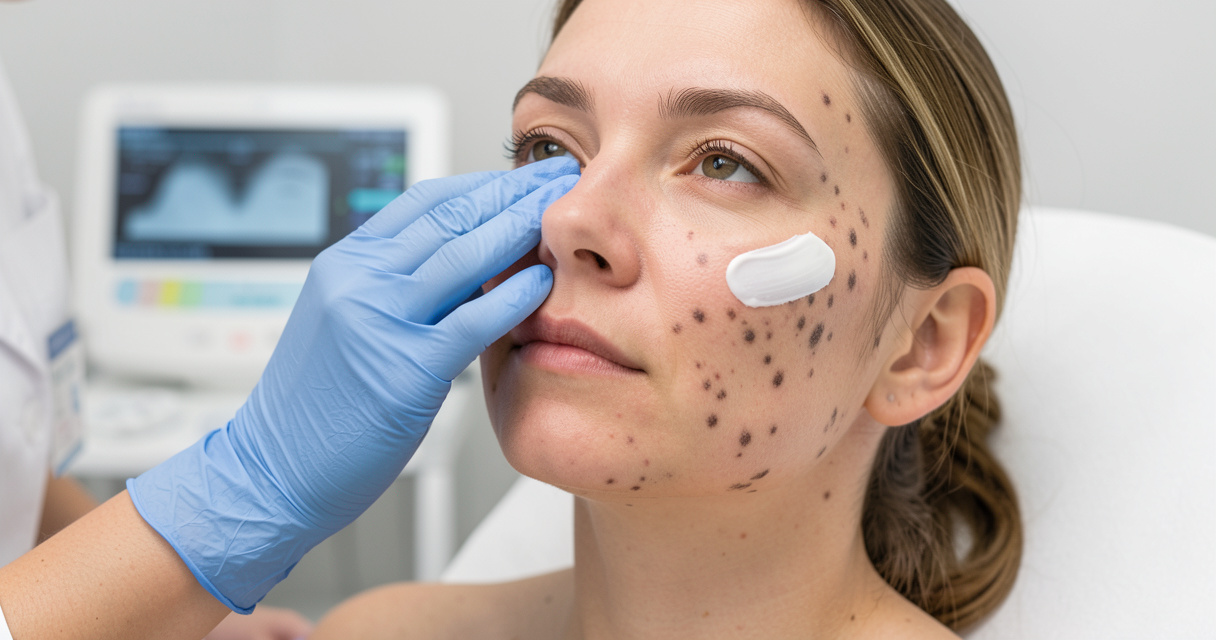
A chemical peel for acne dark spots can be genuinely effective — and genuinely risky. The difference between the two outcomes is rarely the device. It is the assessment that precedes it: skin tone, acne activity, sun exposure, scar tendency and the concentration chosen on the day.
Chemical peels for PIH
Superficial peels — salicylic, mandelic, low-percentage glycolic — loosen pigmented surface cells and are typically performed as a series of four to six sessions spaced two to four weeks apart. Expect two to five days of light flaking. Mandelic acid is often the default for melanin-rich skin because its larger molecular size slows absorption and reduces the inflammatory spike that drives rebound pigmentation. Medium-depth peels should be approached with real caution in deeper skin tones.
Laser and light options
Q-switched and picosecond lasers target pigment directly and are used in experienced hands for stubborn PIH; fractional non-ablative lasers address texture and scarring rather than flat color. The risk profile changes sharply with skin tone. Ablative resurfacing in darker skin carries a meaningful risk of post-procedural hyperpigmentation and, at higher energies, hypopigmentation. Conservative settings, pre-treatment priming and a supervised test spot are not optional extras — they are the protocol.
Microneedling and combination plans
Microneedling is primarily a texture treatment. It is the right answer for rolling and boxcar scarring and the wrong one for flat pigmentation on its own, though it is frequently combined with topical lightening agents delivered during the session. Because it creates controlled micro-injury, it can trigger PIH in reactive skin if depth and frequency are pushed too far.
| Treatment | Best for | Downtime | Skin-tone caution |
|---|---|---|---|
| Superficial chemical peel | Surface pigment, dullness, congestion | 2 to 5 days of flaking | Lower risk; mandelic acid preferred for deeper tones |
| Medium-depth peel | More resistant epidermal pigment | 5 to 10 days | Higher rebound risk; requires an experienced clinician |
| Laser and light | Stubborn dermal pigment; texture | 3 to 10 days depending on device | Highest risk of rebound darkening or lightening; test spot essential |
| Microneedling | Scarring and texture, often combined with topicals | 2 to 4 days of redness | Moderate risk; uncontrolled depth can trigger PIH |
Not suitable right now: active acne, recent sun exposure or tanning, a history of keloid scarring, or a compromised skin barrier. Each of these raises the risk of a worse outcome than the mark you came in with.
Questions to ask before booking
- How many patients with my skin tone do you treat each month?
- Will you perform a test spot first, and when do we review it?
- What pre-treatment priming do you recommend, and for how long?
- What is the plan if rebound pigmentation occurs?
- How many sessions, at what interval, and what result is realistic rather than ideal?
Procedures are an accelerant, not a substitute. Whatever happens in the clinic, the daily routine is what holds the result — and that routine is simpler than most people expect.
A Realistic Daily Routine to Fade Acne Dark Spots Without Triggering New Breakouts
Here is the framework that works for most people, followed by the eight-week build for three skin types. Sunscreen for hyperpigmentation is not a supporting step in this routine. It is the treatment, and everything else is built around it.
Morning routine: protect and prevent
Cleanse gently — a low-foaming formula, or water alone for dry or reactive skin. Apply your acne control if lesions are active, then niacinamide or vitamin C, then moisturizer, then a broad-spectrum SPF 30 to 50. Choose a tinted formula containing iron oxides where possible: iron oxides block visible light, which drives pigmentation in deeper skin tones as surely as ultraviolet does.
Evening routine: treat and repair
Double cleanse if you wore sunscreen, then apply your fading active on dry skin — azelaic acid on one night, a retinoid on the next — followed by a ceramide-rich moisturizer. If skin feels tight or stings, skip the active entirely and use the barrier cream alone. A night off costs nothing. A damaged barrier costs weeks.
The eight-week build, by skin type
| Weeks | Focus | Oily skin | Combination skin | Sensitive skin |
|---|---|---|---|---|
| 1 to 2 | Baseline only | Gentle cleanser, moisturizer, SPF | Gentle cleanser, moisturizer, SPF | Gentle cleanser, barrier cream, SPF |
| 3 to 4 | First active | Azelaic acid nightly; add niacinamide AM | Azelaic acid 3 nights weekly; niacinamide AM | Azelaic acid 2 nights weekly, buffered |
| 5 to 6 | Cell turnover | Retinoid 3 nights weekly on alternate nights | Retinoid 2 nights weekly | Hold azelaic acid; reassess tolerance |
| 7 to 8 | Refine and review | Add vitamin C AM; exfoliating acid 1 night weekly | Add vitamin C AM; exfoliating acid 1 night weekly if calm | Add vitamin C derivative AM only if calm |
What to skip when skin is irritated
No scrubs, no hot water, no alcohol-based toners, no at-home peel kits, no lemon juice, no picking. Do not stack benzoyl peroxide, a retinoid and an acid in the same evening. When skin is inflamed, every additional active is a new source of inflammation — and new inflammation is precisely what creates new post-acne dark spots.
Non-negotiable: UV and visible light darken existing pigmentation and slow fading. Sunscreen is not a finishing step, it is the mechanism by which the rest of the routine works.
Which leaves the question every reader eventually asks, usually at week six, usually in frustration: how long is this actually going to take?
Prevention and Timeline: How Long Acne Dark Spots Take to Fade and When to See a Dermatologist
How long do acne dark spots take to fade without treatment? Longer than any marketing campaign will admit. According to World of Asaya, dark spots from acne can take 12 months or more to fade naturally when left untreated. With a disciplined routine and daily photoprotection the process can move faster, but it remains gradual: lightening is measured in weeks and months, not days.
The realistic fading timeline
Epidermal pigment typically begins to soften within eight to twelve weeks of consistent treatment. Dermal pigment — the deeper, grayer marks — can take six to twelve months, and sometimes longer. Variation by skin tone is significant: the more reactive the melanocytes, the slower the visible change. Judging progress week to week is a recipe for abandoning a routine that was working.
| Stage | What to expect | Action |
|---|---|---|
| Early PIH (0 to 4 weeks) | Mark is at its darkest; color still settling | Control active acne, start SPF daily, no picking |
| 8 to 12 weeks | First visible softening in epidermal marks | Continue the routine; introduce a second active if tolerated |
| 6 to 12 months | Steady lightening; deeper marks lag behind | Consider a superficial peel series if progress has plateaued |
| Persistent marks beyond 12 months | Little change despite adherence | Dermatologist assessment: dermal pigment, scarring or an alternative diagnosis |
How to prevent new PIH
The strongest lever is not a serum. It is preventing the inflammation that starts the whole chain. Treat active acne early and consistently, resist the urge to extract at home, wear sunscreen daily, avoid friction and heat on healing skin, and keep the barrier intact. Once a mark has faded, maintain a low-frequency version of the routine — a retinoid twice weekly, azelaic acid as needed, sunscreen always — because recurrence is common whenever new inflammation or unprotected sun exposure returns.
Red flags that need professional care
- Marks that persist beyond twelve months of consistent, correct treatment
- Pigmentation that is worsening rather than lightening
- New or cystic lesions that keep generating fresh marks
- Raised, firm or growing scars
- Significant distress, avoidance or impact on daily life
Book the appointment if: marks persist beyond twelve months, worsen despite treatment, or are accompanied by meaningful distress. Pigmentation that affects mental health is a medical indication, not a cosmetic preference.
Everything above compresses into one principle, and it is the one worth carrying out of this piece.
Frequently Asked Questions
Are acne dark spots permanent?
No. Post-inflammatory hyperpigmentation is flat discoloration that usually fades over months, though some marks can last 12 months or more without treatment. Treatment and daily sunscreen can speed improvement; scars with visible texture are a different problem and do not fade on their own.
How long do acne dark spots take to fade?
Often months, with wide variation by skin tone, depth of inflammation and sun exposure. Expect gradual lightening rather than overnight change, and track progress with photographs taken every four weeks instead of judging in the mirror.
How can I tell the difference between a dark spot and an acne scar?
Use texture and light. If the area is smooth but discolored, it is likely PIH; if it is indented or raised, it is likely a scar. A dermatologist can confirm the diagnosis and match the treatment accordingly.
What ingredients fade acne dark spots fastest?
No single ingredient is fastest for everyone. Azelaic acid, niacinamide, retinoids, vitamin C and exfoliating acids all help, but introduce one at a time and protect skin with broad-spectrum sunscreen every morning.
Can dark spots from acne come back?
Yes, if new acne inflammation occurs or if sun exposure darkens existing pigment. Preventing breakouts and applying daily sunscreen are the two most reliable ways to reduce recurrence.
Are laser treatments safe for dark skin?
They can be, but the risk of rebound hyperpigmentation or permanent lightening is higher than in fair skin. Choose a clinician experienced with deeper skin tones, request a test spot, and follow the aftercare protocol closely.
Should I treat active acne and dark spots at the same time?
Yes. Control inflammation first to prevent new marks while using gentle fading agents such as azelaic acid or niacinamide. Avoid aggressive layering that irritates the skin barrier and generates fresh pigmentation.
The Edit: Treat the Mark and the Inflammation Behind It
The edit, in four lines. Post-acne dark spots are flat post-inflammatory hyperpigmentation, not textured scars, and they are diagnosed by touch as much as by sight. Treating active acne and refusing to pick are what prevent new marks from forming. Evidence-backed topicals — azelaic acid, niacinamide, a retinoid, vitamin C — plus daily broad-spectrum sunscreen are what fade the ones already there. In-office treatments can accelerate stubborn pigment, but only with skin-tone-aware planning, a test spot and a realistic timeline.
Nothing here is dramatic. That is rather the point. Luxury in skincare is not the most aggressive protocol; it is the correct one, repeated quietly for ninety days until the skin stops being a problem to solve and becomes simply skin again.
So ask yourself: are you treating the mark, the inflammation that caused it, or both?